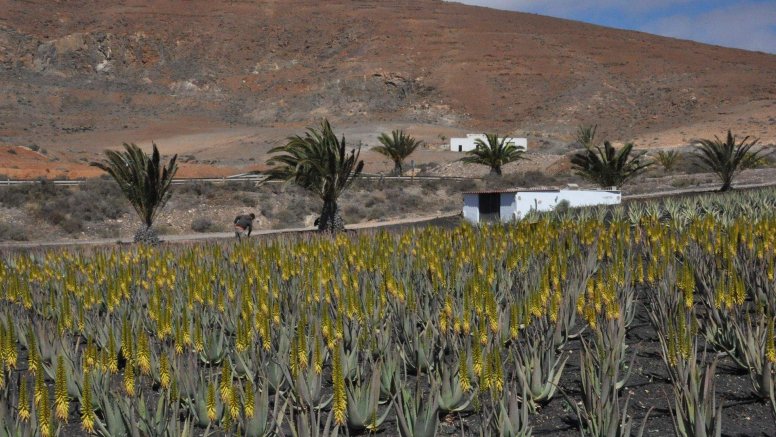
The agricultural producers of Lanzarote will receive this month approximately 70% of the additional POSEI payments corresponding to the 2025 campaign, a payment that represents a significant advance compared to the usual calendar of previous years when transfers were made at the end of the year.
This was announced this Wednesday, during the Agriculture Commission of Parliament, by the Minister of Agriculture, Livestock, Fisheries and Food Sovereignty of the Government of the Canary Islands, Narvay Quintero.
In response to a parliamentary question about the actions taken by the Government of the Canary Islands to reduce the bureaucratic burden on livestock farms, the head of the department commented that the Vice-Ministry of the Primary Sector has published this week the resolution granting the additional aid corresponding to the State aid of the Community Program to Support Agricultural Productions of the Canary Islands (POSEI). This resolution contemplates an amount of 19.51 million euros out of a total of 28.2 million euros from its financial sheet.
According to Quintero, the sector will be able to receive the remaining part (8.7 million euros) when the Government of Spain transfers the pending amounts for this concept. If this transfer becomes effective, the regional executive plans to complete the total payment of the additional POSEI between October and November.
The Government of the Canary Islands claims more than 33 million euros from the State. Of this amount, 24.9 million correspond to the 2022, 2023, and 2024 campaigns and were already advanced by the Autonomous Community with its own funds due to the State's non-compliance with these aids included in the Economic and Fiscal Regime (REF), while the other 8.7 million refer to the 2025 campaign. This measure to support local plant and animal productions is intended for 7,803 farmers and ranchers in the Archipelago.
The head of the department explained that the advance has been possible thanks to the elimination of certain administrative procedures that slowed down the granting and, consequently, the payment of these aids. Among these, he highlighted the suppression of the obligation for producers to submit a specific application to receive the additional POSEI, distinct from the one already processed to access the community part of the program, even though they already met the established requirements.
“By eliminating these procedures, we avoid unnecessary burdens and ensure that resources reach the sector sooner. Advancing the payment by several months allows for improving the liquidity of the farms and reducing the need to resort to external financing to cover their expenses,” stated the counselor.
Less bureaucracy without reducing guarantees
During his speech, Quintero highlighted that a large part of the documentation requested from the farms corresponds to obligations established by sectoral regulations, mostly of a state and European nature. “Our objective is to maintain the necessary guarantees to protect animal health and traceability and, at the same time, minimize the administrative burden that compliance entails for farmers,” he affirmed.
Among the actions carried out by the regional Executive to achieve this goal is the implementation of immediate response procedures through the Electronic Headquarters of the Government of the Canary Islands. This system allows certain procedures to be carried out without having to travel to the offices and obtain an immediate response when administrative checks are favorable.
This electronic processing is already applied to updates of the censuses of the Canary Islands Livestock Register, the issuance of health permits for livestock movements, and the registration and deregistration of individual identification of sheep and goats.
The Directorate General of Livestock also reviews procedures from their origin to determine if each requirement, document, or step is necessary. Within this framework, the Livestock Production, Improvement, and Marketing Service has participated in a simplification initiative promoted by the Directorate General of Modernization, which has allowed for the analysis of one of the aid lines with the highest volume of applications and the adoption of measures to streamline both its application and its granting.
Added to these actions is the review of the language used in the procedures, with the aim that citizens can clearly understand what procedures they must carry out, what documentation they need, when they should submit it, and what the expected outcome will be.
“Administrative simplification must be a permanent task. It is about eliminating unnecessary burdens, leveraging technology, and making procedures faster, more accessible, and understandable, while keeping animal health and traceability guarantees intact,” concluded the counselor.
Add La Voz de Lanzarote as a preferred Google source.
Stay informed with the latest current news.