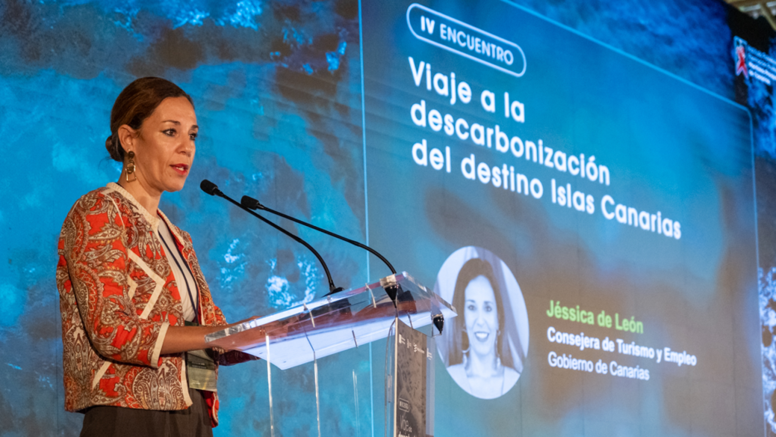
Lanzarote became this week the venue for the debate on the sustainability of the sector in the archipelago by hosting the IV Meeting ‘Journey to the decarbonization of the Canary Islands destination’.
The event, held on the island with the participation of specialists, institutions, and businessmen, served for the Ministry of Tourism and Employment to announce an expansion of its free advice and training, specifically designed to help small and medium-sized enterprises (SMEs) measure and reduce their emissions before the Climate Change Law obliges them to do so starting in 2027.
During the inauguration, the minister Jéssica de León stressed that the regional strategy seeks to accompany the business community in this transition towards a more resilient model. “For four years, we have strictly followed the commitment to the Glasgow Declaration, which called on all signatories to reduce the carbon footprint of Canary Islands companies dedicated to tourism, in addition to complying with the Climate Change Law, which obliges companies to measure their carbon footprint from 2027 onwards,” she recalled.
To facilitate this compliance, Turismo de Islas Canarias promotes the free digital tool ‘Journey to decarbonization’, which allows for the calculation of the environmental footprint and the planning of savings measures. “While large corporations continue to advance, we are closing the gap with those who need it most, the SMEs,” said De León. Currently, the initiative has 292 registered companies —131 of them with the calculation already completed—, which can request private appointments with sustainability specialists to resolve doubts adapted to their activity.
New on-demand training platform
To the six in-person workshops and 33 online sessions held this year (with 614 attendees), a new training platform with on-demand consultation materials will soon be added. As explained by the managing director of Turismo de Islas Canarias, José Juan Lorenzo, the goal is to further personalize support so that companies can turn calculations into real measures.
This tool will be launched with the practical guide ‘How to decarbonize your tourism company’, which will link emission reduction with everyday management decisions such as energy consumption, facility maintenance, mobility, waste, and contracted services, adapting to different business profiles.
Radiography of emissions and roadmap in Lanzarote
During the day, which included a presentation and panel discussion moderated by naturalist José Luis Gallego, the latest data on the sector's carbon footprint in the islands were also presented. In 2025, tourist activity at the destination generated 1,055,001 tons of CO₂ equivalent (3% more than in 2024), although the impact per visitor decreased by 0.4%, standing at 57.38 kilos per arrival. Activities accounted for 40% of emissions, followed by accommodation (31%) and internal mobility (29%). Added to this are the 6.57 million tons associated with flights to the Canary Islands, 24% above 2019 levels, which has led the Executive to explore the development of sustainable aviation fuels (SAF) in the archipelago.
On the island level, the CEO of SPEL-Turismo Lanzarote, Héctor Fernández, presented the Climate Action Plan for Lanzarote and La Graciosa. Fernández highlighted that the local roadmap is already translating into concrete projects such as the intelligent mobility system to reduce emissions and improve traffic, or the pilot project for the urban renaturalization of Arrecife to recover green spaces.
The meeting also served to review public-private collaboration initiatives, such as the blue tourism agreement signed with the CSIC and the two public universities of the Canary Islands—funded with 4.2 million euros to research water quality and geotourism—and the Regnext program, aimed at channeling voluntary contributions towards environmental and social recovery projects.
The day concluded with the intervention of the Director of Projects at Institut Cerdà, Helena Lorente, and a round table moderated by Mónica Palacios (Turismo de Islas Canarias) with representatives of the campaign ‘The destination we want to be’, which showcases 38 sustainable initiatives developed on the eight islands in areas such as renewable energy, biodiversity, inclusion, and labor well-being.
Add La Voz de Lanzarote as a preferred Google source.
Stay informed with the latest current news.