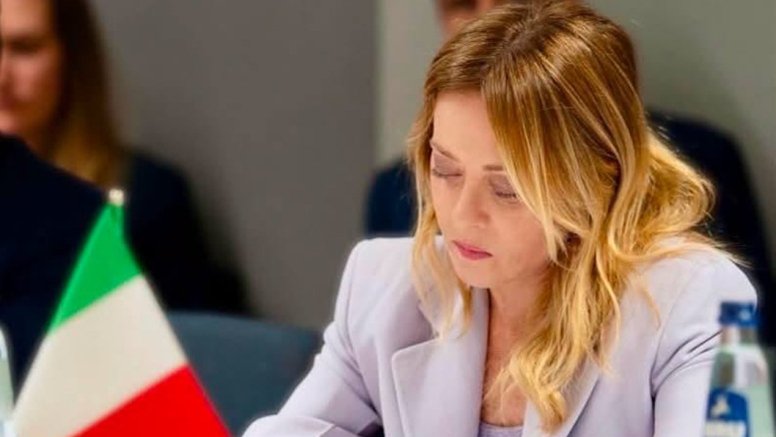
Since last Saturday, August 1st, Italian authorities have begun to carry out random inspections at airports and ports on passengers traveling from Spain.
The measure, taken by Giorgia Meloni's Executive after temporarily suspending the Schengen treaty in response to the serious migratory crisis experienced in Ceuta, seeks to protect "national security."
The checks are generating delays and longer waiting times after landing. The operation is being deployed in two ways.
On the one hand, Italian police officers are requesting passports or ID cards upon disembarking the plane from all types of travelers, both EU and non-EU citizens, to verify their nationality.
As confirmed by the EFE agency, selective document checks are also being carried out in the public area where passengers wait after collecting their luggage.
According to the Italian government, this is a measure focused on travelers from third countries to confirm they have the required documentation within the Schengen area. Only if irregularities or suspicions are detected is a more thorough check carried out.
This temporary suspension of the free movement area is expected to last throughout August, coinciding with the peak of the summer tourist season. To appease the industry, Prime Minister Meloni assured that they will ensure that the inspections do not harm the flow of tourists.
Two meeting requests in Europe with opposing approaches
The Ceuta crisis has led the President of the Government of Spain, Pedro Sánchez, and the Prime Minister of Italy to demand a European-level summit, although they do so from radically opposed positions and analyses.
On the one hand, Giorgia Meloni has led a formal letter — promoted with the Danish leader Mette Frederiksen and supported by 22 other countries — addressed to the EU leadership to urgently convene the Ministers of the Interior.
The Italian Prime Minister's argument focuses on national security and containment: she maintains that the shielding of the EU's external borders is a shared responsibility that requires immediate reinforcement of police measures and control against irregular immigration.
On the other hand, the Spanish president, Pedro Sánchez, has called for an extraordinary summit focused on solidarity and shared responsibility. His argument does not focus on border closure, but on the need to articulate a coordinated humanitarian response at the community level.
Sánchez demands from European partners financial and logistical support, the activation of migrant sharing mechanisms among Member States, and a substantial increase in cooperation agreements at the source with Morocco to manage flows from the root.
This escalation of political and border tension occurs after the tragic events experienced in Ceuta last Thursday, where an unprecedented massive entry of more than 60,000 people was recorded, resulting in at least 67 deaths. At the moment, the border between Morocco and the Spanish autonomous city has returned to normal.
Add La Voz de Lanzarote as a preferred Google source.
Stay informed with the latest current news.