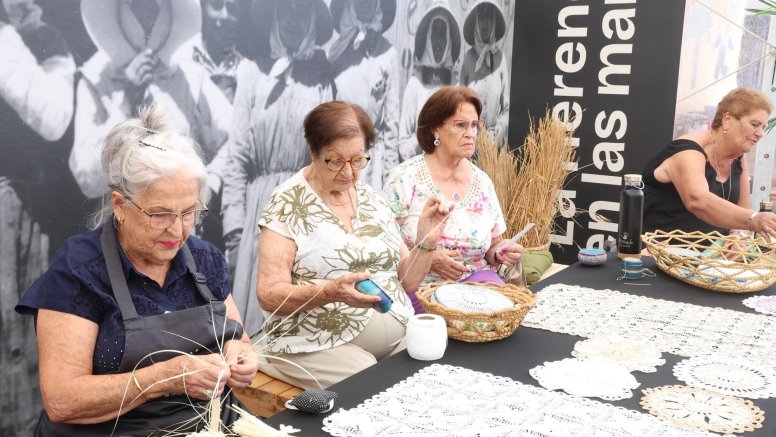
The carving of volcanic stone, the making of the cogollo hat, the weaving of the roseta, or the traditional shirtmaking of La Graciosa share a worrying diagnosis: they are trades that are part of the identity of Lanzarote and the Chinijo archipelago, but which run the risk of extinction in a matter of years.
The draft of the Craft Development Strategy in the Canary Islands 2026-2030, submitted for public information this September by the regional government, provides a precise radiograph of the sector. Of the 341 professionals identified throughout the archipelago in practices considered "high risk," the eastern catalog places several of the most representative island manifestations in a direct scenario of "zero succession."
The document classifies as "trades at risk" those modalities that have five or fewer accredited artisans in practice or that completely lack a generational pipeline. In this group, Graciosa shirtmaking and the maker of the cogollo hat (made from braided dried palm leaves) stand out, both indispensable garments of the traditional attire of the Famara and La Graciosa area.
Lack of apprentices and industrial intrusion
The document also highlights other trades at risk, such as the making of rosetas and calados, highly complex textile lace techniques that require hundreds of hours of meticulous work and whose transmission has been relegated to small groups of older people in municipalities such as Haría or Yaiza.
Regarding cooperage and leatherworking, the Strategy points out that these are trades closely linked to the wine culture of La Geria and traditional goat farming, today reduced to anecdotal testimonies in the face of industrialization of processes.
Likewise, stonemasonry and stone carving trades, fundamental in the finishing of traditional Lanzarote architecture, have fewer and fewer young candidates willing to undertake physically demanding work.
The diagnosis reveals a critical disconnect between master artisans and new generations. In the set of surveys conducted for the drafting of the plan, more than 66% of active artisans are over 45 years old (with the bulk of the group concentrated between 55 and 64 years old). On the other hand, young people under 25 years of age represent barely 0.8% of the registered census.
In Lanzarote and La Graciosa, this problem is aggravated by the high cost of housing and the attraction exerted by the service sector and tourism, which absorbs young labor to the detriment of traditional manual trades.
Despite the threat of extinction, island artisans themselves point out that their main daily barrier is not finding apprentices, but achieving the economic viability of their workshops. 62.4% of professionals point to marketing difficulties, while almost 50% denounce the lack of visibility of their real products compared to imported souvenirs.
In destinations like Lanzarote, where tourist flow is massive, local artisanal pieces compete at a disadvantage against replicas of industrial series production manufactured outside the islands and sold at prices without direct competition in markets or souvenir shops. Added to this is that only 52.2% of artisans can dedicate themselves exclusively to this activity as their main source of income.
Shock plan: Master-Apprentice program and visitable workshops
To curb this trend before 2030, the strategy designed by the regional Executive sets a roadmap structured in 52 measures. The backbone of this shock plan is the articulation of a paid Master-Apprentice program, conceived to finance both the dedication time of master artisans and the training of young apprentices who decide to take over.
In a territory with the tourist dynamics of Lanzarote and La Graciosa, the proposal advocates for turning artisanal workshops into visitable experiences. The intention of the regional administration is to integrate these creation spaces—such as the island's pottery or weaving workshops—within the island's cultural and tourist offer, guaranteeing direct sales to visitors and promoting the pedagogical dissemination of the trade.
In turn, the document addresses the market gap through the creation of a network of protection and geographical distinction. This measure seeks to differentiate by law and with clear labeling real local craftsmanship from imitation products and industrial souvenirs in commercial areas and public spaces.
Lastly, in those cases where the commercial viability of a discipline proves unattainable, the strategy proposes the creation of a living archive of knowledge. This aims to articulate the digitization and documentary record of technical processes, guaranteeing the conservation of the ethnographic memory of the islands before their last artisans disappear.
Add La Voz de Lanzarote as a preferred Google source.
Stay informed with the latest current news.