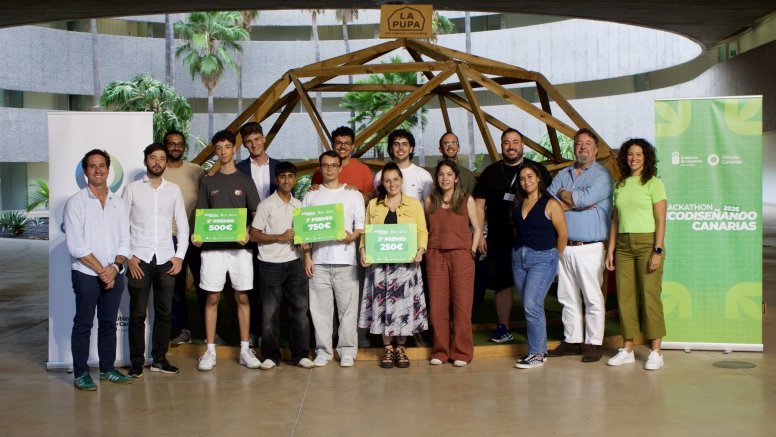
The Ministry of Ecological Transition and Energy of the Government of the Canary Islands, through the Directorate General of Environmental Quality, concludes the two days of the 2026 Canary Islands Ecodesign and Circular Economy Hackathon, held on September 26 in Tenerife and October 3 in Gran Canaria with 6 awardees.
The initiative has brought together students, professionals, entrepreneurs, and individuals from different disciplines to work intensively in the search for innovative and applicable solutions to some of the Archipelago's main environmental challenges.
During both days, the teams developed proposals around four priority areas: the reduction of single-use plastics in events and hospitality; the transformation of agricultural waste into new products or business models; the promotion of repair, reuse, and second life for products; and the application of ecodesign to reduce waste associated with the tourism sector.
The Director General of Environmental Quality, Ángel Montañés, highlights that “these meetings have made it possible to translate the circular economy into concrete challenges, bringing together very diverse profiles to propose innovative solutions adapted to the reality of the islands”.
Thus, he pointed out that “from a specific problem and in a few hours of collaborative work, the teams have been able to generate proposals with the potential to continue developing and provide new answers to the islands' environmental challenges”.
Six proposals recognized in Tenerife and Gran Canaria
Throughout the two days, the teams have had the support of specialized professionals to advance from identifying the challenge to defining a solution, analyzing its environmental impact and its technical and economic viability, and finally, presenting it to a jury.
The proposals were evaluated based on criteria of innovation, environmental impact, viability, and potential for implementation in the Canary Islands.
On the day held in Tenerife, the three best-valued proposals were:
- First prize – Tareco
A platform to reduce large waste in the island municipalities. The proposal consists of trying to prevent these items from reaching landfills by encouraging their purchase or exchange between users. This way, it reduces the economic burden for local councils and promotes reuse.
- Second prize – Re-Urban Canarias
It consists of the creation of a new material through the valorization of disused tires and plastic containers.
- Third prize – Trama Canaria
It addresses the problem of the textile sector by trying to prevent large quantities of it from ending up in landfills. How do they do it? By collecting textiles from hotels and making decorative pieces or even useful items for the hotel chain itself.
For their part, the following proposals were recognized at the event held in Gran Canaria:
- First prize – Tajinaste
Initiative aimed at recovering plastics from abandoned greenhouses to create modular hydroponic cultivation units and promote food sovereignty on the islands.
- Second prize – Segunda Vida
Development of motor recovery devices from plastic waste from hospitals that are not in contact with any pathogens, thus promoting the circular economy within the healthcare system itself.
- Third prize – Canary Sleep Cycle.
The development of a new mattress rental system for the tourism sector with the aim that these items do not end up in landfills before their time and, at the end of their life, to separate the materials that compose them for subsequent sale.
Each event awarded 1,500 euros in prizes, with 750 euros for first place, 500 euros for second, and 250 euros for third, totaling 3,000 euros between the two islands.
From challenge to solutions designed for the Canary Islands
The Hackathon has been conceived as a space for ideation, collaboration, and experimentation in which people with different knowledge and experiences work together on real challenges linked to the circular economy.
In this way, the methodology has allowed each team to evolve from an initial approach to the problem to a structured proposal, incorporating environmental, technical, and economic criteria and evaluating its possible application in the Canarian context. Furthermore, the two events have generated a space for connection between profiles from different fields and have reinforced the role of innovation and collaborative work as tools for advancing towards more circular production and consumption models.
The Canary Islands Ecodesign and Circular Economy Hackathon 2026 is part of the Canary Islands Circular Economy Strategy 2021-2030 and its Circular Economy Action Plan 2024-2026.
Add La Voz de Lanzarote as a preferred Google source.
Stay informed with the latest current news.