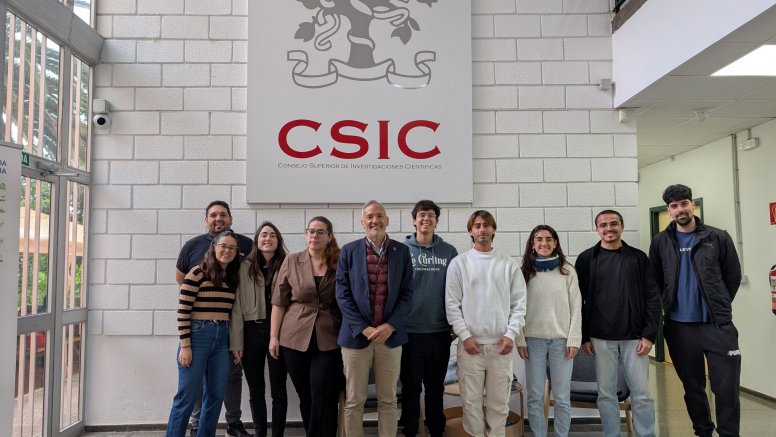
The Institute of Natural Products and Agrobiology (IPNA-CSIC) consolidates itself as a reference scientific infrastructure in Canarias, with capacity to generate innovative solutions in strategic sectors of the archipelago.
This was made clear by the visit of the director of the Canarian Agency for Research, Innovation and Information Society (ACIISI), Javier Franco Hormiga, who learned firsthand about initiatives with direct impact on the life of the citizenry.
The Institute of Natural Products and Agrobiology of the Spanish National Research Council (IPNA-CSIC) received this April 15 the institutional visit of the director of the ACIISI of the Government of the Canary Islands, Javier Franco Hormiga, in a day aimed at strengthening collaboration between both entities and learning about the center's role in promoting research and innovation in the archipelago.
The visit, promoted by the CSIC Delegation in Canarias, is framed within the strategy of the Ministry of Universities, Science and Innovation and Culture, which Migdalia Machín directs, to strengthen the scientific ecosystem and improve the transfer of knowledge towards the productive fabric, in which the IPNA-CSIC plays a relevant role as a generator of applied research in priority areas for the islands.
During the institutional reception, held at 9:30 hours, the director of ACIISI held a first meeting with the management team, research staff and predoctoral staff of the institute, where the main lines of work of the center and its contribution to the Canarian scientific system were presented.
Throughout the day, Javier Franco Hormiga visited different areas and research groups, among them the Volcanology group, the Social Sciences and Humanities area, and the Canary Islands Air Quality Laboratory (AirCanLab), an infrastructure dedicated to the analysis of air quality on the islands.
During the tour, he/she was able to learn about initiatives with a direct impact on daily life, such as the work in the control of pests that affect homes and infrastructures —such as the eradication of termites— or the research in the Agrobiology area, aimed at improving the productivity and sustainability of the Canarian agricultural sector.
Likewise, advanced scientific tools were presented, such as the DNA sequencing robot from the Ecology and Evolution in Islands group, which allows analyzing biodiversity and contributing to the conservation of island ecosystems, or the Natural Products Library (LiPNat), a repository of compounds that can serve as a basis for the development of new drugs and industrial applications.
The visit also included a tour of the general services and the administration area, offering a comprehensive vision of the center's functioning, both in its scientific and management aspects.
The day concluded with a working meeting in the boardroom, in which possible lines of future collaboration between ACIISI and IPNA-CSIC were addressed, especially in terms of boosting R&D&i, knowledge transfer, and connection with the business fabric.
This visit strengthens the cooperation between the Government of Canarias and the IPNA-CSIC, and highlights the role of the institute as a strategic asset for the development of the archipelago, capable of generating knowledge with real impact on the economy, the environment and the quality of life of the citizenry.
Add La Voz de Lanzarote as a preferred Google source.
Stay informed with the latest current news.