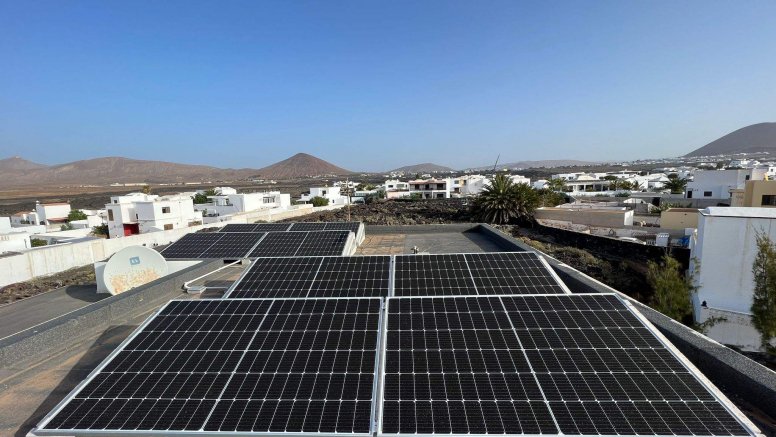
The Government of the Canary Islands has allocated five million euros to the residential sector, within the 18.46 million euros allocated this year to Green Transition aid, with the aim of maintaining the momentum for photovoltaic self-consumption.
The Minister of Ecological Transition and Energy, Mariano Zapata, explained this Friday in a parliamentary commission that these subsidies, financed through the FEDER Canarias 2021-2027 program, allow for the continuation of support for individual and shared installations.
Zapata indicated that aid can cover up to 50% of eligible costs for individuals and 60% for homeowners' associations. Additionally, one million euros have been reserved for energy communities.
The call includes photovoltaic installations, energy efficiency improvements, and storage systems, which allow for the use of part of the electricity generated during the day at night and reduce the energy purchased from the grid.
The minister pointed out that the objective is to make it easier for more families to produce their own energy and reduce their electricity bills, and he defended collective formulas so that self-consumption is also accessible to those who live in buildings and do not have their own roof.
Zapata recalled that the Ministry did not attend to the Canary Executive's request to extend the deadlines for completing projects under the Sustainable Energy Strategy in Islands financed with European funds until the end of 2026.
"Now what corresponds to us is to continue that work," stated the minister, who defended the need to maintain other funding avenues given the difficulties that initial investment poses for families.
According to data from the Government of the Canary Islands corresponding to June 2026, the archipelago had 24,817 photovoltaic self-consumption installations, with a combined power of 302.6 megawatts. Of these, around 21,400 corresponded to the residential sector.
Between the end of 2025 and June 17 of this year, 56.5 megawatts of power were added, compared to the 54 megawatts added throughout 2025, Zapata detailed.
The minister stressed that more than 24,000 installations are located on roofs and terraces, which allows for the generation of clean energy without occupying new land, an issue he considered relevant in a limited territory like the Canary Islands.
Zapata has concluded that the Government's commitment is to consolidate progress and expand the number of households that can benefit from self-consumption, in addition to providing information and support to families about available aid and its processing.
Zapata states that self-consumption is not enough to decarbonize the Canary Islands
Likewise, Mariano Zapata has stated that photovoltaic self-consumption, despite the growth recorded during this legislature, is not sufficient on its own to decarbonize the archipelago, which needs to develop more renewable generation facilities to reduce its dependence on fossil fuels.
The minister has defended the need to continue promoting these facilities in homes and businesses to reduce electricity bills, but has warned that the roofs of buildings, terraces, and other anthropized spaces do not allow for covering all the energy needs of the archipelago.
As an example, he indicated that Fuerteventura currently has 27 megawatts of self-consumption and has the capacity to reach 80 megawatts in already anthropized spaces, which would mean almost quadrupling the installed power.
However, he added that, even with that increase, it would still be necessary to have land to develop the rest of the necessary renewable generation.
Zapata has assured that the Government will continue to promote self-consumption and aid, including those financed with FEDER funds, but has insisted that the ultimate goal is to move towards decarbonization and energy independence for the Canary Islands to reduce external dependence and lower electricity costs.
Add La Voz de Lanzarote as a preferred Google source.
Stay informed with the latest current news.