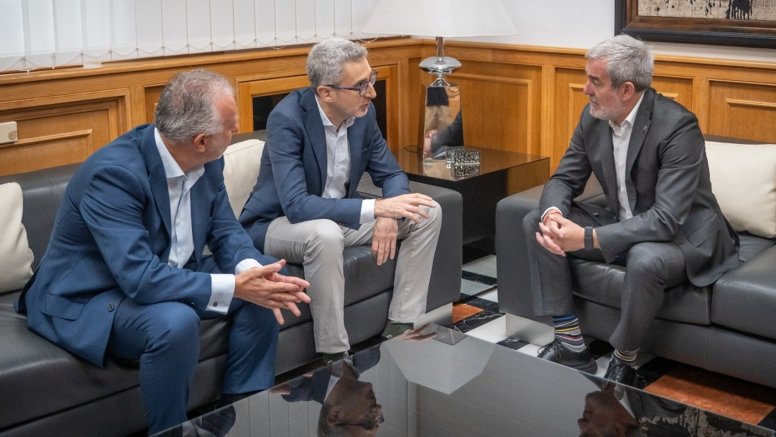
Canarias and the State have agreed this Monday on the unlocking of more than 196 million euros in pending transfers from the State intended for employment policies, the fight against poverty, and strategic infrastructures for the islands, which will be submitted this Tuesday to the Council of Ministers.
This is one of the main advances achieved after the meeting held this Monday between the president of Canarias, Fernando Clavijo, and the Minister of Finance, Arcadi España, which also included the Minister of Territorial Policy and Democratic Memory, Ángel Víctor Torres, and the Minister of the Presidency, Public Administrations, Justice and Security, Nieves Lady Barreto, as well as the Vice-Minister of the President's Cabinet, Octavio Caraballo, and the Secretary of State for Finance, Jesús Gascón.
President Clavijo valued the advances achieved and highlighted the importance of maintaining institutional dialogue that allows pending commitments to be translated into concrete responses for Canarias. In this context, he stressed that "the important thing is that Canarias moves forward and that commitments become facts. We have defended the interests of the islands through dialogue, with firmness and seeking agreements that allow us to improve our public services, boost investment, and address issues that have been pending for too long," he said.
The transfers in detail: employment, poverty, energy, and ports
Specifically, the transfers that the State plans to submit to the Council of Ministers this Tuesday amount to 196.1 million euros, including 30 million euros for policies to combat poverty, 45 million euros for the Comprehensive Employment Plan of Canarias, 23.1 million euros to compensate for the economic effects derived from the war in the Middle East, 53 million euros for actions in the port of Granadilla, and 45 million for the Reina Sofía breakwater, in the Port of La Luz and Las Palmas.
The president highlighted that the unlocking of these resources means progress in fulfilling pending commitments with Canarias and stressed that the regional government will continue working so that the rest of the items and open issues can be resolved in the coming months.
"When we talk about defending Canarias, we are talking about ensuring that commitments are met and resources reach the islands. These are funds to generate employment, reinforce support for those who need it most, and advance in strategic infrastructures for our development," he stated.
Regarding this, the Minister of Finance, Arcadi España, highlighted at the end of the working meeting the capacity of the Government of the Canary Islands for "dialogue and reaching agreements" and pointed out that "with this agreement, we not only understand the singularity of the Canary Islands but we address it".
Progress in Unblocking the Canary Islands Decree
The meeting also allowed for progress in the approval of a specific decree for the Canary Islands, whose processing is planned for the end of August or the beginning of September and which will prioritize responding to the most urgent commitments linked to the recovery of La Palma.
Among the priority measures are the 60% tax rebate on personal income tax for residents of La Palma and a contribution of 100 million euros aimed at continuing to boost the economic and social recovery of the island.
Clavijo insisted that this progress does not close the negotiation on the rest of the pending commitments. The Government of the Canary Islands will continue to demand, among other issues, resources for hydraulic works, additional funding for POSEI and compensation derived from the care of migrant persons.
In this regard, he stressed that "important issues remain to be resolved and we will continue negotiating them. This is not an end point. Our obligation is to take advantage of every dialogue space to achieve progress and continue defending the commitments that the Canary Islands need," he said.
The president particularly emphasized the need to respond to La Palma and to ensure that the most urgent measures for the island's recovery do not suffer further delays.
In this context, the Minister of Territorial Policy and Democratic Memory, Ángel Víctor Torres, stressed that this Canary Islands Decree will be taken to the first Council of Ministers after the summer period, which could be August 25 or September 1.
He also reported that the Canary Islands will receive 93 out of the 108 million euros in regional incentives, as reported in the Official State Gazette this Monday, July 27.
Greater Capacity to Invest Canary Islands Resources
Another of the advances achieved will allow for the expansion of the Autonomous Community's investment capacity through greater flexibility in the use of its surplus.
Canarias has managed to close an agreement that allows it to allocate these resources to a wider range of investments, without being exclusively limited to so-called financially sustainable investments. This measure will allow the mobilization of around 600 million euros and significantly reinforce the Autonomous Community's capacity for action in strategic policies and investments for the eight islands.
Clavijo highlighted the importance of Canarias being able to use its own resources to respond to its needs, including the improvement of healthcare, education, and social policies, and argued that having a greater investment capacity will allow for accelerated actions and responses to demands that require public resources.
Thus, the head of the Canarian Executive argued that “it makes no sense for Canarias to have resources and not be able to use them to meet the needs of the islands. Achieving greater investment capacity means having more tools to improve essential public services,” he pointed out.
Canarias improves its position in the new financing system
During the meeting, the new regional financing system was discussed, in which Canarias has defended the position set with economic and social agents in the President's Advisory Council.
The progress made will allow Canarias to have more than 1.337 billion additional euros between the resources derived from the new regional financing system and the complementary mechanisms provided for.
The negotiation maintains the two guarantees considered essential by Canarias and which had been set as fundamental lines by the Advisory Council: the Economic and Fiscal Regime will remain outside the ordinary regional financing system, and the compensation linked to the old IGTE is resolved, preventing these resources linked to the Canarian singularity from being integrated into the ordinary financing of the Autonomous Community.
Although the new financing model, if approved, would adjust one tenth in the weighting of the insularity component and certain criteria linked to the calculation of adjusted population, the agreement includes that its impact will be compensated through the Economic Dynamism Fund and other mechanisms included in the negotiation, allowing the initial position of the islands to be corrected.
Thus, Canarias will receive 611 million euros from the financing system under the new model, while the Economic Dynamism Fund will contribute an additional 726 million euros and will have three fundamental guarantees requested by Canarias during the negotiation: its resources will be freely available to the Autonomous Community, it will be indefinite, and its settlement will be carried out monthly and simultaneously with that of the regional financing system.
In this way, as explained by the president of Canarias, it will allow Canarias to allocate these resources according to its priorities, especially to the maintenance and improvement of essential public services such as healthcare, education, and social services.
Added to these mechanisms are improvements linked to participation in the increase in VAT collection and to the so-called non-homogeneous competences, which help to compensate for the impact of less favorable variables for Canarias.
Clavijo recalled that the objective set by Canarias from the beginning of the negotiation was to improve its position, fully preserve its economic and fiscal singularities, and guarantee that the new resources would be stable and could be allocated to the islands' priorities.
Thus, the head of the Executive stated that "Canarias set a clear and shared position, that of fully preserving our REF, definitively resolving the issue of the old IGTE, and improving our financing. We have made significant progress in these objectives, and we have done so from a position built with dialogue and consensus in Canarias," a position that "is not only that of this Government but also that defended unanimously by the social and economic agents of the islands."
The Government of Canarias will continue negotiations with the State in the coming months to finalize pending commitments, advance measures that cannot be initially incorporated into the Canarias Decree, and guarantee compliance with the agreements reached.
Add La Voz de Lanzarote as a preferred Google source.
Stay informed with the latest current news.