The Protected Designation of Origin Islas Canarias – Canary Wine participates, through the Association of Winegrowers and Winemakers of the Canary Islands (AVIBO), its management body, in PENVITIS+, a supra-autonomous project aimed at promoting the modernization of viticulture on steep slopes through the incorporation of new technological tools and sustainable vineyard management strategies.
PENVITIS+, whose full name is Intelligent and sustainable viticulture for climate adaptation and improvement of vineyard quality on steep slopes, brings together twelve entities from Galicia, the Canary Islands, and Catalonia and has a public subsidy of 599,238.85 euros, granted by the Spanish Agricultural Guarantee Fund (FEGA) within the framework of the Strategic Plan of the Common Agricultural Policy of Spain 2023-2027.
The project is coordinated by the Catalan Winegrowing Cluster Association (INNOVI). Alongside AVIBO, the Regulatory Council of the Qualified Designation of Origin Priorat, Adegas Moure, and Celler Mas Doix participate as beneficiary entities. The initiative also includes the Regulatory Council of the Designation of Origin Ribeira Sacra, Bodegas Viñátigo, the Catalan Institute of Vine and Wine (INCAVI), the Viticulture and Enology Station of Galicia (EVEGA-AGACAL), the Canary Institute of Agri-food Quality (ICCA), GALA Media, and Zabala Innovation.
Solutions for viticulture on steep slopes
PENVITIS+ focuses on a viticulture model that is developed on land with slopes exceeding 30%, where mechanization possibilities are very limited and a large part of the work continues to depend on the manual effort of winegrowers.
To these difficulties are added the effects of climate change, the aging of the sector, the lack of generational succession, and the growing pressure from pests and diseases. All of this compromises the continuity of an activity with significant economic, social, cultural, and landscape value for numerous rural territories.
The project will work during the 2026, 2027, and 2028 winegrowing seasons in representative areas of viticulture on steep slopes in the Canary Islands, Ribeira Sacra, and Priorat. Its objective is to develop applicable solutions that improve vineyard resilience, facilitate decision-making, and reduce the physical burden associated with certain tasks.
Artificial intelligence to anticipate pests and diseases
One of the main focuses of PENVITIS+ will be the application of artificial intelligence to vineyard management. The project will develop and validate predictive models capable of anticipating at least 80% of pest and disease-related incidents.
To this end, the FITOVIT model, developed in Galicia, will be combined with artificial intelligence systems created in the Canary Islands. The Viticulture and Enology Station of Galicia, dependent on the Galician Agency for Food Quality, will be responsible for scientifically validating the accuracy of these models in the participating territories.
The application of these tools will allow for the integration of meteorological and agronomic data, as well as data from plot monitoring to improve decision-making. Among the planned objectives is also to reduce the use of phytosanitary products by 30% through more precise interventions tailored to the actual needs of the crop.
The participation of DOP Islas Canarias – Canary Wine will allow the incorporation into the project of the experience gained in the Archipelago in the use of artificial intelligence to anticipate the appearance of vine diseases and determine the crop's water needs.
Drones to work in the most difficult terrains
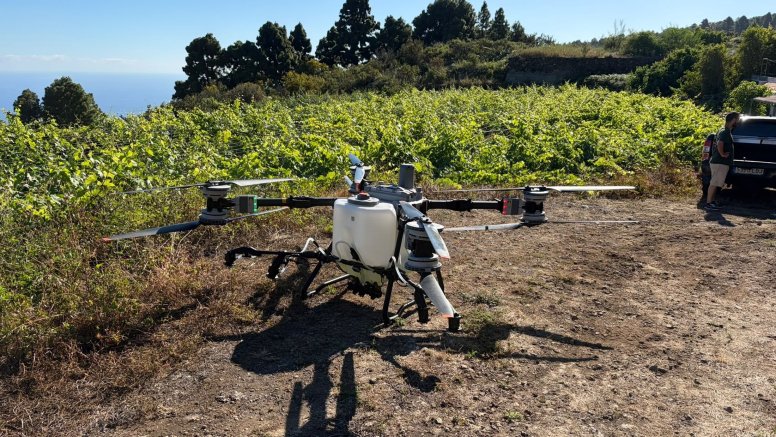
The second major line of action will be the use of drones for the application of phytosanitary treatments in plots with steep slopes and difficult access.
PENVITIS+ aims to reduce manual labor time for these tasks by 30%, as well as improve the safety of winegrowers and facilitate more efficient application of treatments. Trials will be carried out on plots in the Canary Islands, Galicia, and Catalonia with characteristics representative of heroic viticulture.
Among the test platforms are plots from Adegas Moure, in Ribeira Sacra, with slopes reaching up to 70%. These conditions will allow for the evaluation of the drones' effectiveness in some of the most demanding scenarios for vine cultivation and comparison of their results with conventional methods.
More resilient soils against climate change
The third pillar of PENVITIS+ focuses on the implementation of regenerative practices and the improvement of soil health. Through the use of cover crops and adequate management of vegetation and foliage, the project seeks to conserve moisture, reduce erosion, and protect grape clusters from high temperatures.
One of the established objectives is to reduce the effects of heat stress on grape ripening by 30%, promoting a greater balance between sugars, acidity, and pH. These practices will also contribute to strengthening the adaptability of vineyards to rising temperatures, drought, torrential rains, and alterations in ripening cycles.
Innovation shared between wine-growing regions
In addition to the planned tests and trials, PENVITIS+ will promote knowledge transfer through technical workshops, reports, and educational materials aimed at grape growers, wineries, appellations of origin, and technology centers.
The purpose is for the developed solutions to be applicable and replicable in other wine-growing regions with similar conditions, contributing to the preservation of the landscape, the prevention of rural abandonment, and the continuity of a cultivation model closely linked to the identity of its territories.
The participation of the DOP Islas Canarias – Canary Wine reinforces its commitment to innovation, sustainability, and the adaptation of the Canary vineyard to new challenges. Artificial intelligence, drones, and regenerative practices thus converge in an initiative aimed at providing new tools to grape growers and contributing to the future of viticulture in extreme conditions.
Add La Voz de Lanzarote as a preferred Google source.
Stay informed with the latest current news.