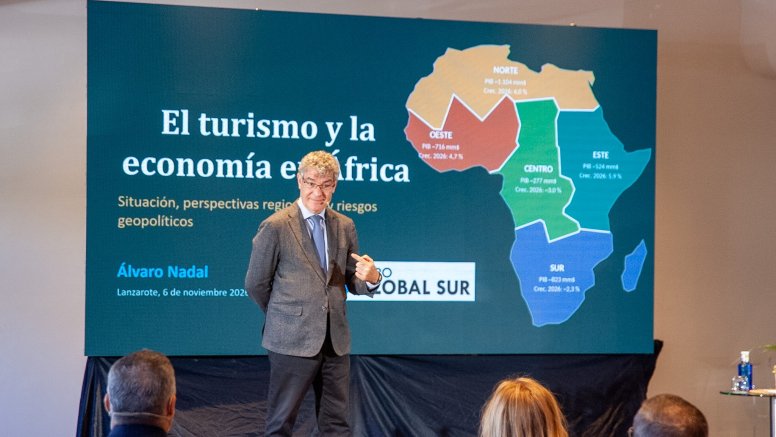
The Global South Forum once again placed Lanzarote at the center of international economic debate. In this edition, the main speaker was Álvaro Nadal, former Minister of Energy, Tourism and Digital Agenda (2016-2018), former director of the Economic Office of the President of the Government and until a few weeks ago executive director for Spain, France and Belgium at the African Development Bank (AfDB), Nadal offered an unvarnished radiography of a geography as close as it is unknown to island society.
"Africa is an interesting continent, complex in itself, in which there are enormous contradictions and very great business opportunities of which we in Spain are not so aware," Nadal asserted at the beginning of his presentation.
Faced with projected continental economic growth above 4% annually —higher than the world average—, the former minister contrasted a profoundly heterogeneous structural reality and a massive deficit of basic infrastructure.
The meeting was held with the sponsorship of the Cabildo de Lanzarote, the Centers of Art, Culture and Tourism, Suntelco and CICAR, and with the collaboration of the Chamber of Commerce and the Circle of Entrepreneurs.
Africa's "Demographic Dividend" and the Labor Market Gap
While continents like Europe or Asia are experiencing gradual aging, "the median age in Africa is only 19 years, compared to 43 years in Europe or 50 in Japan." By the year 2050, it is estimated that 90% of the new working-age population globally will be African.
As Nadal highlighted during his speech, "Africa is the poorest continent, but it is the only one that will have young people in 20 or 25 years." Along these lines, he insisted that "the great demographic power we have 100 km from here is spectacular." However, the translation of this so-called demographic dividend into economic development is hampered by a serious structural bottleneck.
Each year, around 12 million young people enter the sub-Saharan labor market, but the region's economies are only capable of generating about 3 million formal jobs. The remaining 9 million are relegated to informal employment or a complete lack of opportunities. It is in this structural gap, as the speaker explained, that the permanent migratory pressure that directly affects the Canary Islands and Lanzarote originates.
"In Africa, the difficult thing is not selling, the difficult thing is getting paid"
From the point of view of business and investment, the African continent presents high returns, but subject to demanding risks. With 600 out of the 700 million people lacking electricity worldwide concentrated in the sub-Saharan region, the productive impact of any basic infrastructure is substantial. However, legal certainty and the ability to collect payment mark commercial operations.
Citing a common maxim at the Ministry of State for Trade, Nadal recalled that "in Africa, the difficult thing is not selling, the difficult thing is collecting". Unlike intra-community trade in Europe, activity in African markets requires rigorous coverage of political and non-payment risks, which increases operating costs.
For Lanzarotean companies considering a leap to the continent, the speaker made a stark recommendation: "If you go to Africa, don't even think about having a single project, you have to have several at once". Diversification is the only way to offset projects that fail with those that obtain high returns.
Likewise, Nadal emphasized the inevitability of having a solvent local partner who knows the dynamics and informal channels of the country.
Five Africas in One: Economic Zoning and Income Gaps
To understand the complex diversity of this economic mosaic, Álvaro Nadal drew a precise regional zoning of the continent, differentiating five major socioeconomic areas with very unequal growth rates and average per capita income indicators compared to European standards:
North Africa stands out as the closest, best-known, and industrialized region. Engaged in nascent manufacturing processes, it presents key focal points such as the automotive sector in Morocco—a country that, as Nadal pointed out, "is in a process, I would say, of proto-industrialization"—or the powerful textile industry in Egypt, with notable growth of 5.1% annually and average income levels of $4,000 per capita.
For its part, West Africa (Gulf of Guinea) concentrates intense socioeconomic contrasts. There, first-rate agricultural giants converge, such as "Ghana and Ivory Coast, which are the first and second largest producers in the world of both cocoa and coffee," along with key trading partners for the Canary Islands, such as Mauritania, the origin of most Spanish imports in that Atlantic stretch.
In this same area, while Senegal hosts significant Spanish investments entangled in strong political instability among its leaders, Equatorial Guinea represents a unique case of a Francophone oil economy where Spanish remains the official language.
In the heart of the continent, Central Africa stands out as "the most complicated area, but where there is oil, a lot of it," which conditions a dynamic marked by political instability and conflict derived from the struggle for its immense hydrocarbon resources.
Conversely, East Africa is consolidating itself as the great dynamic engine of the region. With accelerated expansions in Kenya, Tanzania, Rwanda, and Ethiopia, the area stands out for its global connectivity: Nadal emphasized that "in Addis Ababa they have the third best-connected airport in the world, it's a spectacular hub" capable of operating uninterruptedly 24 hours a day.
Finally, Southern Africa and the South remains historically articulated around South Africa, which "was probably the most promising because it is the only African power worthy of the name." Although the South African power shows some stagnation after the apartheid era, it retains the most developed economy in the sub-Saharan region and coexists with neighbors in a clear expansionary phase such as Botswana.
The Chinese monopoly and the decline of Western aid
Geopolitics in Africa has undergone a radical transformation in the last two decades. China has already matched the commercial volume of the entire European Union with the continent, comfortably surpassing the presence of the United States. Through bilateral loans and tariff agreements, the Asian giant has consolidated a trade surplus with Africa exceeding 100 billion dollars.
In development tenders, Chinese dominance is even more overwhelming. Nadal revealed that, within the African Development Bank, "China, with 1% of the capital, took 70% of the contracts" awarded to non-African companies. The former minister explained that the operations of Chinese corporations benefit from fewer restrictions in the regulatory and ethical frameworks that govern Western companies under European penal codes.
This advance coincides with a severe decline in official development assistance provided by traditional powers, which has fallen by 23% in the last year. Countries such as the United States or the United Kingdom have reduced their contributions to reorient funds towards defense or the balancing of their own budget deficits.
Tourism and a historical gap of three centuries
Within the amalgam of African economies, the only territories that have reached income levels typical of emerging countries are three archipelagos: Cape Verde, Mauritius, and Seychelles. Similar to the model of Lanzarote and the Canary Islands as a whole, these economies have used the tourism sector as a central lever for development and the formation of middle classes.
In Cape Verde, for example, per capita income has risen from $1,000 to $5,000 in two decades, driven by tourism. On a continental level, however, the sector remains underdeveloped: the total number of tourists that Africa receives in a year does not reach the annual number of visitors hosted by Spain.
In conclusion, Álvaro Nadal framed the economic distance separating the two shores with a historical perspective. According to his calculations, Africa is approximately "300 years behind Spain" in terms of market and institutional maturity.
To illustrate this gap, Nadal explained that the economic structure of many African countries today resembles Spain three centuries ago, when activities were not governed by free markets or free competition, but by the gracious concession of the sovereign: "300 years ago the king would say: 'you will make the swords, you the coal,' and he would collect royalties for granting monopoly privileges."
Even with optimal development policies, Nadal explained that closing this gap will require generations, which compels the Canary Islands and the rest of Europe to maintain a strategic, realistic, and permanent outlook towards the neighboring continent.
Add La Voz de Lanzarote as a preferred Google source.
Stay informed with the latest current news.