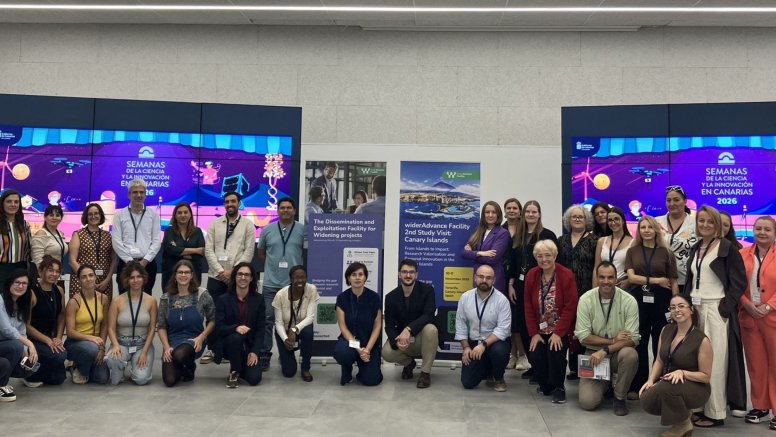
A study visit program and a matchmaking event –bilateral meetings and partner search– held on November 10, 11, and 12 in Tenerife has served to boost the international projection of the Archipelago's scientific and technological capabilities, an initiative promoted by the Ministry of Universities, Science, Innovation and Culture of the Government of the Canary Islands through the Canary Agency for Research, Innovation and Information Society (ACIISI).
These activities, integrated into the official programming of the Science and Innovation Weeks in the Canary Islands 2026 (SCIC26) promoted by ACIISI, are part of the European project Wider Advance Facility, funded by the Horizon Europe program and in which ACIISI itself and the Institute of Natural Products and Agrobiology (IPNA-CSIC) participate from the Canary Islands. This European initiative aims to provide specialized support services for the dissemination and exploitation of research results, connecting regional research potential with new opportunities for international collaboration.
During these days, participants were able to learn firsthand about reference infrastructures, specialized laboratories, and innovative projects from various scientific, technological, and business centers in Tenerife, generating an ideal space for the exchange of experiences and the creation of synergies.
Institutional Opening and Tour of Strategic Infrastructures
The first day began with an institutional welcome by Gonzalo de la Torre de Juan, representative of ACIISI, who accompanied in the opening by Antonio Aparicio Juan, Vice-Rector for Research and Transfer at the University of La Laguna (ULL); Katarzyna Walczyk-Matuszyk, project coordinator from the Institute of Fundamental Technological Research PAN; and Tomás Martín Ruiz, director of IPNA-CSIC.
After an initial dynamic of presentation and networking in a speed dating format, the group toured various facilities of the IPNA-CSIC, including the Air Quality and Biological Activities services, the Medicinal Chemistry laboratories, the Chemical Library and Natural Products Library, and the Agrobiology Service.
The agenda continued at the General Service for Research Support (SEGAI) of the ULL, where the delegation learned about advanced equipment for mass spectrometry, infrared spectroscopy, atomic absorption, X-rays, and electronic microscopy. The day concluded at the Technological Institute of Renewable Energies (ITER), with visits to its renewable energy and bioclimatic facilities, the wind farm, supercomputing and telecommunications equipment, and its environmental laboratories.
European Funding Opportunities and Cutting-Edge Innovation
On the second day of work, the program focused on identifying avenues for cooperation and European funding to strengthen the participation of the Canary Islands ecosystem abroad. Anselmo Sosa Méndez, from the Canary Islands Institute of Astrophysics (IAC), and Héctor Martínez Hernández, from the Canary Islands Technological Institute (ITC), presented various opportunities within the Widening calls, leading to a space for exchanging questions and experiences.
Subsequently, the delegation delved into other highly specialized areas of Tenerife's innovation ecosystem. During the visit to Arquimea, lines of work in quantum computing and technologies, robotics, neuroscience, and biotechnology were presented, as well as the funding mechanisms for their R&D&i projects.
During the visit to IACTEC, attendees learned about the infrastructure dedicated to the development of scientific and space instrumentation, including its clean rooms for assembling optical instruments and satellites, vacuum chambers, and spaces for designing, manufacturing, and polishing mirrors and lenses.
The tour concluded with a visit to the University Hospital of the Canary Islands (HUC) and the presentation, by the team of researcher Esteban Porrini, of an innovative method for measuring kidney function using a microdroplet technique on blotting paper; a minimally invasive and low-cost solution that facilitates the monitoring of patients with kidney disease.
Add La Voz de Lanzarote as a preferred Google source.
Stay informed with the latest current news.