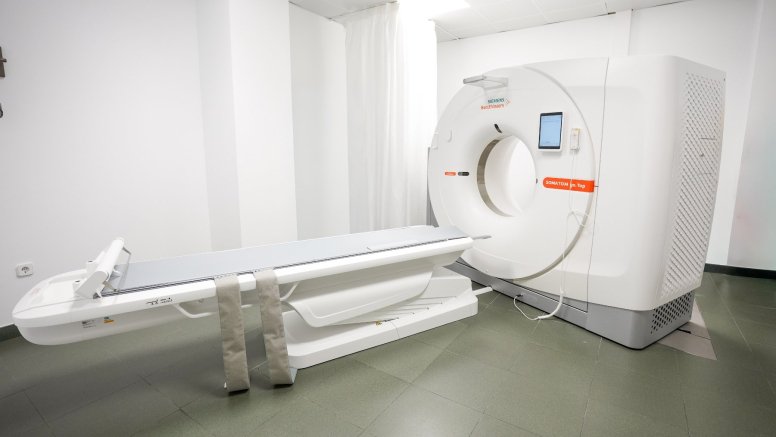
Hospiten Lanzarote and the Hospiten Bellevue University Hospital take a decisive step in diagnostic imaging with the incorporation of a new Siemens Healthineers Dual Energy spectral computed tomography (CT) scanner, a state-of-the-art technology designed to offer more precise diagnoses, faster scans, and a much safer and more comfortable experience for the patient.
The arrival of this equipment represents a relevant change in the way advanced radiological studies are performed, especially in critical areas such as Emergencies, Oncology, Cardiology, or Vascular Pathology. Thanks to its ability to work simultaneously with two different X-ray energies, the system can accurately differentiate tissues and materials such as calcium, iodine, or fat, allowing the detection of minimal lesions that could go unnoticed with conventional equipment.
The medical director of Hospiten Bellevue University Hospital, Dr. Tomás González, highlighted that the incorporation of this technology "represents a very important advance in the diagnostic capacity of the center and in the quality of care we offer our patients".
"This new scanner allows us to see more and better, but above all to do so more quickly, more safely, and less invasively. The most important benefit is for the patient, who obtains more precise diagnoses, less need for repeat tests, and much more agile care in critical situations," he pointed out.
For his part, the head of the Radiology Department at Hospiten Lanzarote, Dr. Álvaro Morales, explained that Dual Energy spectral technology represents "a qualitative leap in diagnostic accuracy and in the ability to obtain relevant clinical information from the first scan".
"Until now, in certain cases it was necessary to supplement the study with additional tests to resolve diagnostic doubts. With this system, we obtain much more information in a single acquisition, which allows us to better characterize lesions, optimize clinical decision-making, and accelerate the start of treatment when necessary," he stated.
For the patient, this translates into more reliable and earlier diagnoses, a reduction in clinical doubts, and a greater ability for specialists to identify tumors, hemorrhages, inflammations, or vascular alterations with a significantly superior level of detail.
One of the great advances of this technology is its ability to generate multiple types of images from a single acquisition. The new scanner can create 'virtual' images that allow, for example, visually removing bone or contrast without needing to repeat the test. This avoids additional scans and reduces both diagnostic time and the patient's overall exposure.
Reducing the time inside the scanner not only improves patient comfort but also allows for faster action in situations where every minute is crucial.
Another of the differential aspects of the new equipment is its maximum radiological safety profile. The system is designed to maintain a radiation dose equivalent to or even lower than that of a conventional CT scan thanks to advanced filters and automatic dose modulation mechanisms.
Likewise, the scanner intelligently adjusts acquisition parameters according to weight, age, and the anatomical area to be studied, guaranteeing an optimal image even in complex profiles such as pediatric patients or people with obesity. This personalization also reduces the need to repeat studies due to image quality problems.
Advanced functional diagnosis in oncology and cardiology
Beyond showing anatomical structures, the new spectral technology also provides advanced functional information. The equipment allows for real-time analysis of blood perfusion, tissue composition, and contrast concentration, offering a much more complete view of certain pathologies.
These capabilities are especially useful in Oncology, where they facilitate more precise tumor characterization and better therapeutic planning; in Cardiology, by speeding up coronary evaluation; or in vascular and trauma studies, where it improves the detection of active bleeding and the visualization of complex structures.
About Hospiten
Hospiten is an international healthcare network with more than 55 years of experience committed to providing a service of the highest quality, which has 20 private medical-hospital centers in Spain, Dominican Republic, Mexico, Jamaica, and Panama, in addition to 175 outpatient medical centers, under the Clinic Assist brand. Founded by Dr. Pedro Luis Cobiella. It annually serves more than three million patients from all over the world and has a staff of more than 5,000 people, a care that will be reinforced in the Community of Madrid thanks to the construction of a general hospital in Boadilla del Monte, which is expected to open at the end of 2026.
MD Anderson Cancer Center Madrid - Hospiten, is a subsidiary of the prestigious MD Anderson Cancer Center of Houston (Texas, USA). With more than twenty years of history in our country, MD Anderson Madrid - Hospiten currently has a Phase I Clinical Trials Unit, more than 150 medical specialists trained in oncology, a total of 87 hospital beds, and state-of-the-art technological equipment for the diagnosis and treatment of different types of cancer.
Add La Voz de Lanzarote as a preferred Google source.
Stay informed with the latest current news.