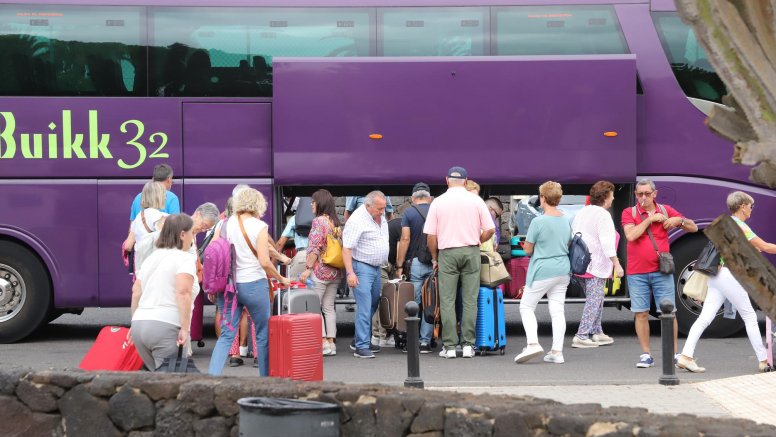
After a record winter in foreign tourist visits and turnover, the Canary Islands is trying to contain a fire outbreak with at least two fronts. On the one hand, the population's discontent with a tourism model that it considers exhausted is emerging, and on the other hand, the fear of the hotel employers and the Canarian Government that the message that tourismophobia may have taken hold in the islands will be transferred to key markets, such as the English or German, is evident.
On the horizon, a demonstration on April 20 in the main cities of the archipelago, including Arrecife (Lanzarote), against the current tourism model that the organizers foresee as "massive" and that the employers and the regional Executive see "with concern" and try to appease, especially after verifying how some protests carried out before tourists who had just landed on the islands have been received in the United Kingdom, however sporadic and minority they may be.
"Whoever comes to enjoy, spend a few days and leave their money in the Canary Islands should not be rebuked," said President Fernando Clavijo (CC) this week. "Are we willing to shoot ourselves in the foot?" added Vice President Manuel Domínguez (PP). Even more graphic was Gabriel Wolgeschaffen from the Tenerife employers' association Ashotel: "You shouldn't touch the cow that gives milk."
The context
After the effect of the pandemic, when hoteliers led campaigns asking residents to help the sector emerge from the 'tourist zero', the Canary Islands has once again reached record levels. Thus, a total of 13,942,966 foreign tourists visited the Canary Islands during 2023, the second best year in history, a figure that is 13.1% higher than in 2022 and 6.1% above 2019.
In February 2024 alone, 1.4 million tourists arrived from other countries, 14% more than in the same period of 2023, who spent 2,177 million euros on their vacations, 21.6% more, and made 10.3% more overnight stays. And it is that, after the pandemic slump, the tourism sector already accounts for 35% of the Canary Islands' GDP and nearly 40% of employment, according to data from the Ministry of Tourism.
Since the times of the artist from Lanzarote, César Manrique, who led well-known demonstrations in the eighties, a part of Canarian society feels uncomfortable with the excesses of the development model and its successors. It is a pulse that in recent years has materialized several times in mass protests, such as those called against the high-voltage towers in protected areas near Teide, the Repsol oil explorations off Lanzarote and Fuerteventura, or the port of Granadilla, in Tenerife.
Drops that overflow the glass
This social movement now converges with several symptoms of exhaustion: the continuous collapse of roads in Tenerife and Gran Canaria, the tension in housing prices in the metropolitan and tourist areas of the islands, or the saturation by visitors, thanks to the internet and social networks, of delicate natural areas that previously only residents used to visit.
These are drops that have been filling the patience of a part of the population that in recent decades has perceived few changes in the regional development policy, focused on feeding the tourism industry and with few nods to the protection of the territory that, when there were any, quickly diluted.
This was the case of the first tourist moratorium in 2000, later softened for luxury hotels and later dynamited by the Airbnb effect, or the attempt in 2014 to regulate precisely this new type of accommodation, when vacation homes were still an emerging phenomenon, through a decree whose main articles were overturned by the Supreme Court after a complaint from the National Competition Commission.
The Accelerants
The current Minister of the area, Jéssica de León (PP), has just shown herself open to debate about it, but doubts its effectiveness.
Regarding vacation homes, there is a new measure known this week: a draft law that limits to 10% the residential buildability that can be dedicated to tourist accommodation use, a percentage that can be doubled in La Gomera, El Hierro and La Palma, islands with much less hotel stock.
Expelled from 'paradise'
This rule seeks to solve absurdities such as what happens in El Cotillo, a town on the north coast of Fuerteventura with more places in vacation homes than the registered population (1,683), a situation that links to one of the main problems facing the Canarian population: access to housing.
With a scarce supply available -almost no public housing has been built in the last 20 years-, prices are not at all affordable for those who, like the Canarians, have the second lowest average salary in Spain: 22,466 euros gross (about 1,500 euros net in 12 payments), according to data from the National Institute of Statistics.
In areas such as the Guanarteme-Las Canteras neighborhood, in Las Palmas de Gran Canaria, it is common for studios of just 40 square meters to cost no less than 700 euros and for two-bedroom homes to exceed 1,200; unaffordable prices for the local population and that often end up in the hands of non-residents, something that also happens with the purchase of housing.
And on islands like Lanzarote, even public workers have problems paying rent, if they can find it. They compete against the purchasing power of English, Germans, Dutch, Norwegians or Italians who claim those same spaces for vacation stays or even as second homes.
Because, in the archipelago, the purchase and sale of housing by foreigners accounted for 28.5% of the total in 2023, according to the latest Real Estate Registry Statistics from the College of Registrars.
Hoteliers warn against "tourismophobia"
With all this climate, hoteliers focus their messages on the dangers they perceive in sowing "tourismophobia", after the appearance of some graffiti in the tourist areas of the islands that read "Tourists go home!" and some mobilizations in airports of the islands.
That message has already reached the United Kingdom through the tabloids and some television programs, where these issues are mentioned and people are even starting to talk about "boycotting" the destination as a response, as happened this week on Good Morning Britain, the morning show on the ITV channel.
The president of Ashotel (and of the Spanish hotel employers' association, CEHAT), Jorge Marichal, has stated on the COPE radio station that his hotels have received calls, in the plural, from tourists asking "if it was safe to travel to Tenerife."
Exhaustion of the model?
The activists who have promoted the demonstration on April 20 reject being accused of promoting tourismophobia.
"This is not against tourism (...), what is being asked is that no more be built. For years we have promoted ourselves as a unique nature destination in the world, but tourism is deteriorating the product we sell. The tourist figures are unsustainable from a social and environmental point of view," says biologist and documentary filmmaker Felipe Ravina.
He does so in a video broadcast on social networks where it is argued that the change in the tourist paradigm of recent years, in which visitors no longer only stay in the hotel, has massified emblematic places that residents can no longer enjoy, while vacation homes skyrocket rental prices and displace the local population.
"A tourist and vacation moratorium would allow us to stop this growth temporarily and have space to propose new ways of doing things," he adds.
The triggers
Ravina is part of a new generation of environmental activists who have mobilized in a short space of time in three events, all of them in Tenerife:
-The port of Fonsalía, in Guía de Isora: A commercial port project, a priori already discarded, located in a special conservation area with a large influx of cetaceans.
-The hotel on La Tejita beach, in Granadilla, whose works were resumed in February. Activists involved in the protests against its construction have warned that they are willing to undertake a hunger strike until they are heard by the regional Government.
-The Cuna del Alma project, in Puertito de Adeje, a complex of 400,000 square meters of surface area, with 420 luxury apartments and villas, a semi-private beach -which today is public- but which has at least two orders to suspend the works for having started them without first having the environmental impact report
And there is a fourth front of discord that connects with 'classic' environmentalism, the one represented by Ben Magec-Ecologistas en Acción, which has convinced the Ministry of Ecological Transition to initiate the dismantling of a hotel complex erected on the Dunes of Corralejo, in Fuerteventura, but has found the Government of the Canary Islands (the current and the previous one) in front of its position.