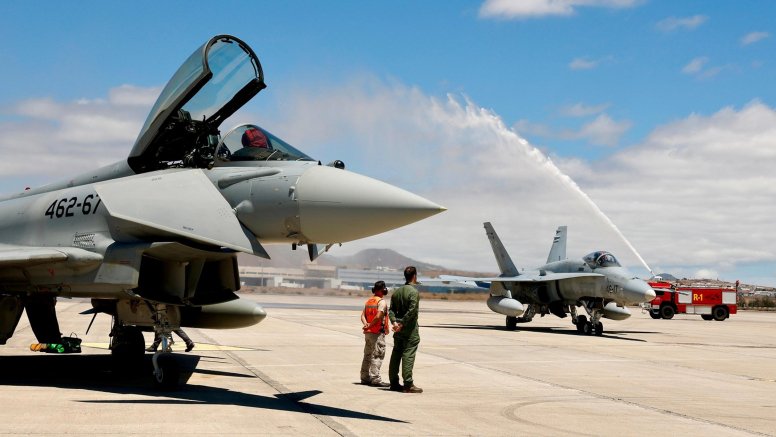
Gando Air Base, in Gran Canaria, has received this week the first eight Eurofighter Typhoon fighters that relieve the F-18 Hornet in the defense of the islands, a legend of military aviation that has guaranteed Spain 25 years of air superiority in this area of the Atlantic.
With all military solemnity, the Army formalized this Friday the withdrawal from the islands of the American F-18 fighter-bombers that made up the bulk of the force of Wing 46, aircraft with almost 30 years of service (they were based on the peninsula before arriving in the Canary Islands), close to their operational limit.
Currently, only six F-18s remained active in the Canary Islands, which from this week will be temporarily transferred to Zaragoza Air Base, to Wing 15, until they are decommissioned, which is scheduled to happen in December of this year.
For the thousands of people who use Gran Canaria airport daily, adjacent to Gando Base, the change will hardly mean a change in silhouette in the sky during the fighters' takeoffs and landings: from the characteristic double tail of the F-18, it will change to the single tail and dart-shaped nose of the Eurofighter.
However, the change is much deeper, both technologically and emotionally, especially for a whole generation of Spanish pilots whose military careers have been linked almost from beginning to end to the 'old' F-18 Hornet.
Among them, Colonel Bayardo Abós, head of Gando Air Base, who during the ceremony said goodbye to one of the American aircraft, with which he began flying as a pilot 30 years ago, at Zaragoza Base. And he did so by addressing the aircraft personally, as if speaking to a friend or a comrade-in-arms.
Technologically, the arrival of the Eurofighter Typhoon means having one of the most advanced and capable interceptors in the world in the Canary Islands, highlights the Air Force, two decades more modern in armament and key systems than the F-18 Hornet.
The substitution has also been a training challenge for the pilot and mechanic staff of Wing 46, who have spent months at bases on the peninsula where the European fighter was already serving to complete the corresponding conversion courses and get used to it.
Gando base thus becomes the third operational base in Spain with the presence of the European fighter, which was already operating in the detachments of Wing 14 -Albacete- and Wing 11 -Morón de la Frontera, in Seville-.
The Chief of Staff of the Air Force, General Francisco Braco, has underlined that the step taken this week in the Canary Islands represents "a milestone" in equipping this area of the Atlantic with the necessary air defense capabilities at this time.
In total, the Ministry of Defense plans to assign 20 Eurofighter fighter jets to the Canary Islands, an aircraft whose cost is around 160 million euros per unit (the last batch of 25 purchased by Spain from the consortium led by Airbus cost 4 billion euros in 2024, including logistical support and engines).
The Typhoons take on responsibility in the islands for the first time this week, but their presence there is not unusual. For years, Eurofighters from several of Spain's allied countries have regularly participated in simulated combat exercises organized by the Air Force over the maritime space surrounding the Canary Islands.