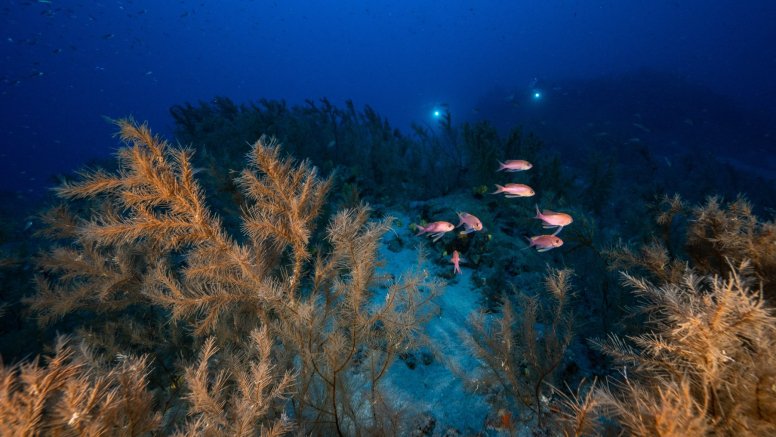
A study has identified the main environmental and geomorphological factors that regulate the distribution of black corals in the Canary Islands and nearby seamounts, creating the first comprehensive map of their location. The research was carried out by the Biodiversity and Conservation Group (BIOCON) of the ECOAQUA University Institute of the University of Las Palmas de Gran Canaria and published in the scientific journal Progress in Oceanography.
The research confirms that these organisms, capable of forming true animal forests in mesophotic and deep zones, are not randomly distributed but respond to a combination of variables such as depth, bottom type, underwater slope, current speed, and location within the Canary Islands' insular gradient.
The study corroborates that the distribution of black corals varies among the different island groups. The eastern and central islands showed a higher frequency of some species compared to the western ones, reflecting the influence of the archipelago's oceanographic and geomorphological gradient.
The study compiles data obtained from various sources over more than two decades using scientific diving, towed cameras, and remotely operated vehicles, which has allowed for the collection of over 6,500 records of black coral presence and absence in 144 locations, from shallow waters to nearly 1,000 meters deep.
The work was led by researchers from the ECOAQUA Institute of the ULPGC, in collaboration with Oceana, the Royal Belgian Institute of Natural Sciences (Belgium), the LECOB institute belonging to the Oceanological Observatory of Banyuls sur Mer (France), the University of Genoa (Italy), the Under The Pole consortium (France), and other international specialists.
Hidden Forests Between Light and Darkness
Black corals, also known as antipatharians, are colonial organisms related to anemones and jellyfish, characterized by a dark, flexible, and spiny skeleton. Although little known to the general public, they play a fundamental ecological role as ecosystem engineers, as their three-dimensional structures provide refuge, food, and breeding grounds for numerous marine species.
The study identified eleven black coral taxa belonging to six families, confirming the high richness of these organisms in the Canary Islands and reinforcing the archipelago's role as a key point of marine biodiversity between the Atlantic and Mediterranean regions.
According to ULPGC professor Francisco Otero-Ferrer, a researcher at the BIOCON group of ECOAQUA and principal investigator of the study, "this work allows us to better understand why some black coral species appear at certain depths or bottom types, while others occupy completely different environments. It is not enough to know where they are: we need to understand what conditions make their presence possible."
Depth and bottom type, decisive factors
The results show that depth and substrate type are the main factors conditioning the distribution of the most common species. Antipathella wollastoni and Antipathes furcata, for example, were mainly associated with hard bottoms in mesophotic environments, between 30 and 200 meters deep. In contrast, other groups such as Parantipathes spp. were more frequent in bathyal zones, below 200 meters.
The study also reveals that some species exhibit a very wide vertical distribution. This is the case for Stichopathes spp. and Leiopathes sp., which were recorded from relatively shallow areas to deep environments, showing a great capacity to occupy different habitats.
"The Canary Islands function as an exceptional natural laboratory," explains Otero-Ferrer. "Within a few hundred kilometers, we find old and young islands, wide island platforms and abrupt bottoms, areas influenced by African upwelling and more oceanic areas. This combination creates an enormous variety of habitats for black corals."
Currents, slopes, and island singularity
In addition to depth and substrate, the study demonstrates that hydrodynamics and seafloor morphology significantly influence the presence of these corals. Horizontal currents favored the presence of some deep taxa, such as Parantipathes spp., while other species showed different responses to water vertical velocity or bottom inclination.
These results suggest that black corals depend on a delicate balance between substrate availability, current exposure, food transport, and habitat stability. In many areas of the archipelago, canyons, slopes, shelves, and seamounts generate local conditions that favor accelerated currents and the supply of food particles, creating suitable scenarios for the development of these animal forests.
Key information for conservation
Black corals are long-lived, slow-growing, and fragile organisms, making them particularly vulnerable to impacts such as bottom fishing, marine litter, underwater mining, illegal extraction, or any activity that alters the seabed. Although many of these habitats are found at inaccessible depths, their conservation requires precise information about their distribution and the factors that explain their presence.
The study provides an essential scientific basis for improving the management of these vulnerable ecosystems, especially in the context of marine spatial planning, impact assessment, and the design of future conservation measures.
“Knowing the factors that regulate the distribution of black corals helps us predict where these habitats may be found, even in areas that are still little explored,” highlights Otero-Ferrer. “This information is fundamental for anticipating conflicts with human activities and for protecting ecosystems that, although hidden at great depths, fulfill essential ecological functions.”
Beyond its regional relevance, the work positions the Canary Islands as a strategic enclave for the global study of animal marine forests. The combination of volcanic islands, seamounts, depth gradients, and contrasting oceanographic conditions makes the archipelago a privileged setting for understanding how these ecosystems are structured in the eastern Atlantic.
With this new advance, ECOAQUA continues to expand knowledge about the black coral forests of the Canary Islands, providing key information for their recognition, management, and long-term conservation.
This work has been partially funded by the European project OCEAN CITIZEN and by the ‘Climate change and biodiversity’ initiative of the BNP PARIBAS Foundation through the DEEP LIFE project.
The scientific team wishes to thank the Network of Marine Environment Observers in the Canary Islands (RedPROMAR) of the Government of the Canary Islands (https://redpromar.org/home), for providing the data, and B. Palacios Castillo, for their contribution to the design of the icons for certain black coral taxa (https://palaciosdelcastillo.com/).