This Friday, the European Pact on Migration and Asylum enters into force in the European Union, a highly controversial regulatory package due to its security-oriented vision and border externalization that will change some key aspects of migratory control and international protection in Spain.
Agreed in December 2023 under the Spanish presidency of the Council of the European Union, its implementation comes one day after Pope Leo XIV's 'scolding' of Europe in the Canary Islands for its migration policy, which he reproached by saying that "one cannot speak of dignity and allow the seas to be cemeteries."
The implementation of this immense regulation - nine regulations and one directive - has been carried out with discretion by the Government - or lack of transparency, according to NGOs - and arrives at the deadline without the expected legislative reforms, such as a new asylum law to replace the current one, from 2009.
Although some adjustments remain, these are some of the novelties that come into effect this Friday, as confirmed to EFE by ministerial sources.
An exhaustive triage for arrivals
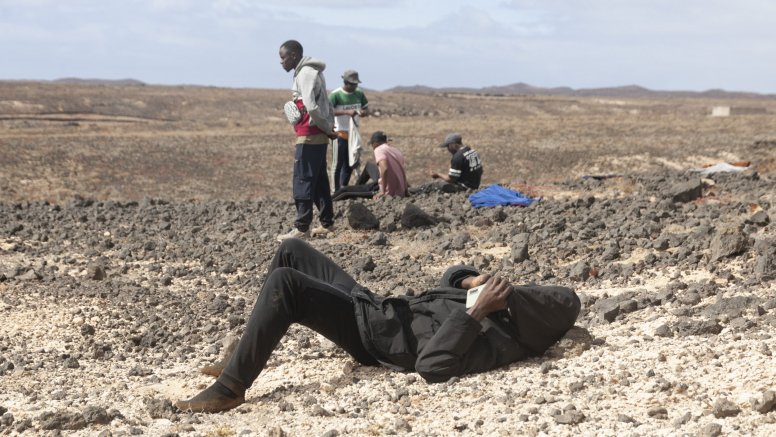
The pact introduces an exhaustive common triage process throughout the EU for nationals of third countries arriving at the border without an entry permit, such as people arriving by canoe in the Canary Islands.
This includes a preliminary medical examination, an assessment of vulnerabilities such as victims of trafficking, identification work, biometric data registration, completion of a form, and referral to the international protection or return procedure.
While the process, carried out by the National Police, is ongoing, the migrant will not be able to receive an entry permit into the territory and must remain at the disposal of the authorities. The pact allows this triage to last up to seven days but, in Spain's case, the current period of 72 hours is maintained.
In addition, a monitoring mechanism for the respect of fundamental rights by the Ombudsman will be launched.
Massive data collection, including for children
One of the most criticized points of the pact is the collection of biometric data in this triage, which is significantly expanded from the mere registration of fingerprints to taking a facial photograph and digitizing documentation, if available.
Another of the novelties that have raised the most alarms is that the age of migrants from whom this data is collected is lowered: before it was for those over 14 years old and now it will apply to all those over 6.
The objective is to share this information not only with the national databases of the National Police and Civil Guard, but with all Member States through a new database that will no longer only be applicable to asylum seekers, but will contain information on all persons arriving irregularly in Europe.
Twelve weeks to resolve asylum at the border
Other novelties of the pact have to do with asylum, for which three procedures are established: border, which will be resolved in twelve weeks including judicial review if there is any; accelerated examination, in three months, and standard examination, in six.
Regarding the border procedure, the applicant will not be able to receive an entry permit into the territory while it is being resolved and must remain in designated facilities, although not deprived of liberty.
3-month accelerated procedure for some cases
The accelerated procedure applies in certain cases, such as people from a country with a recognition rate of protection equal to or lower than 20% in the European Union as a whole or from a country considered "safe" by the EU, such as Colombia or Morocco.
Many NGOs see here risks that an individualized analysis will not be carried out with due guarantees, although the Government assures that it will be studied on a case-by-case basis.
For the general procedure, the deadlines are shortened: from the moment the person expresses their desire to request protection, the application must be registered within five days and formalized within another twenty-one days, whereas until now there were no specific deadlines for this step.
In all cases, the denial of the application will entail denial of entry or return, although in practice it is often difficult to execute these orders due to issues such as the lack of agreements with countries of origin.
With the entry into force of this pact, the Ministry of the Interior will cease to recognize and renew temporary residence permits for humanitarian reasons, such as those granted in recent years to Venezuelan citizens.
The state reception network for migrants is maintained
Regarding the reception network for migrants arriving irregularly in Spain and asylum seekers, the Government has guaranteed that it will maintain its capacity.
The Ministry of Inclusion, Social Security and Migrations has made its centers available for the border procedure for international protection, with approximately 10,000 places, and will update the regulation governing the reception system, a modification that is already in the public consultation phase.
An obligatory solidarity that will benefit Spain
The regulatory package includes a mandatory solidarity mechanism that obliges States to share the responsibility of collectively hosting refugees arriving in any EU territory, but allows countries to be released from hosting their quota if they make a financial contribution.
Within this system, Spain has been identified as a 'member state under migratory pressure' and, therefore, eligible to benefit from measures that will be specified in upcoming meetings.
No to return centers in third countries
Within the scope provided by the European pact, Spain has been adamant in rejecting some of the most restrictive measures towards which many other member countries are heading, such as the creation of deportation centers outside the EU territory, due to having "serious doubts" about their "legality and proportionality".
Add La Voz de Lanzarote as a preferred Google source.
Stay informed with the latest current news.