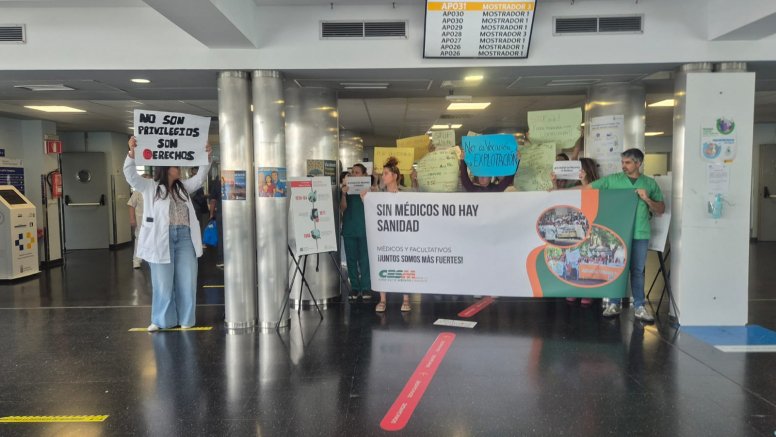
Canarian doctors registered a letter this Wednesday in the SCS hospitals addressed to the regional president, Fernando Clavijo, to request a meeting that would allow the labor conflict to be unblocked and progress to be made in the negotiation that has kept the group on indefinite strike since last October 16.
The president of the Canarian Medical Union (CESM Canarias), Eric Álvarez, explained to journalists that this is the fourth letter and recalled the public commitments made by Clavijo, both in the media and in Parliament, "to sit down with the medical collective."
"We understand that his agenda may have been slightly disrupted by the migratory emergency in El Hierro, but our phones, emails, and all communication channels are open 24 hours a day to try to resolve this conflict which, evidently, one way or another, has an impact on the population, which is what both parties understand we want to avoid," Álvarez stated.
The initiative to register the letter in the public hospital registries originated from doctors at hospitals in Gran Canaria, but, as the union president indicated, they are aware that it is also being done in Primary Care, as well as on the islands of Fuerteventura and Lanzarote.
In a letter, registered by more than fifty doctors at the Doctor Negrín Hospital, the group's representatives assure that the physicians do not wish to prolong the strike and request direct dialogue with the head of the Canarian Executive to convey "the real situation of the negotiation, what the demands are, and what possibilities exist to reach a satisfactory end-of-strike agreement for all parties."
The letter also reflects the strike committee's loss of confidence in the director of the Canarian Health Service (SCS), Adasat Goya, due to his public statements and discrepancies regarding the economic valuation of the demands.
Greater representation and labor improvements
The union representative recalled that the group's demands focus on three main areas: greater representation of doctors in negotiation tables, labor and rest improvements, and salary advancements to make the Canarian healthcare system competitive compared to other autonomous communities, the European environment, and the private sector.
As he explained, economic demands occupy only a minority part of the demands.
"Most of our demands are not that we are asking for money. In fact, of the 18 points, which I say are technical issues, only two, three at most, directly address pay issues. The others are directly related to improving working conditions, which in turn leads to better conditions for serving the population," he stated.
Álvarez assured that the indefinite strike will continue as long as there is no rapprochement from the regional Executive.
According to him, neither the Ministry of Health nor the SCS have contacted the union since two days before the start of the indefinite stoppage.
"We did not want and do not want one more day of strike, but obviously if nothing has changed we will maintain it," maintained the president of the medical union, who expressed confidence that Clavijo will convene a meeting "shortly."
"Unsustainable" waiting lists before the conflict
The union leader acknowledged the inconvenience the strike is causing patients, especially due to delays in diagnostic tests and surgical procedures, although he argued that the waiting lists were already "unsustainable" before the conflict and that they intend "for that to change."
In this regard, he stated that the Canary Islands have difficulties retaining healthcare professionals and warned that many doctors trained in the islands choose to move to other communities or the private sector due to current working conditions.
Álvarez pointed out that in Primary Care, physicians see around 40 patients daily and considered that this workload makes it difficult to offer adequate care and carry out preventive work.
The union maintained that improving working and contractual conditions would allow for strengthening staff numbers and reducing waiting times in the Canary Islands' public healthcare system.
Add La Voz de Lanzarote as a preferred Google source.
Stay informed with the latest current news.