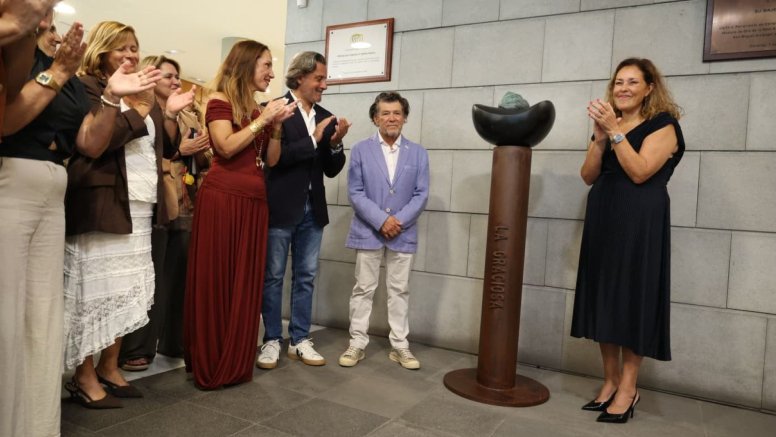
The Parliament of the Canary Islands has, since this Wednesday, the representation of the eight islands of the Archipelago at its main entrance with the incorporation of a sculpture dedicated to La Graciosa, by the Lanzarote artist Paco Curbelo. The new piece completes the sculptural ensemble originally created by José Abad, which until now represented the remaining seven islands.
The president of the Parliament of the Canary Islands, Astrid Pérez, highlighted during the presentation that the incorporation of the new piece represents much more than completing an artistic ensemble. “Today La Graciosa finally has its own permanent presence in the home of all Canarians,” she stated, emphasizing that “recognizing is not just naming. Recognizing is being there, it is having a place, and today, finally, La Graciosa has it.”
The new sculpture establishes a dialogue with the works of José Abad without altering the ensemble conceived by the artist. The piece incorporates elements linked to the identity and landscape of La Graciosa, including the burgado, and seeks to transfer to stone some of the characteristics that define the island and its population.
Pérez recalled that the Canary Islands Statute of Autonomy, after its reform in 2018, expressly recognizes La Graciosa as an island integrated into the territorial scope of the Autonomous Community, although administratively it continues to be linked to Lanzarote.
“This sculpture does not simply come to occupy an empty space. It comes to complete something. It comes to put in its place an island that had to be here,” said the president, who highlighted the unique identity of La Graciosa and the historical and social bond it maintains with the entire Archipelago.
The president of the Parliament particularly highlighted the choice of Paco Curbelo to create the new piece, considering that his career and his deep knowledge of Lanzarote and the materials linked to the Canarian landscape allowed him to approach the commission with respect for the pre-existing work.
“Paco knows how to listen to the stone, and that is evident in his work,” stated Pérez, who explained that the sculptor has not sought to create a literal representation of La Graciosa, but rather to transfer to the piece “its character, its landscape, its memory, its fragility, but also its strength.”
The Lanzarote sculptor stated that “making this sculpture was easy because I knew the material had to be basalt and it had to represent the island with the sea snail, the complicated part was integrating the work into José Abad's sculptural ensemble”
Children from the Ignacio Aldecoa school in La Graciosa and neighborhood representatives were present at the inauguration ceremony, showing their emotion at finally seeing their island represented in the Parliament of the Canary Islands.
Astrid Pérez also recalled José Abad's connection with La Graciosa, where the sculptor also left his mark with the work "La Puerta de la Isla de La Graciosa," located in Caleta del Sebo. In this regard, she insisted that the new addition does not aim to modify the original work, but rather to continue the artistic dialogue initiated by Abad.
Pérez, who also highlighted her status as a deputy for this island, pointed out that for those who maintain a connection with Lanzarote, the incorporation of La Graciosa carries a special emotional weight. “La Graciosa is not something that is simply on the other side of the sea. It is part of our history, our memory, and our life,” she stated.
The new sculpture is installed in the entrance hall of the Parliament of the Canary Islands, next to the set of pieces representing the remaining islands, as a symbol of the diversity and unity of the Archipelago.
Biography of Paco Curbelo
Paco Curbelo was born in 1956 in Lanzarote. In 1975, he began his studies at the Higher School of Fine Arts in Las Palmas. Upon the closure of that school, he moved to Barcelona to complete his studies at the Faculty of Fine Arts, where he obtained his degree in Painting in 1980. During his years of training, he also took several courses in engraving, ceramics, and photography organized by the University, as well as the Mural Painting Restoration Course at the International School “Miguel Farré". In 1981, he obtained his degree in Fine Arts in Sculpture from the University of La Laguna, Tenerife, and returned to his native Lanzarote.
Since then, and until February 2016, he carried out important teaching work as a professor of Volume at the Pancho Lasso Art School in Lanzarote, while simultaneously developing his career as a professional sculptor.
Paco Curbelo's sculpture is the result of a deep knowledge and work with materials, mainly stone such as basalt, marble, or onyx.
Add La Voz de Lanzarote as a preferred Google source.
Stay informed with the latest current news.