Recycle, reduce, and reuse. Three verbs that Fernando Clavijo's Government has not learned to conjugate and put into practice. Coalición Canaria prefers the euphemism of "valorizing waste," that is, burning it. They remain stuck between the Age of Fire and the Age of Concrete.
The European Union has set the deadline of 2035 for the reduction of waste and its proper management. And incinerators will end in 2029.
The Government of the Canary Islands, characterized by its absolute lack of will to protect the nature of the Islands, still has not approved a Waste Plan, after 12 years of consecutive non-compliance which, as everyone knows, fills the waters of our coasts, ravines, badlands, forests, paths, and even the streets of towns and cities with toxic, fecal, and industrial filth.
But, at the same time, the government managers are aware that their irresponsible negligence will have repercussions in the very near future on the pockets of all the people who inhabit the Canary Islands, because we will have to pay millionaire fines for failing to comply with international and state regulations on waste.
And to complicate it even further, the Clavijo Government seeks the worst of the solutions - the one that Europe now prohibits throughout its continental territory - which is none other than burning waste through new incinerators on the islands of Gran Canaria and Tenerife, transporting waste from the rest of the islands to them. This is included in section 7.3.2 of the Pircan (Insular Waste Plan of the Canary Islands), which has not yet been approved.
Clavijo and Coalición Canaria, after 27 years, remain between the age of fire and the age of stone, or rather, the age of concrete.
First, further promoting the burning of fossil fuels (the gas project) and now, obtaining an exception for the Ultraperipheral Regions (UPR) of the EU that allows placing incinerators and burning waste, which no one in the rest of Europe wants to burn because they poison people.
The European Populars and French and Portuguese deputies have supported the exception for the ultraperipheral regions. And that makes the Government of the Canary Islands a real danger to the environment and to our lives, and with their proposals they seem like environmental criminals.
Garbage is a big business. And that is known by the Italian mafia that exercises its control over waste in Southern Italy.
They want to transfer to the Canary Islands the tremendous nonsense that has occurred in the Balearic Islands, where they imported garbage from Italy to feed the incinerator and continue to import it from Ireland. And for that they have created a lobby (composed of business people with interests, politicians at their service, and related officials) who, it seems, are very interested in this incineration business.
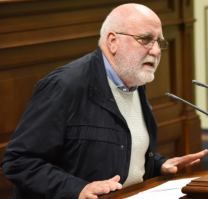
Three times in the last year, in Parliament I have asked Councilor Nieves Lady Barreto if they were going to place incinerators on us. She never answered me. Recently, she has denied that possibility in parliamentary headquarters. I don't know if it will be a retreat for electoral reasons.
Meanwhile, the incineration lobby has quietly continued with its plan. For that, on a trip organized by the Government, they had visited some places in the State to contemplate 'in situ' the waste-devouring monster and producer of huge profits.
And what does Coalición Canaria say? The party of hydrocarbons, gas, the Land Law, and the concrete mixer. The party that ignores the island nature in the sea and on land, has also decided to support incineration.
But everything will depend on popular pressure before the next elections. That is why it is necessary to inform ourselves and mobilize.
The initial financial sheet foresees about 150 million euros of European funds and, apparently, as much put by the State and the Canary Islands for an incinerator in Tenerife and another in Gran Canaria, each destined to burn the waste from all the islands of their respective provinces, with its transfer by boat from the non-capital islands being planned.
That's what the subsidies for the transport of goods are for. Another absurdity.
And this is where ECOEMBES comes into play, the entity in charge of collecting all plastic containers in the Canary Islands, whose recycling must be taken care of by the companies that produce them and who pay this entity for their collection and transfer.
If they do not have to transport the collected plastics to the Peninsula, ECOEMBES, which curiously presents itself as a non-profit NGO, saves the transport, although it earns by transferring them to incinerators in Tenerife and Gran Canaria, in whose incinerators they will give us, in passing, fumaroles of toxic smoke.
And what do incinerators need plastic containers for? Without that combustible material, the organic matter would not burn and then the incinerator would not work. Plastic is the fuel for that combustion.
Therefore, when they talk about revaluation, it must be stated that incineration does not produce energy, it consumes it through plastic derived from petroleum, endowed with a high calorific power.
And so that plastic containers go to the "waste" container of the garbage, it is only necessary to relax the rules, not promote a correct separation of the garbage and convert the organic garbage, for example, into something contaminated and not usable if it is mixed with others.
In addition, since it has a lot of water, it is very heavy and, therefore, more tons for the incinerators to pocket in their pockets.
The strategy that the incinerators have followed in all places is to start with small quantities, around 20%, to immediately double and triple the garbage that is burned because, the more garbage burns, the more money the company awarded the incineration receives.
By paying for the packaged product, we are paying for the recycling of the packaging, recycling that is not going to occur.
I explain: the company to which the incineration is awarded signs a contract for so many tons per year and for a time of 30 years. Each City Council spends between 40 and 50 euros per ton to collect the garbage and deliver it to the Cabildo in its transfer plant.
Compared to those 44/50 euros per ton that are paid today for managing the garbage, if an incinerator is implemented we will go on to pay 3 or 4 times more (between 175 and 185 euros per ton).
City Councils such as that of Santa Cruz de Tenerife will pay the company Valoriza 200 million euros for the municipal management of garbage. In turn, the Cabildo pays around 150 euros per ton, weighed at the foot of the incinerator, to the company that burns it.
Therefore, the 'monster' needs food, and that it does not decrease; because, if it does, the contract is breached and you have to pay even if the garbage does not arrive.
That is why, in the Balearic Islands, it is imported from Ireland. That is why burning garbage is a great business for four smart people and a very bad business for our health, that of the territory and that of our punished atmosphere. More warming for climate change...
In this matter there is no unity of criteria between the 88 municipalities, not even those of each island with its corresponding Cabildo. In these kingdoms of taifas of public discoordination, the companies in the sector move comfortably, like a fish in water.
And what is at stake is the public money from our taxes, with the fees and public prices that we pay and with the health of all of us and the future of the habitat that we will leave as an inheritance to our descendants.
Does incineration generate or destroy jobs? When you incinerate, for each job you create, you destroy between 10 and 15 jobs in a process where recycling occurs.
What guarantees do incinerators offer for people and other living beings that are located in their vicinity? As an example, the most modern incinerator in the world, currently installed in Holland, and which in recent studies makes it clear that in a radius of action of 2 km around (without winds or other expansive phenomena) all the eggs of the birds throw high doses of dioxins (highly carcinogenic toxins).
What will the Government of the Canary Islands do in islands like Tenerife with the towns of El Río de Arico, Chimiche, La Cisnera, Villa de Arico, La Jaca, Las Maretas, Tajao, Las Arenas, La Caleta or Barranco Del Río, which are in that radius of action, on days without wind, which is very unlikely? Does it plan to relocate its inhabitants to other places or is it going to condemn them to die of cancer? If we pay attention to what was said by the Canarian MEP of the PP, Gabriel Mato, "the Government must prepare emergency plans for those places".
Incineration is not the solution to waste.
It is already invented in many countries of the European Union: reduce, recycle and reuse. Minimize waste, separate it properly at the source. Take advantage of the organic matter for a quality compost. Reuse the rest (paper, plastic containers, fabrics and footwear, remains,?), eliminate all plastic bags as well as glasses, straws, plates and cutlery.
Other countries have done it, our visitors do it in their countries of origin, why don't we do it in the Canary Islands?
In the EU, more than 50 percent of waste is recycled. In the Canary Islands, we do not reach 18 percent.
The decision to impose an incinerator, once implemented, has no turning back due to its high cost and requirements; in addition, incinerators, even the latest technology, continue to produce serious pollutants that threaten terrestrial and marine biodiversity; therefore, the incinerated waste does not disappear, but is transformed into highly toxic slag, whose deposits will have to be managed and paid for its maintenance for centuries.
Organic matter continues to be more than 40 percent of our municipal solid waste. One kg of organic matter, such as the compost that we can obtain from our organic waste, helps to retain up to 20 liters of water in the soil; incinerators are the excuse to burn organic matter and packaging, and not have to compost or recycle them.
Incinerators also need to burn dry organic matter, so that the bio-stabilized plants that already exist will be dedicated to dehydrating to burn what could have been converted into compost; in Madeira, its ambitious Composting Program of organic waste disappeared completely from the moment an incinerator was implemented on the Island.
If we receive European money for costly incineration, we will no longer be able to receive it for reduction, composting, recycling and reuse projects.
The Canarian population, which massively took to the streets to stop Repsol's oil explorations, to denounce the ecological attack of the Vilaflor towers, the one that has opposed the Granadilla dock or the unnecessary expansion of the Agaete dock, has to go back to the streets to stop this new attack against our health, our economy and our future.
We have to prevent these potential environmental criminals from continuing in the Government of the Canary Islands and in the Cabildos. Afterwards, complaints are useless.
The solution is now in our hands.
No to incineration.
Manuel Marrero Morales
Deputy of the Podemos Canarias Parliamentary Group
Candidate for Tenerife of Podemos Canarias to the Parliament
Add La Voz de Lanzarote as a preferred Google source.
Stay informed with the latest current news.