We are on the verge of a new school year. And in the Canary Islands, the main social and educational problem is poverty. We have the highest rates of poverty and social exclusion in the Spanish State and the European Union, exceeding 45%, and especially among children.
However, the Government of the Canary Islands looks the other way in the face of this very serious situation. It does not seem that poverty is a problem that has to do with a party that has been governing in the Canary Islands for more than a quarter of a century. Nor do they consider education a priority. There are no transversal policies that address the problems from different fronts. Their star measure in Education has been the promotion of E-sports. That is the level of our Government.
Recently, the School Council of the Canary Islands issued a report in which it advised the Government of the Canary Islands to facilitate school population to have access to three daily meals from schools, with the support of other Ministries.
What can we expect from the Canarian Government of Mr. Clavijo, which repeatedly fails to comply with the Canarian Education Law, approved in 2014 and which foresaw that in 2022 at least 5% of GDP would be dedicated? Taking into account that at the time of the approval of the Canarian Education Law, 2014, the Education budget represented 3.8% of GDP, in 2018 it should have already been at 4.4% to comply with the provisions of said Law. To comply with the legislation, from the current 3.62% of GDP we should go up to 4.6% of GDP by 2019. And, nevertheless, we are demanding another year to reach 4%, a mission that seems impossible with this Coalition Canaria Government, concerned about the businesses of its powerful friends and unconcerned about the rights of the social majority.
It is necessary to ensure adequate funding for the education system, which requires assuming politically and socially that education funding must start from the maxim that education should not be considered as an expense, as the subsidy of a service, but as an investment that has far-reaching socio-economic repercussions.
Consequently, investment in education must be guaranteed as a priority in the Autonomous Community of the Canary Islands, due to its individual and social profitability (employment, health, social services, etc.), due to the strategic role that training plays as a generator of progress and personal and social well-being, and, therefore, as a resource to improve the current socio-economic situation and an essential requirement for the future development of the Canary Islands.
Already in 2017, the School Council of the Canary Islands itself urged "the Government of the Canary Islands and the Parliament of the Canary Islands to allocate at least 4% of GDP to Education in the Budgets of the Canary Islands Autonomous Community for the year 2018 and requests that the increase from 3.57% to 4% be allocated to non-university education, including the stage of Early Childhood Education from 0 to 3 years". The UN recommends investing in childhood. Budgets must have childhood approaches. The Government turns a deaf ear to education and poverty.
With this purpose, from the Podemos Parliamentary group we presented a Non-Law Proposal to comply with the objective of the School Council of the Canary Islands, which was supported by the majority, with the abstention of Coalición Canaria.
In these days, we are facing a new course: poverty has not decreased and investment in education has not increased. And the government is not there nor is it expected to solve these serious problems.
We need urgent measures, which facilitate a social rescue measure, a benefit per dependent child, which guarantees, first of all, the daily meal of the entire school population and, secondly, the free provision of school materials for all students in need. And we do not have to wait for the budgets for 2019. The Government has our support to approve an extraordinary credit for this purpose.
We must bet on a more bearable back to school for families and a more dignified life for children.
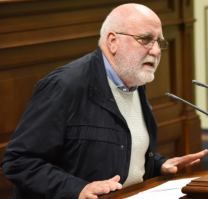
By Manuel Marrero, deputy of the Podemos Canarias parliamentary group
Add La Voz de Lanzarote as a preferred Google source.
Stay informed with the latest current news.