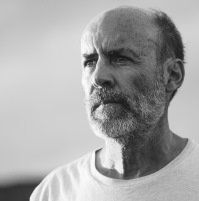
The only time I spoke with Pepín Ramírez was in his Senate office. I went to ask that man for help so that a place would not be touched. My 'art', my creativity, consists of leaving things as they are. My 'work for art' is leaving a place as it is. And that has to be worked on day by day and year by year. And be very creative and stubborn to try to achieve it. Just the opposite of what he and Cesar had done: try to do things on the island to put it in the world. Both, although opposite, are about the same thing. But everything has its time. And he understood me and was very kind and signed my paper to be an honorary game warden. Let's say that card was my first brush. And with it I began to paint shearwaters and fish where they were already fading. Or they had been erased. Until that day, I painted only spots with my hands and feet. Then I got an eraser and started erasing mechanical shovels that, in turn, erased mountains or gerias to repaint them in the urbanizations of the south. And from the east. I am always remembered for shearwaters and shearwater chicks, but one day I will tell the battles of the rofe, the black gold of that time. And if we 'irrational' ones hadn't been there, little would have remained of La Geria and many volcanoes and lajiares. Very little. I'm happy to have been there. I'm happy.
But most of the time we talked about another art, the 'art' of fishing for vieja. So I dedicate this piece to him in homage to how brave he was in denouncing the one who was stealing from all of us. And combating the historical apathy that gripped the ruling classes, lying in an area that was more soporific than comfortable, as always sustained by the work of others. I can imagine the pain that caused him, and the well-being that he gave us in return. Another thing is what we have done with that well-being afterwards, in which we largely did not know how to be. It is not easy to be well, perhaps that is the supreme art and perhaps it does not depend on well-being. And perhaps, more than being able to be happy to have been. And now be where your heart tells you to be.
The viejas. Salted in the sun, moon and wind. Not with just any salt, salt from a shallow puddle, from the northeast. At the edge of the sunrise. Collect the salt from a high, warm puddle. Neither cold from the morning sea breeze nor fiery from midday. Salt foams. Sprinkled and lovingly caressed with the night dew and parboiled with fire from jallos on the shore, woods from other continents, with aromas of goat's foot and memories of distant rivers and prodigious storms. To give exotic fumes. And sea water. Seasoned with a couple of greased pebbles. Without weight and without price. Fished and dried with your hands, with your way of fishing and drying. The clean slime at its point, scrubbed with seaweed from the tide, the brown algae, tenderly rough, freshly arrived from the edge. And the unmistakable smell of the night. The ties in your style and the black and polished little stones from the beach in their place, holding the cut, the tie. Opening them, offering them to the flies instead of hiding them. Certifying with their rejection of pecking them, the purity of the work. That's it. I could have 'left' at that moment, but I continued. Life anchors, even if you have finished the job well. The boat that left me there did use a little oil, but it could have been by sail. I needed to go back a little further in cultural time. In the other, I don't even know if I've returned.
This could be an absolutely macabre story for someone who loves live fish, I should correct, that we define as already dead. Aware of the gift of their lives. And I would understand that person's disgust at my story, which narrates one of the most magical moments of my life. And I would ask for compassion for me, and I would sink my head into the sea and see the red shadows and their living reflections slip away vibrant with sun and salt. And I would feel happy and on the shore I would see myself, fishing for fish, watching myself in the sea fooling around behind colors, gratefully handing over my hunter's necklace to the silverside. Or returning it. And in the end I tell them a fable of the air and the breaking of my filleting knife and what we have left to learn from the world and its energies and mysteries.
César was that. He saw the living colors and painted the fishermen, harmony. But there was already the germ there, not of ecology, another later one, that of respect for the life of every living being. The struggle of consciousness to endow us with consciousness. There are no more intelligent ones than others on that journey; science lacks a lot of consciousness to stop screwing live animals to exhaustion. But it progresses, without a doubt. Consciousness with science or science with consciousness, a long journey of uncertain destination. Meanwhile, here in Lanzarote, art was abducted by concrete horses. Meanwhile, death roams freely through any ravine, any islet, any mountain, between power lines, on the shores and the bottom of the sea, deadly roads, plastic hangovers and slaughterers.
I suppose I don't know a damn thing about art and that I fail in my attempt. I'm not like those experts in foundations. Or in stripping artists of their souls and courage. I like Turner tied to the mast in the storm, or Van Gogh or Caravaggio or Pollock. The madmen, I like the madmen of all the arts. And the madwomen that the stories of the knowing experts have stolen from my consciousness, and that I now seek. Madwomen and witches. To transmute them in my conditioned consciousness into creators and wise women. And then, from there, return to them in my heart the madness and witchcraft. And I can see how so many assholes are parboiled in the bonfire of vanities. Sane, tied to their sanity. Winding everything up. Under the table.
And I go with the knife. The filleting knife is sacred. Each one has their own and it is untouchable for others. That, in Alegranza, was the only order I gave, the limit to those who arrived new. The knife is not touched, looked at or coveted. Well, it happened that twice that order, that mandate, was broken. The first time a friend picked it up, the tip broke, it split. He hadn't done anything special with it, he had picked it up to clean fish and it broke. The second time another friend picked it up, it broke in half. That friend hadn't done anything special with it either, no extra effort, nothing, it broke in half. Twice in a few years. And both times it broke.
All my life those two events seemed extraordinary to me. Chance has its reasonable and logical limits, beyond that you have to ask yourself, always ask yourself and if there is no answer, then wait. And don't surrender to chance. Surrendering to chance is, for me, the cowardice of reason, the contempt of logic.
Today, talking with a veteran vieja fisherman about the fishing matters of before, I told him the anecdote; in the middle, he murmured: "Air, it was the air." I hardly paid attention to him, but, for some reason, before leaving I asked him: "Why did you say that about the air before?" And he told me, somewhat timidly, again returning to the whisper, that filleting knives were always sacred to fishermen, nobody touched the others', because when they did "the air reached them" and they broke. And I think, isn't that what happens with hearts, that when you play with someone else's without being one with them, the air gets to them and they can break?
Today I am sad. Someone whose conclusion I was waiting for says they have read and informed themselves very well about the horses and have listened to all parties. and that even so, without further ado, they believe that they should stay there. And it tasted like the reverse, when people think that immigrants should leave and you assume that it is due to misinformation and you pass them all the data and reasons and justifications for why they are here, including our immense responsibility for what happened in their wonderful countries, and after looking at all the angles they tell you, yes, you are right, but they should leave. Leave, stay, kick them out, leave them. Maybe 'the air' got to all of us. And it broke us.
Well, that's it, what I remember about Pepín, about Don José Ramírez, is that he listened to me. That he experienced what I was telling him. And that, in some way, he already knew what was coming and that our art would have to be that, leaving things as they were. And that that was going to be unbearable for artists and creators and builders. It's like growing up among hunters and when you see yourself ready to kill the lion, the old hunters, the masters, tell you: "It's no longer time to kill; now you have to clean up the blood." And it's going to be much, much harder than hunting the lion or the shark. Because the only head that can be cut off as a trophy will be yours. And it will be for them, and what you manage to clean up the blood if you save your head, will not be for you, it will be for those who are not here yet. But that, for those who count and measure time, 'their time', is very difficult.
They live like the one with the hook, with the tick-tock tick-tock always present. Absent from the world. The metallic tick-tock tick-tock instead of the deep pumping of the heart and the murmur of the blood in its place, flowing through its caves in the life of each being. Consciousness creating consciousness is the same effort as the Big Bang creating the universe. To put it in some way.
And just in case it helps, in a colloquial and metaphorical sense, I feel sympathy for the pirates and I detest the privateers. And every day I distrust more those who, until yesterday, in their letter of marque have the signature of the successive powers of the island. Above all, for them to define art and nature for me. Ha, ha, ha! and for them to rummage in the public pocket. You know, that ship to attack and board and loot. With the permission of the viceroy.
Add La Voz de Lanzarote as a preferred Google source.
Stay informed with the latest current news.