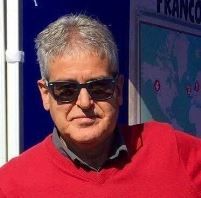
There are not many people like Julián in each of the island's municipalities. His rigor to document himself in each of the facets to which he has dedicated himself, his level of social commitment, his critical character, his generosity, his curiosity, his ease of learning and his multifaceted character in defense of the conservation and recovery of cultural identity have distinguished him as an exemplary citizen.
Now that he has reached his retirement as a worker of the Tías City Council, after more than forty years of service, we review his career inside and outside said institution, where his contributions to the knowledge of local culture distinguish him as a Lanzarote native worthy of special recognition.
Julián Vicente Rodríguez Rodríguez was born in Las Cuestas de Tías in 1959 into a family of 10 brothers and sisters. The entire large family collaborates in the agricultural environment of their home, caring for goats and other domestic animals. From an early age he is interested in learning from the elderly in his environment, grandparents, neighbors. Songs, popular sayings, stories, proverbs, hunches, weather forecasting, signs of the times. From his childhood, his curiosity and restlessness are infinite. The Rancho de Pascua de Tías will link him to all the traditions, he asks the elders, reads a lot, takes notes and begins to collect data, he is interested in all the traditions and also in the divine:
“The Virgin and Saint Joseph set out on the road/and in Mary's womb/ carries the divine word.”
He lived a complicated adolescence due to the last gasps of the Franco regime and its restrictions on meeting and acquiring commitments. His combative and social spirit launches him to heritage rescue. His tireless work to revive customs leads him to investigate the environment and interact with the elderly. He participates in the preparations for social events and in popular festival committees. Prematurely he participates in youth groups that rehearse theater with Candelaria Borges. The parish and the progressive priests who arrive in Tías help the “aperturismo” and facilitate the creation of new associations. Julián was never an altar boy but he moves in all the associative movements close to the church. He participates in the creation of the New Youth Club that promotes theater and poetry. Through this group they manage to create the first public library in Tías installed in the parish halls of the church.
He actively participates in the so-called Junior Movement promoting social activities: walks to the Virgen de Las Nieves, Los Dolores and San Marcial; taking all the elderly in the municipality for taxi rides; helping to create the first neighborhood association; promoting first talks.
After his time at the Arrecife Institute, Julián joined the Tías City Council as a worker in 1982, in the times of the first democratic corporation with Mayor Juan Calero. His first task was to start the Technical Office together with the technical architect Javier Pérez. Openings and building permits were his first functions. Then would come the proposal to create the office of public heritage and historical heritage. In this last section, and selflessly, with the help of Nona Perera, they elaborate a detailed catalog of artistic historical heritage, the first on the municipality of Tías. This catalog includes homes, cisterns, archaeological, ethnographic heritage, ecclesiastical architecture, funerary architecture, economic architecture, educational, cultural and political management architecture. The entire catalog contains the definition of each element, file, photo and sketch.
Julián from the “watchtower” of the Technical Office of the Tías City Council has been a direct witness to the evolution and transformation of the entire municipality, from the agricultural change to the tourism sector, the demographic increase, the construction of the entire coastal area and all the morphological transformation of the towns, as well as the loss of cultural identity. For all these reasons, Julián has maintained a hard battle against oblivion and the loss of values. This commitment has led him for many years to learn different techniques and skills of traditional crafts that he shows and shares in his own home. He has spared no time or resources, his generosity is unlimited and he has fought tirelessly on all fronts, starting by putting his own house, on the Camino de Cho Pilas, at the disposal of all those interested in knowing the heritage, whether they are workshop users, bibliographic consultations or simply contemplate traditional elements such as a taro, farm tools, pots, etc.
In “Cho Pilas”, crafts have become a fundamental element in the rescue of historical heritage: The traditional work of pírgano basketry in Lanzarote; spiral crafts in the work of Fuerteventura rush, comparative essay with Lanzarote; rescue of blacksmith workshops, with a forge and tools of how farm tools were created (hoes, seedlings, etc.); drum workshops: Herreño and Gomero; workshops of toys and figures made in prickly pear; figures for the nativity scene on the occasion of the Christmas dates: mules, virgins, camels, donkeys…; trout workshops to rescue Christmas (trout made of chickpeas, sweet potatoes, rice, pumpkin and sweets); rescue of mistelas and workshops to learn how to make them (recipes for lemon, orange, blackberries and fig leaf); elaboration of bread in a traditional way, flat and unleavened pot bread; process to make gofio (we toast with sand, pass through a sieve and the tasting is finished, without salt, sugars or preservatives).
“La Casa de Cho Pilas” is a kind of craft rescue laboratory and resource center for research. It has a large documentary collection on Canarianisms. Likewise, the documentary funds contributed by the local researcher Carmelo Marín Díaz are also deposited in this house, with more than 40 folders with 19th century contents referring to the surnames Fajardo, Díaz and Monfort. The house, in addition to being a place of illustration, has been an inn and boarding house for restorers, researchers, doctorates and archaeologists from all over the world.
Julián Rodríguez, within his extensive catalog of commitments, has traveled on multiple occasions to all the communal corners, paths, ravines, plains and mountains, sands and badlands. In them he has discovered canals, pylons, engravings, limpet spoons and a long sample of significant elements of the rich heritage. Years of weekend walks, of afternoons with groups of friends to discover and rescue the paths on the volcano. Many hours of dedication with children and adults to value paths, roads and ravines as public heritage. He is a firm defender of the idea that to ensure the conservation of diversity, we must start by making the island's heritage known, discovering and valuing the man-nature relationship over time.
Incalculable has been the work of Julián rescuing all the cultural values of traditions as signs of cultural identity. Julián knows the high risk of losing the idiosyncrasy of the Canarian population in the face of rampant development, he believes it is necessary to act firmly and promote the values of trust, respect and cooperation. One of his
first publications compiled the content of the Popular Festival of Santa, games and songs, edited by the Tías City Council. Julián has an extensive database on popular couplets about the Rancho de Pascua through oral collection, gossip and popular stories; the stories of old Lucas, Pepe el de Julio's notebook and Benigno's.
Julián's commitment to archeology, tireless desire for knowledge and his desire to transmit what our people did in the past, has led him to dedicate much of his life to collecting information, interviewing elderly people, collecting popular knowledge, visiting sites and collaborations in surveys. An important fact in this sense is his intervention in the Fiquinineo site, first avoiding looting and, later, that a schedule of excavations could begin.
Long is the list of presentations, proclamations, articles, prologues and publications of all kinds that have borne his signature, being a regular participant in the Lanzarote-Fuerteventura Study Days, with contributions that appear collected in the publication services of the Cabildos of Lanzarote and Fuerteventura. Julián Rodríguez has participated in a multitude of groups, always fully committed to actions that benefit the entire island society, distributing values that allow the development of human relations. He has had many recognitions, not enough for his worth and sometimes his modesty does not allow it. Based on what has been related in this hasty article, as a consequence of having finished his professional stage, it must be remembered that the Mercedes Medina Díaz Association with the collaboration of Tías Foro por la Identidad, in the 2019 call, registered a dossier with the Island Council with the object of proposing him for the Lanzarote Biosphere Reference Award, an event that has not taken place. It is fair to recognize those who have fought so hard for popular culture and the rescue of popular knowledge, archeology, aboriginal history, weather forecasting, traditional music, documentary sources, the culture of water, the landscape, the deterioration of the territory and above all for teaching us and communicating all his wisdom.
For all this and more. Thank you Julián for so much!
Add La Voz de Lanzarote as a preferred Google source.
Stay informed with the latest current news.