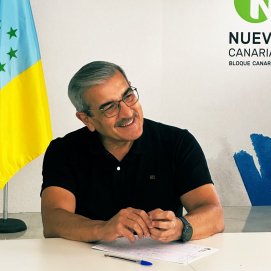
The clear and forceful alignment of the President of the Government of the Canary Islands, Fernando Clavijo, with Morocco's theses regarding the decolonization of the Sahara constitutes a political event of enormous importance for the Canary Islands. Because it breaks with the position that until now the Parliament of the Canary Islands and the majority of the institutions of the islands, as well as the whole of its society, have unanimously maintained, in favor of international legality, demanding the holding of a referendum on self-determination. And for also shattering the common position that Canarian nationalism, in practically all its versions and orientations, has been maintaining in the last fifty years.
In an international context of global instability, with wars in Ukraine and the Middle East, as well as in Africa, it is at least imprudent to take a position contrary to international law and European law itself, as expressed in the recent ruling of the Court of Justice of the European Union on trade agreements on Saharan resources.
Until now, Coalición Canaria, and especially some of its island organizations, had expressed clear support for Saharawi demands, backed by international law. In its electoral program for the regional elections of May 2023, CC highlighted that it would continue "promoting the need to find, within the United Nations, a fair, lasting and mutually acceptable political solution between the parties in accordance with the different UN resolutions."
Clavijo's shift (also that of CC and the Government of the Canary Islands?)
"fully assuming" the position of the state government against the self-determination of the Sahara, as uncritically as it is submissive, has generated deep unease, even within his own party. A shift that recalls that of Felipe González who, after visiting the Saharawi camps in the second half of the seventies, firmly committed himself to the independence of the Sahara, offering his support "until the final victory." And that, after arriving at La Moncloa, he completely forgot his promises. A breach of the duties of what was the colonizing power with the Sahara that would continue the subsequent socialist presidents of the Government, first José Luis Rodríguez Zapatero (who in 2008 already expressed his support for Morocco's autonomy plan) and, more recently, Pedro Sánchez.
UN Resolutions
Two and a half years ago, in March 2022, Pedro Sánchez "officially" modified the traditional Spanish position on this prolonged conflict. We learned this from the content of a letter addressed to Mohamed VI and made public, with interest, by Morocco. In it, the head of the Executive and also Secretary General of the PSOE considered that the Moroccan proposal, presented in 2007, was "the most serious, credible and realistic basis for the resolution" of the conflict. A proposal that bets on a "statute of autonomy for the Sahara region, within the framework of the Kingdom's sovereignty and its national unity."
At that time, Clavijo described Sánchez's change as "surprising and alarming," wondering if the stability of the Canary Islands had been endangered. For his part, the CC spokesperson in Parliament, José Miguel Barragán, demanded that the then President Torres "return to exemplary behavior" and express his explicit support for the Saharawi people. Denouncing that the state PSOE was placing itself against the referendum and assuming Morocco's expansionism.
For my part, I said then the same thing that I reaffirm today. Ensuring that the position expressed by Sánchez in that letter meant abandoning the neutrality maintained by Spain; and that it forgot international law, the UN resolutions that urge holding a referendum on self-determination so that the Saharawi people can freely decide their future. Indicating, also, that the foreign policy of a democracy requires a high consensus. And that it was unacceptable for economic or geostrategic interests to prevail over the laws and rights of peoples.
Highlighting, also, that it was little or nothing presentable to change the Spanish position by a party and a leader who had 120 seats in the Congress of Deputies. Without communicating it to his partner in the coalition government of the time, Unidas Podemos, nor to the main force of the opposition, the PP; nor to the rest of the parties with parliamentary representation. Nor, likewise, to the Government of the Canary Islands, as representative of the territory geographically and emotionally closest to the Sahara.
The Moroccan proposal, transferred to the United Nations in 2007, is for a "statute of autonomy for the Sahara region, within the framework of the Kingdom's sovereignty and its national unity." And it proposes that the statute resulting from the negotiations between the parties be submitted to consultation "by means of a referendum of the populations concerned, in accordance with the principle of self-determination and the provisions of the Charter of the United Nations." It therefore limits self-determination to the autonomy of the Sahara within Morocco, without other options being considered, such as independence.
CJEU Ruling
The Canarian president's about-face comes a few days after the Court of Justice of the European Union (CJEU) made public a ruling annulling the trade agreements signed by the EU with Morocco for the exploitation of agricultural or fishing resources of the Sahara. Stating that "the application of an international agreement between the Union and Morocco in the territory of Western Sahara, as provided for in the agreements in dispute, must obtain the consent of the people of Western Sahara."
With this, the court based in Luxembourg agrees with the Polisario Front, which had denounced these trade agreements, and rules that the agreements were reached without the consent of the Saharawi people. Recognizing, at the same time, the Polisario Front as a legal person with the right to challenge these trade agreements on economic activities carried out in Saharawi territory.
International Legality
From Nueva Canarias we have always defended international legality in this and other matters that affect the nearby Sahara. Recalling that the nature of the conflict is an unfinished decolonization due to the intransigence of the government of Morocco. A decolonization that is under the framework of the United Nations and that, in application of the UN Charter, must be resolved by the recognition of the Right to Self-determination and its exercise through a referendum, free and without coercion.
A referendum where the two options are raised: the acceptance of the sovereignty of the occupying country, Morocco, or independence. Western Sahara has this Right to Self-determination recognized as it was a colony of the Spanish State until 1975. This right of the Saharawi people is included in more than 60 resolutions of the Security Council and the General Assembly of the UN.
Finally, it is worth asking whether Clavijo's visit to Morocco served for anything more than that subordination to the Alawite kingdom in the Sahara conflict. And whether there was also talk of the frequent military maneuvers in the vicinity of the Canary Islands, of the oil explorations near the coasts of Fuerteventura and Lanzarote - and that may affect our environment and our economy - or of the peculiar attempts at unilateral delimitation of its maritime borders, through the approval of two laws, including waters close to Western Sahara and the Canary Islands, part of the latter requested by Spain before the United Nations (UN). Contentious issues that we have with Morocco and that are the issues that should have been addressed in his visit.
To clarify all these issues - as well as that alleged agreement on the return of immigrant minors, as surprising as it is of dubious legality and humanity, and even less practical effect - we have requested his urgent appearance in the Parliament of the Canary Islands.
In Nueva Canarias-Bloque Canarista we regret that CC, confirming its conservative and anti-nationalist drift, abandons the Saharawi people and sides with the occupying force. We continue to think that Spain and the Canary Islands must be in neutrality and respect for international legality from which they should never have left. In continuing to work to ensure that the resolutions of the United Nations are complied with and that a referendum can be held in which belonging to Morocco is an option, but not the only way out, a forced imposition without listening to the voice of the affected people. We continue to believe that it is the Saharawi men and women who have the last word, who must freely and democratically decide their destiny.
Add La Voz de Lanzarote as a preferred Google source.
Stay informed with the latest current news.