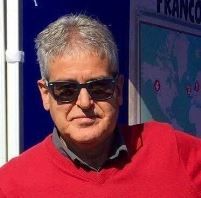
Mácher gains a cultural reference with the discovery of the bust of the distinguished teacher who, in a short period of stay, in the early sixties, knew how to connect with parents and students to make them jump the barrier of primary studies and choose to go to secondary education in Arrecife and later access university studies. In the first decades of the 20th century, illiteracy rates were close to 70%. In the islands of Señorío, the landowners did not look favorably on the children of sharecroppers accessing studies because it restricted the number of laborers for their lands. Therefore, the teacher's task was not easy: to convince parents and the students themselves that they had easy access to the labor market. José María Espino was born in Guatiza, the son of a shoemaker, and completed his secondary education with great effort. In the first year, he went down by bicycle to the secondary education center in the 1947 course, located in El Charco, and his return was made by putting the bicycle in a body shop of a truck.
From Don José's stay in Mácher, in the sixties, came a large number of university professionals and qualified workers from all fields. Doctors, lawyers, teachers, pharmacists, bank employees, police officers, postmen, businessmen. Don José María Espino González, after his change of destination, went on to be a scholarship holder and study Language and Literature at the University of La Laguna where he obtained the number one in his promotion. He returns to Lanzarote and continues to be linked to education. He joins the Benito Méndez school, in Titerroy, is part of a prestigious private academy and will be one of the promoters of the Associated Center of the University at a Distance, where he serves as professor and director for more than 30 years.
His political journey began as a constituent Deputy of the Canary Islands Board, prior to the creation of the Autonomous Community. He served as mayor of Arrecife in the period 1983-1995. He was also a Councilor of the Island Council of Lanzarote. As mayor of Arrecife, in the democratic period, he has been the mayor who has remained in office the longest. During his term, major structural works were carried out for the capital and were never sufficiently recognized. He carried out the works for the construction of the Arrecife Town Hall. He approved the General Plan of Arrecife in 1991 and executed the Neighborhood Plan to bring water, electricity and sewerage, creation of Socio-Cultural Centers. Youth House culmination of the Medular Via, an important artery for the city. He executed the pedestrianization of the entire Ribera del Charco and the works to "elongate" the Charco to Calle Real. It can be said that in his period as mayor, Arrecife began its modernization of the third capital of the Canary Islands.
Pepe Espino, despite his many occupations, never forgot Mácher and his former students. Close, affable and very correct in his treatment, we sporadically maintained meetings with the teacher to have some snacks and share the events of this large group, who stopped being students of the teacher and went on to cultivate a lasting friendship of more than sixty years. The last meeting took place just a month before his death. On August 21, he made his last visit to the school groups of Mácher, chatting and taking an interest in the lives of his former students. It was an emotional meeting full of greetings and hugs foreshadowing the imminent farewell. The teacher was pleasantly pleased to share with all of his former students and we are all proud of his work and of having contributed to his "return" and that his bust represents a permanent tribute in a place of reference for the town, in the public square of Mácher, next to the church of San Pedro.
Thanks and congratulations to all the people, to their former students, to the town hall of Tías, in particular to the Mayor, the Councilor of Culture and to the author of the magnificent work of art, the artist Cintia Machín Morín.
Mácher April 29, 2024.
Juan Cruz Sepúlveda
Add La Voz de Lanzarote as a preferred Google source.
Stay informed with the latest current news.