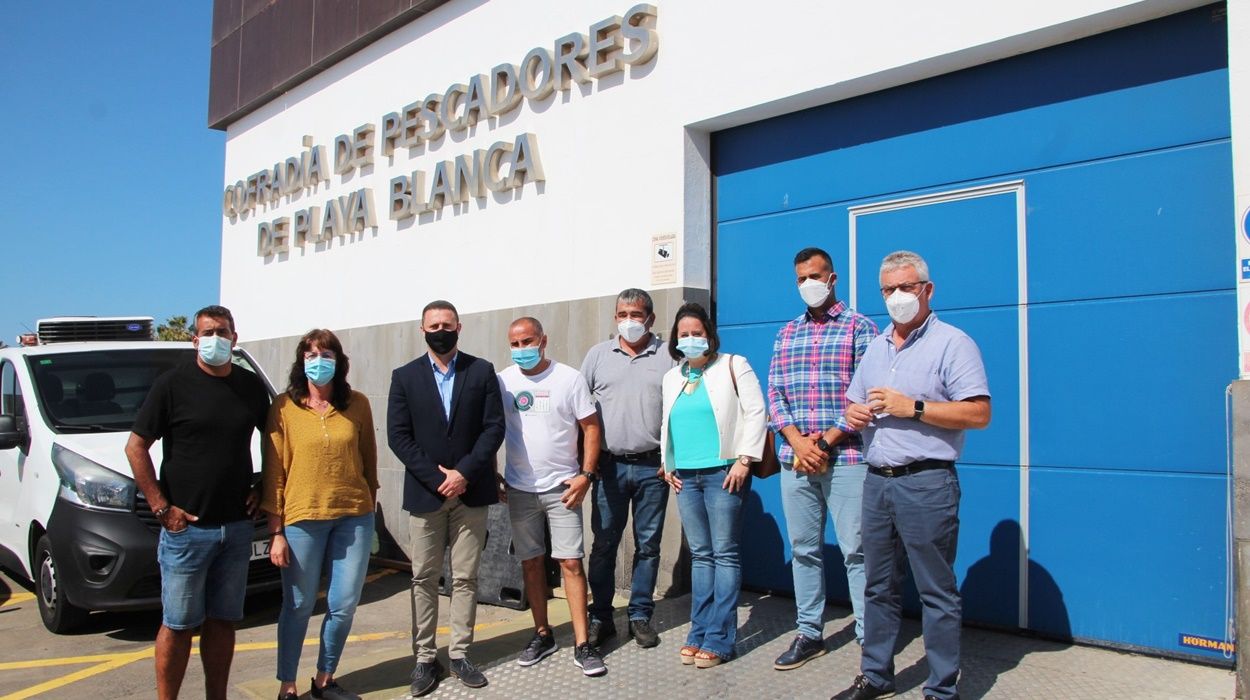
Although the coast of Yaiza is not directly affected by the detailed regulation published on March 1 by the Government of the Canary Islands on the ZIA LZ2 Aquaculture Interest Zone, which allows the installation of marine cages on the coast of Arrecife, San Bartolomé and the neighboring municipality of Tías, the City Council presided over by Óscar Noda has made available to the fishermen's associations of the Island and the institutions of Lanzarote all the environmental studies commissioned at the time by Yaiza as well as its legal experience in the fight it maintains against the cages authorized in Playa Quemada and those that were intended to be installed in Playa Blanca.
"Word of mouth support is not enough, we are in solidarity with the affected municipalities and we have given the guilds the detailed technical reports commissioned by Yaiza so that the island's fishing sector and institutions can reinforce their allegations," said the southern mayor when leaving Wednesday's meeting with representatives of the guilds in Playa Blanca.
The meeting was attended by a representation of the sailors formed by the skipper of the Playa Blanca Guild, Cristo Caraballo, the vice-skipper of La Tiñosa, Hopólito Cuadrado, and the legal team that on behalf of the four guilds of Lanzarote will present this Thursday a motion for reconsideration against said regulation as a preliminary step to a possible litigation before the Justice.
The mayor of Yaiza was accompanied by the first lieutenant, Ángel Domínguez, the councilor of the Primary Sector, Emilio Machín, and the councilor of the Environment, Águeda Cedrés. The guilds, who thanked Yaiza for their support, argue that "the little work that aquaculture can provide does not compensate for the destruction of hundreds of jobs in fishing and the damage that cages cause to the environment and the tourism sector. The cages destroy the seabed and the species in the environment”.
"Clear signs of contamination"
To respond to the complaints of the residents of Playa Quemada and the concerns of the Administration, in 2016 Yaiza commissioned an investigation to the company Elittoral, later updated in 2017, on the quality of the marine-coastal environment of the Playa Quemada environment and possible effects on the beach. According to the City Council, the studies show that the organic matter in the sediment has a tendency to increase, tripling in five years, warning of the appearance and increase of polychaetes, an organism that is related to organic contamination. “This shows that there are more than clear signs of contamination”, said “Óscar Noda”.
The City Council asked the Government of the Canary Islands for a thorough inspection of the facilities in order to define the maximum capacity they were occupying, their limits and the activity actually carried out. Likewise, taking into account that the current activity (cultivation of sea bass and sea bream) differs from the one initially approved (fattening and greasing of tuna), Yaiza explained to the regional Executive the need to carry out a new environmental procedure on the aquaculture activity.
This request was based on the impoverishment of the environmental quality detected in the seabed located north of the concession, near Playa Quemada. As a consequence of this and other extremes, the City Council also requested the revision of the suitability of the Surveillance Program of the Playa Quemada cages and demanded a copy of the reports related to the hydrodynamic conditions of the location area of the aquaculture facility in the municipality, the result of the “Technical Assistance for the analysis of the sections of coast between Playa San Juan and Punta El Becerro (Tenerife), and Punta del Garajao to La Puntilla (Lanzarote), to assess its suitability as areas of interest for aquaculture”, published in 2010 by the Vice-Ministry of Fisheries of the Autonomous Community.
“There were and still are many efforts by Yaiza, although we sincerely miss the strong support of the administrations of the Island, starting with the Island Council. In any case, the important thing is that all this experience contributed serves to help defend the interests of Lanzarote, and that is that from Yaiza we are very clear that everyone, absolutely everyone, has to pull the cart in the same direction,” said Óscar Noda, who at the time was the councilor responsible for the Yaiza Environment Department.
Background
In 2014, Yaiza presented allegations to the Provisional Approval of the Regional Aquaculture Management Plan (PROAC), with which it sent a technical report regarding the negative environmental impacts of aquaculture, while in 2015 it requested the Vice-Ministry of Fisheries to include indicators for monitoring the adverse effects derived from the application of the future PROAC.
Yaiza, and specifically the coastal town of Playa Quemada, has suffered the consequences of aquaculture and the effect it produces on its coasts. What initially, in 2001, were going to be 10 floating cages for tuna farming, ended up becoming 25 cages of 25 meters in diameter each for sea bass and sea bream farming. Its installation and cultivation in 2012 caused that, almost as an immediate effect, in 2013, the residents of Playa Quemada noticed the impact on their waters, which gradually took on a cloudy tone, also observing the arrival on the coast of remains of oils and feed", they point out from the Consistory.
In this regard, they point out that "for years it seems that the number of cages exceeds the maximum permitted capacity, which is 31, without certainty of the action of the surveillance plan". The City Council not only presented allegations, but also convened meetings and sought the support of groups since the concern of Playa Quemada was joined by Playa Blanca. “A lot of media noise but little effective support,” recalled the mayor.
In 2013, the concession procedure was initiated for eight marine cages off the coast of Playa Blanca for the cultivation of sea bass and sea bream. Hand in hand and advised by the Playa Blanca Fishermen's Association, meetings were initiated to paralyze the concession, whose granting has not yet been consummated.
From the southern City Council they initiate that "the experts in this matter, the fishermen, consider the sea bass a predator of other species, harmful to the seabed and to the ecosystem, generating a harmful effect for the breeding of native species, in addition to the economic impact that it entails for a sector in need of support such as fishing".
“Since then, the inhabitants of Lanzarote have verified the effects that aquaculture causes on our coasts, and whoever has regularly visited Playa Quemada, will have verified it without the need for large studies, so here is Yaiza to lend a hand,” concluded the mayor.
Add La Voz de Lanzarote as a preferred Google source.
Stay informed with the latest current news.