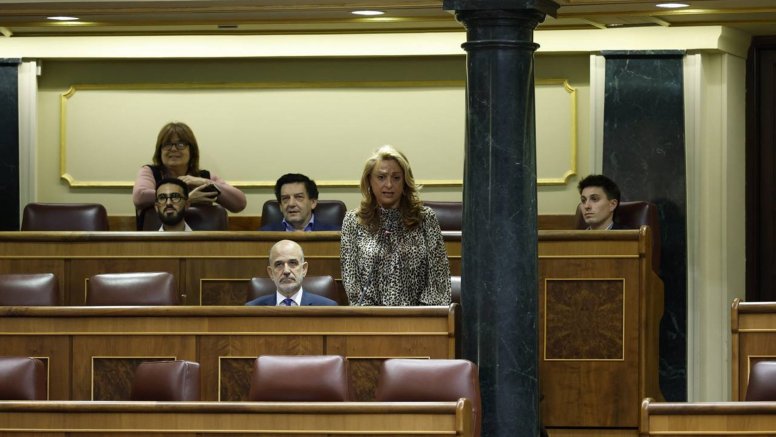
The spokesperson for Coalición Canaria in the Congress of Deputies, Cristina Valido, has called on the Minister of Culture, Ernest Urtasun, to intercede in the Council of Ministers to end the "situations of discrimination" faced by Canary Islands artists. In her question during the government control session, Valido referred to the high costs that creators from the Archipelago must face to export their work outside the islands and the lack of exposure for Canary Islands artists in the headquarters of the Cervantes Institute, for which she has demanded equal treatment compared to the rest of the State.
Cristina Valido began her statement by alluding to a series of responses from the Ministry of Culture in which unfair treatment of Canary Islands creators was denied, so she asked Urtasun if he believes that "as your Ministry has answered me, Canary Islands artists do not suffer from discrimination and have the same opportunities as creators from the mainland."
Valido has taken advantage of the "outstretched hand" offered by the Minister of Culture in his response to this first question to provide two examples of the marginalization suffered by Canary Islands artists, which require the intervention of the central government.
Thus, the spokesperson for Coalición Canaria referred to the case of the Cervantes Institute, in which, according to Valido, artists from the islands "are not programmed" in any of the 85 locations it has on five continents. "Furthermore," she elaborated, "when they arrive in any of these cities by their own means, they do not have the possibility to contact, nor support, nor collaboration."
In this regard, Urtasun stated that he has "no problem discussing this issue" with the director of the institution and expressed his "conviction that we can give greater projection to Canary Islands artists, if necessary, within the Instituto Cervantes network."The Canary Islands nationalist deputy also spoke about the high costs that cultural creators from the Archipelago must face to export their work outside the islands. "How many thousands of euros do you think a Canary Islands artist needs to have in their pocket to take their work off the islands?" she asked Urtasun directly.
Valido has detailed that local artists must "face customs, insurance, and transport costs" to be "on the same starting line as any other artist from any other autonomous community". "This makes it impossible for people without resources to disseminate their work," she lamented.
The CC parliamentarian reminded Urtasun that his own ministry sponsors an event in the Canary Islands that addresses mobility and taxation, for which "they recognize this situation and this problem." Therefore, the spokesperson expressed "surprise" at the Ministry's responses to her written questions, which state that discrimination against island artists "does not exist."
The Canary Islands Coalition deputy emphasized that the Parliament of the Canary Islands recently approved a non-binding proposal —“with the support of all groups in the chamber, except Vox”— so that “our Economic and Fiscal Regime, our Ultra-peripheral Region status are recognized and respected, and that all the measures that the Canary Islands cultural industry needs are applied”.
For all these reasons, he has urged the minister to intercede before the Council of Ministers to "end this situation," since "Canarian creators are of equal quality and have equal rights to creators from any other autonomous community." "Equal visibility, equal respect, equal rights, and equal mobility for Canarian cultural creation as in the rest of the State," Valido concluded.
Add La Voz de Lanzarote as a preferred Google source.
Stay informed with the latest current news.