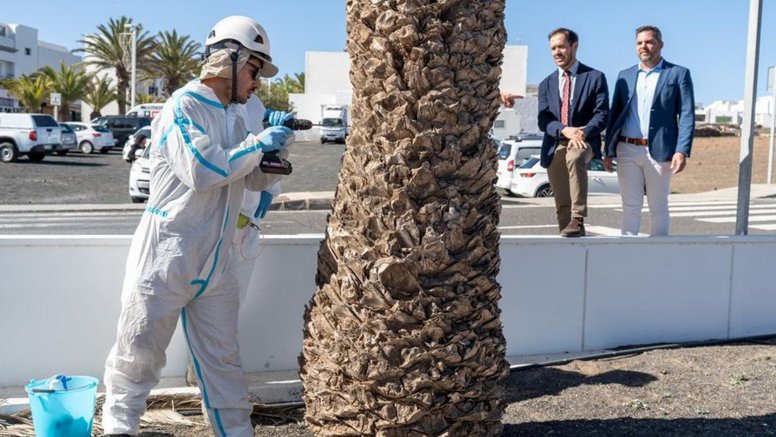
The control plan for Diocalandra frumenti in Lanzarote has continued to advance during 2025 in line with the set objectives, consolidating the work initiated in September 2023. This project is being developed within the framework of the cooperation agreement between the Ministry of Ecological Transition and Energy of the Government of the Canary Islands and the Island Council of Lanzarote.
During this year, 20,372 palm trees have been surveyed and inspected, which, added to the actions carried out since the start of the project, bring the total to 80,666 palm trees checked in Lanzarote and La Graciosa.
The Minister of Ecological Transition and Energy of the Canary Islands Government, Mariano H. Zapata, highlighted that "this plan demonstrates that, when there is institutional coordination and a clear strategy, it is possible to face serious threats to our natural heritage. We are protecting a key element of the Canarian landscape, but also a symbol of cultural and economic identity for Lanzarote".
Zapata also emphasized that "the control of this plague is not limited to the application of treatments, but incorporates training, dissemination, and social participation, which guarantees a more effective and sustainable long-term response."For his part, the president of the Cabildo of Lanzarote, Oswaldo Betancort, pointed out that "the fight against *Diocalandra frumenti* is a priority for this island, because it directly affects our landscape, our traditions, and sectors linked to the palm tree." In this regard, he added that "collaboration with the Government of the Canary Islands has been fundamental to progress with technical rigor and visible results."
To reduce the impact of the plague, phytosanitary treatments through endotherapy and spraying have been carried out, reaching 8,915 applications in 2025 and a cumulative total of 10,878 since the end of 2024. Likewise, traps with attractants have been installed in treated palm trees, distributed at different points on the island, whose initial results reflect a significant decrease in adult captures.
In parallel, during the first semester of 2025, working meetings were held with municipal representatives and technicians from all the town councils of Lanzarote, with the aim of sharing progress, identifying problems, and strengthening coordination between administrations.
The project also incorporates a significant training and awareness component. Throughout 2025, secondary schools, vocational training centers, companies specializing in palm tree management, and neighborhood associations have participated in these activities. Among the most notable activities is the technical workshop on palm trees held in July, where researchers and professionals discussed the latest advances in palm tree management and their relationship with climate change in the Canary Islands.
Likewise, specific actions have been developed related to obtaining palm hearts for artisanal purposes, carried out in a manner compatible with the control plan and in coordination with the Industry and Crafts department of the Cabildo de Lanzarote, thus guaranteeing the preservation of this tradition
The plague of Diocalandra frumenti has become one of the most serious threats to the survival of palm trees in the Canary Islands, affecting almost half of the palm trees on the island of Lanzarote. The plan, executed by the public company GMR Canarias, reinforces the joint commitment of the Government of the Canary Islands and the Cabildo of Lanzarote to the protection of the natural environment, the conservation of the landscape and cultural heritage, and the training of the local community, integrating scientific knowledge, environmental management, and citizen participation to ensure the future sustainability of the island's palm trees.
Add La Voz de Lanzarote as a preferred Google source.
Stay informed with the latest current news.