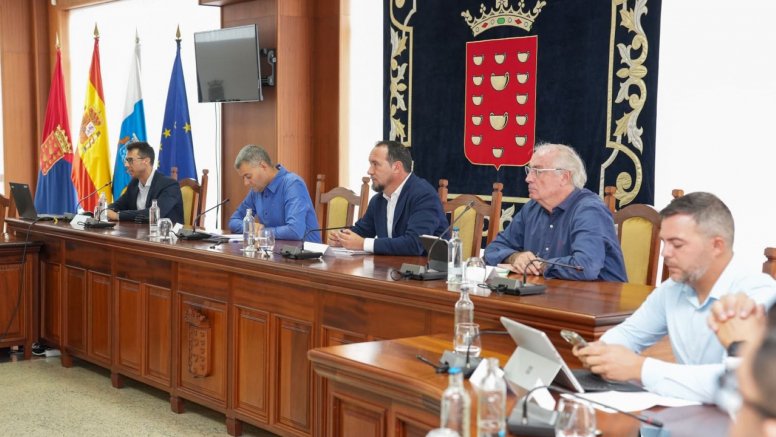
The Plenary Hall of the Cabildo de Lanzarote hosted this Tuesday the celebration of the Island Rain Table, a crucial technical summit to analyze the coordination mechanisms and response capacity to possible adverse weather events, organized by the Consortium of Security and Emergencies of Lanzarote.
The meeting served to review prevention and intervention protocols, highlighting the preparedness and operational resources of the Lanzarote Safety and Emergency Consortium.
The meeting was attended by the president of the Security and Emergency Consortium, Francisco J. Aparicio; the Deputy Minister of Water and Emergencies of the Government of the Canary Islands, Marcos Lorenzo; the General Director of Emergencies, Fernando Figuereo; and the territorial delegate of the State Meteorological Agency (AEMET) in the Canary Islands, as well as representatives of all the consortium members.
```html
```
During the session, the AEMET delegate presented a detailed analysis of the specific atmospheric mechanisms that affect the Island Territory of Lanzarote, such as the Foehn Effect and the Convergence phenomenon. The role of phenomena such as the Trade Winds and the DANA in the island's climatology was also reviewed.
Crucially, the color-code system for the Adverse Weather Event Warning (FMA) was reviewed. In this sense, Orange Level is identified when there is a significant risk derived from unusual weather phenomena that pose a certain degree of danger to common activities. For its part, Red Level indicates that the risk is extreme, caused by high-intensity weather phenomena and with an exceptional danger to the population.
Incessant work during torrential rains
The Island Council has highlighted the essential role played by the Lanzarote Fire Department in managing flood emergencies last April. The Consortium's operational capacity focuses on pumping interventions and vital maintenance services during floods, especially in sensitive locations such as the Molina Orosa Hospital, in addition to providing key support to the Advanced Command Posts (ACP) for coordinated and effective emergency management.
For these tasks, the Fire Department is equipped with specialized resources, with a total of 18 operational vehicles and specific equipment for floods, including two transport and drainage vehicles (BUL type), six portable drainage units, and a High-Capacity Drainage Pump (BAGC).
The president of the Security and Emergency Consortium, Francisco J. Aparicio, highlighted the importance of inter-institutional coordination "for island security." "The Rain Table is a fundamental forum to guarantee that all the links in the emergency chain are perfectly meshed. Prevention and rapid response are crucial," Aparicio stated.
"We have assessed the deployment of the Fire Department, which is equipped with specialized resources and has the necessary training to act immediately in the affected areas, minimizing the impact of intense rainfall events on the island," he concluded.
The Deputy Minister of Water and Emergencies, Marcos Lorenzo, stated for his part that the Cabildo of Lanzarote "performs a fundamental task in the prevention of floods. From the Government of the Canary Islands, we believe that commissions such as the one held today are key to improving coordination and response to emergency situations, since they allow all the agents involved to sit at the same table and adopt effective measures in advance. In addition, the Government of the Canary Islands collaborates by providing resources and funding so that island corporations can execute works that are essential to reduce risks." "We must not forget that, in terms of emergencies, foresight and time are essential," he asserted.
Add La Voz de Lanzarote as a preferred Google source.
Stay informed with the latest current news.