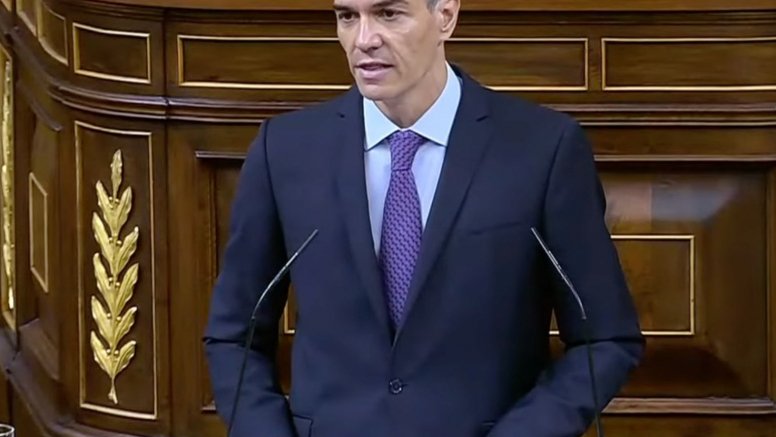
The Government of Spain has made public its State Plan to Fight Corruption, which was announced by the President of the Spanish Executive, Pedro Sánchez, this Wednesday in the Congress of Deputies.
This announcement was made in a monographic plenary session in the Lower House about the Koldo case, where the different political parties have debated the alleged involvement of the former Secretary of Organization of the PSOE, Santos Cerdán, in this alleged plot.
"Corruption is one of the greatest scourges facing democratic societies," begins the document presented by La Moncloa. The elaboration of this state plan was formed with the recommendations of the Group of States against Corruption of the Council of Europe, the OECD and the European Commission and consists of five axes.
These axes are the prevention of corruption, the effective protection of whistleblowers, the search for an effective response in cases already detected, the recovery of assets from such corruption and the promotion of an anti-corruption culture in society.
The fifteen measures, in detail
Among the fifteen measures of this Plan, the Government of Spain has announced the creation of the Independent Public Integrity Agency, which will serve as a body for the prevention, supervision and prosecution of corruption. It aims to unite "the powers of several state agencies" and coordinate actions. This agency could have the capacity to initiate investigations, supervise compliance with key regulations and protect corruption informants.
The second measure proposes extending the use of integrity risk maps to all public funds. These maps already work with the Next Generation European funds and are aligned with the OECD Public Integrity Framework methodology. The Executive proposes as a novelty that the analysis of human risks be incorporated, where "psychological factors and cognitive biases" that can "influence individual decisions" are analyzed to promote "safer, more transparent and responsible decision-making environments."
Thirdly, it wants to promote the Open Administration Law, which incorporates the conclusions of the Open Government Forum, so that the State Transparency Portal reports on contracts, agreements and subsidies, but also on staff remuneration, declarations of assets and the institutional agenda of senior officials. In addition, it seeks to promote accountability and how its breaches will be sanctioned through coercive fines.
Among the proposals to achieve an open administration, it proposes including additional random examinations that report on the asset situation of senior officials each year and throughout their term of office.
To which are added mechanisms of direct citizen participation to be part of the public audit processes, where citizens can submit evaluation reports, complaints or suggestions in tenders, awards or contractual executions.
Fourth, it wants to transform the Public Sector Procurement Platform with open source code (big data) and Artificial Intelligence to carry out "large-scale audits" and facilitate the detection of possible fraud.
In fifth position, it proposes the urgent approval of the Draft Law on Transparency and Integrity in the Activities of Interest Groups, as well as expanding its requirements. This measure seeks to create a register of interest groups and how they influence the elaboration of laws and regulations. It even contemplates including meetings held by "lobbyists", that is, representatives of lobbies that seek to influence the political class or technicians.
A more exhaustive control over the financing of the parties
Sixth, this plan contemplates reinforcing the control over the financing and the economic activity of the political parties. So that, those parties and their foundations that receive more than 50,000 euros must contract an external and independent audit of their accounts, with entities that are authorized and registered in the Official Register of Account Auditors.
Likewise, political parties must expand the public information on the donations they receive, which must be published no later than one month after receiving them and must publish all individual donations that exceed 2,500 euros, compared to the 25,000 euros that were allowed until now. They must also publish the donations or sources of financing that pay for the electoral campaigns, before the start of the campaign or the day after their reception if it is during the campaign.
In the seventh point, it seeks to reinforce the guarantees of protection for whistleblowers of corruption and improve the effectiveness of the reporting channels. The objective is to improve the independence, accessibility and effective protection of people who report to avoid possible reprisals. In addition, a specific allocation will be assigned in the public budgets that contemplates the number of protected people.
The eighth point seeks to reinforce the capacity of the Public Prosecutor's Office and the Judiciary to investigate, judge and punish corruption effectively. In this sense, it seeks to create anti-corruption sections and crimes against the Public Administration in the new courts of Instance. Thus, reinforce the Anti-Corruption Prosecutor's Office with more resources and attribute to the Public Prosecutor's Office the instruction of criminal proceedings, providing it with "greater autonomy and transparency."
In addition, the Government will grant "preferential status" to cases against public officials and will extend the statute of limitations for crimes. In this way, it will be possible to quickly determine "the guilt or innocence of the public official."
The ninth point pursues control and sanction mechanisms against corrupt companies. "It is not enough to prosecute those who, from the public sector, violate the law. It is also necessary to act against companies and private actors that design, participate and promote these practices," the document adds.
In this case, it proposes three measures: stricter sanctions against corrupt companies, the creation of a blacklist that allows excluding a company from contracting with the administration if it is definitively convicted of corruption, fraud, bribery or money laundering, as well as preventing it from obtaining public subsidies and creating anti-corruption mechanisms or periodic audits for those that have been previously convicted.
The tenth measure proposes stricter punishments and the adoption of new measures against corruption and other crimes against the Public Administration. So that it wants to harden the Penal Code to harden and adopt new measures.
In eleventh place, it proposes reinforcing the Asset Recovery and Management Office (ORGA), which assists the justice system in locating profits that come from corruption. Among other functions, it investigates the assets and manages the seized, confiscated or forfeited assets.
In twelfth position, it exposes the need to create the figure of administrative or preventive confiscation that allows the confiscation of assets without prior conviction in the case of actions or criminal proceedings.
Finally, the last three measures propose creating an anti-corruption culture, of citizen, administrative and business integrity. Among them, it considers the creation of mandatory training programs and dissemination of good practices, the organization of a social campaign to strengthen awareness against corruption and an annual survey on the perception of corruption.
Add La Voz de Lanzarote as a preferred Google source.
Stay informed with the latest current news.