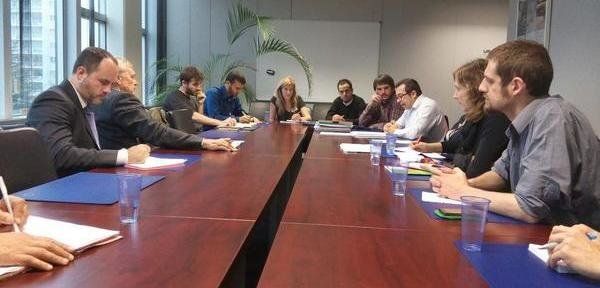
The Directorate General for the Environment of the European Commission will initiate "a thorough investigation into the authorizations granted to Repsol by the Government of Spain to carry out prospecting in the Canary Islands." This was announced by the Cabildo of Lanzarote, after the meetings that the Director General of the Environment, Kart Falkenberg, held this Monday with three technicians, six MEPs and representatives of citizen groups who presented the most important reasons for demanding the urgent halt of prospecting in the Canary Islands.
The two meetings, which lasted for four hours, have different origins but have converged in time by decision of the European authorities, as they deal with the same subject, since in both cases the intervention of the European Commission has been requested to investigate both the legality of the authorizations and the operations that the oil company plans to carry out off the islands of Lanzarote and Fuerteventura.
The first meeting took place between the Director General of the Environment and the head of the Global Action Office of the Cabildo of Lanzarote (OAG), Ezequiel Navío, who gave a presentation listing the most important reasons that justify the intervention of Europe to stop Repsol's surveys. MEPs from three of the four major political groups in the European Parliament actively involved against the prospecting (Social Democrats, Liberal Democrats, United Left, and The Greens) were present at this meeting, such as Pablo Echenique (Podemos), Juan Fernando López Aguilar (Spanish Socialist Workers' Party), Marina Albiol and Ángela Vallina (United Left) and Ernest Urtasun (Iniciativa per Catalunya Verds), who intervened to demand that the Director General intervene by the European Commission in this matter.
Risk of spills and impacts on biodiversity
The second meeting with the senior official of the European Commission was led by the university professor of Marine Conservation at the University of Alaska, Richard Steiner, and the marine biologist from the University of La Laguna and expert in cetaceans Natacha Aguilar, who documented the probabilities of risk of spills and the impacts on biodiversity, respectively. Elena Solís and Pedro Hernández, advisors to the Cabildo of Fuerteventura and petitioners of the complaint before the Petitions Committee, attended this meeting and highlighted the differences in criteria that the Spanish State applies to suspend or authorize oil prospecting in waters of the different autonomous communities.
The Cabildo of Lanzarote gave the Director General a detailed report with all the arguments and more than 60 technical documents to document the criteria against the surveys, a document that Falkernberg has promised to study urgently. Richard Steiner, Natacha Aguilar and Pedro Hernández provided documents on the impacts and risk indices for evaluation by the Commission.
According to the Cabildo, the Director General of the Environment showed "his concern" about this matter and accepted the OAG's request to designate a work team to evaluate "immediately and as a priority" the documentation provided. During the meetings with Falkernberg, the threats of oil operations to the most vital interests of the islands' population were exposed, such as the possible impact on access to drinking water, the impacts on tourism and fisheries, the damage to biodiversity that is recognized as unique in the European Union, and the different community regulations that Spain may have violated to give the green light to the oil company.
Add La Voz de Lanzarote as a preferred Google source.
Stay informed with the latest current news.