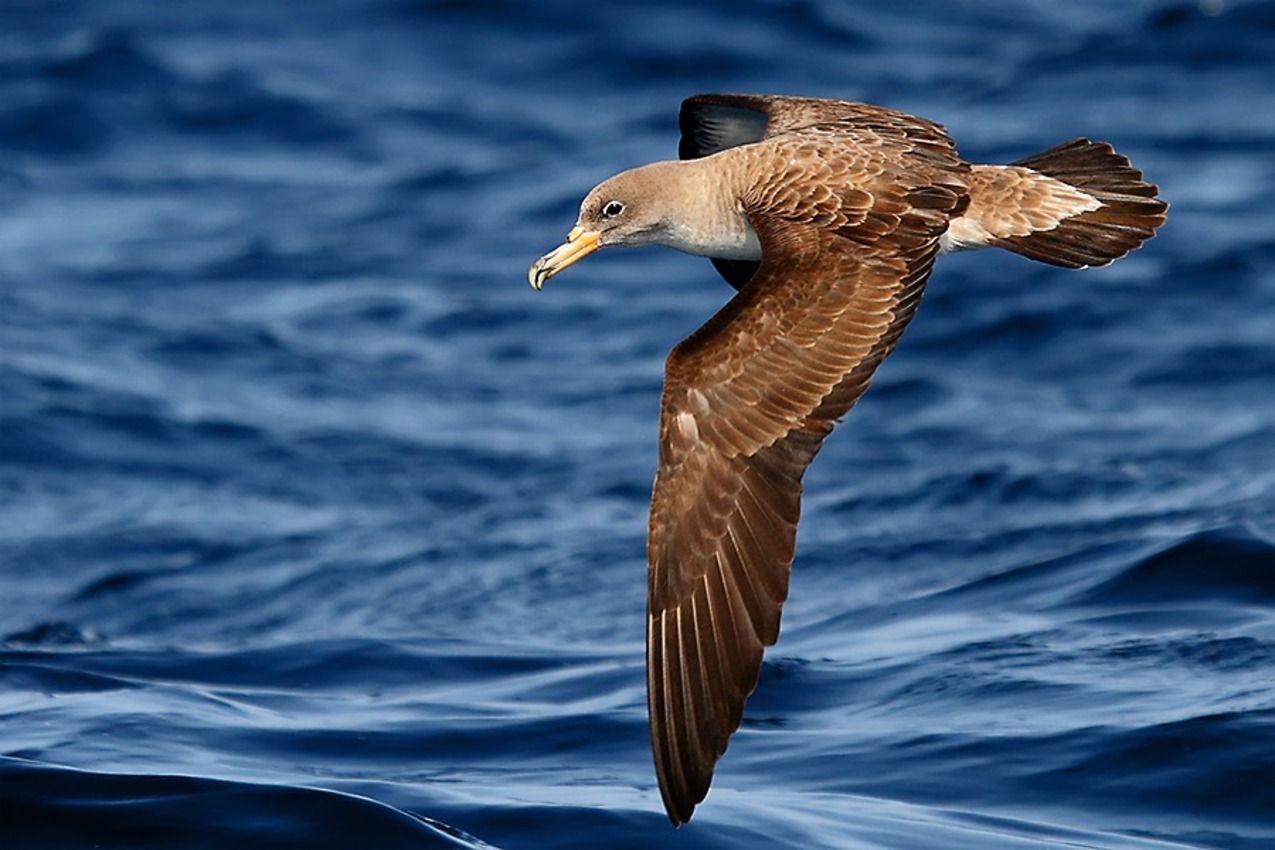
The Atlantic shearwater (Calonectris borealis), a seabird that nests in Portugal and Spain, is a key species that can be used in the North Atlantic as a bioindicator of marine litter, specifically plastics, according to an international scientific study.
Researchers from the University of La Laguna have participated in this scientific work, published in the journal Environment International, which specifies that a bioindicator is a species that provides information on the state of the environment in relation to a pollutant of human origin, in this case, the small pieces of plastic that float in the oceans, usually the result of the degradation of larger objects.
After more than 1,200 necropsies of juvenile and adult shearwaters from the Azores and Canary Islands - whose causes of death were natural or accidental - it was found that more than 90% of the juveniles already contain plastic particles in their stomachs when they leave the nest.
This is one of the highest values found compared to other shearwater species from other regions, the University of La Laguna said on Wednesday.
The fact that these juveniles contain plastics in their stomachs, even before feeding, indicates that this material is ingested during the feeding process by the parents, during their growth in the nesting areas.
After analyzing the data obtained, the essential parameters were defined to determine the potential of this bioindicator.
This work was led by the Okeanos Institute of the University of the Azores with several international collaborations, including the Research Group in Applied Analytical Chemistry of the University of La Laguna, led by Professor Javier Hernández-Borges, who worked on the identification of the composition of the plastics ingested by the birds.
One of the most relevant data obtained is the establishment of a limit value to define the 'good environmental status' in relation to the number of plastic particles found, in such a way that values above the established limit indicate the need to control and mitigate this pollutant in the environment.
This will provide information to support regional, national and international political action in areas of the North Atlantic that currently lack an effective bioindicator species to monitor pollution by plastic particles in the oceans.
The team that participated in this study emphasizes that no invasive practices were used to collect the data, since the juvenile Cory's shearwaters are affected by light pollution from urban areas during their first flights from the nest to the sea.
This visual impact causes them to become disoriented and end up falling to the ground, which forces them to be rescued through public conservation campaigns.
Despite the efforts made in these campaigns, not all survive and these were the main animals used to collect data for this study.
“The juveniles victimized by light pollution offer a non-invasive and easily accessible sample, which makes them scientifically useful for marine litter monitoring programs, launched by several autonomous regions of Portugal and Spain, within the framework of European policies, in particular the Marine Strategy Framework Directive”, explains Christopher Pham of the Okeanos Institute, supervisor of the study.
Given that the production and use of plastics continues to grow exponentially, and that measures to manage this material after its use remain deficient, it is foreseeable that the environmental problem of plastics that are introduced into marine ecosystems will continue to increase.
This requires constant monitoring and the application of more forceful measures, according to the main author of this publication, Yasmina Rodríguez, also a researcher at the Okeanos Institute, who completed her initial studies at the University of La Laguna.
“Although different species have recently been proposed as bioindicators of marine plastics in the ocean, until now very few have been based on such exhaustive analyses that allow their effective acceptance”, explains the researcher.
Until now, only the northern fulmar (Fulmarus glacialis) has been used as a bioindicator of floating marine debris in the North Atlantic.
It is a seabird related to the Cory's shearwater, but whose distribution does not cover the seas of southern Europe.
This study, which was carried out over ten years, has filled an important gap in ocean monitoring by allowing the identification of the Cory's shearwater as a good bioindicator of marine plastics and controlling anthropogenic pressure in marine regions beyond the distribution area of that other boreal species.
One of the conclusions is that, while juvenile shearwaters from the Azores will allow monitoring changes in the composition of floating plastic in the North Atlantic Subtropical Gyre, mainly from the coasts of Central and North America, shearwaters from the Canary Islands will be able to monitor litter from the fishing grounds on the northwest coast of the African continent.
Long-term monitoring of juvenile shearwaters in the Azores and Canary Islands will turn these archipelagos into true environmental observatories, adds the educational center.
Add La Voz de Lanzarote as a preferred Google source.
Stay informed with the latest current news.