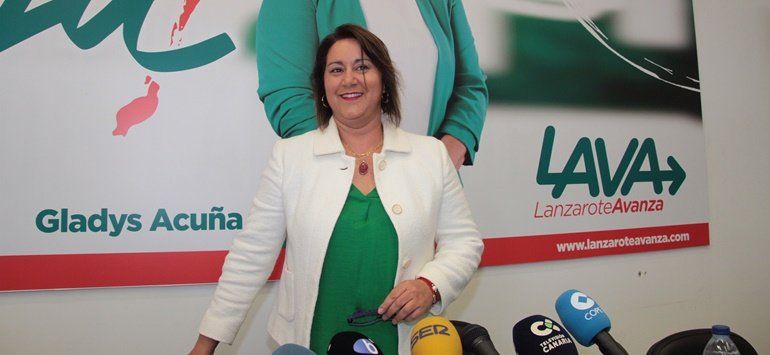
The Constitutional Court has rejected this Thursday the appeal presented by Gladys Acuña, thus confirming that she will not be able to run in the next local and regional elections. According to sources at La Voz from the Court, the Chamber understood that this appeal is "extemporaneous" as it was presented out of time, so it has issued a provision agreeing not to even admit it for processing.
The former mayor of Yaiza had also seen the two appeals she filed with the Contentious-Administrative Court rejected of Las Palmas de Gran Canaria, in an attempt to annul the decision adopted by the Provincial Electoral Board. In that resolution, which was endorsed by the Court, the Board concluded that Acuña's candidacies to the Cabildo with Lanzarote Avanza and to the Parliament with Coalición Canaria were illegal, given that she is subject to a disqualification sentence for a crime of urban planning malfeasance and another of malfeasance by omission in the Stratvs case.
"They are criminalizing me and our political project," Gladys Acuña questioned when announcing both appeals before the Court and her intention to go to the Constitutional Court, which is the one that has now closed the last avenue left to try to save her candidacies. In them, the former mayor argued that her disqualification is only to occupy a municipal position -which was from where the crimes for which she was convicted in the first instance were committed-, and that therefore she could run for the Cabildo and the Parliament. However, both the Electoral Board and the Court have applied the doctrine that the Supreme Court has recently established, in a judgment referring to the politician from Majorca, Domingo González Arroyo.
"Contemporary society demands that jobs and public positions of basic representation cannot be occupied by subjects who have been subject to special disqualification after a criminal conviction, regardless of the area of public administration in which the commission of the crime had taken place", that ruling stated.
Regarding the fact that the Stratvs sentence is not yet final, it should be remembered that current legislation obliges people convicted of crimes against the public administration to leave their positions from the moment the first instance ruling is issued. In fact, that is what forced Acuña to leave the Mayor's Office when the sentence of the Stratvs case was known, in which she was convicted along with seven other people.