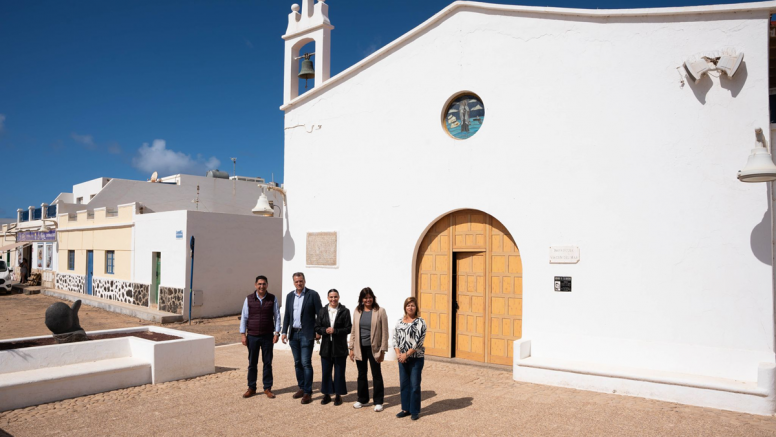
The Government of the Canary Islands, through the Ministry of Universities, Science and Innovation and Culture, continues to advance in the protection of historical heritage with actions aimed at its conservation and enhancement. Within this strategy, the Minister Migdalia Machín, accompanied by the Councilor of the Cabildo of Lanzarote, Domingo Cejas, and the Mayor of Teguise, Olivia Duque, visited La Graciosa to assess the needs of intervention in the environment and elements of the Church of Nuestra Señora del Carmen, an enclave of great significance for the community of the eighth island.
The institutional representatives were received in the temple by the episcopal vicar of Lanzarote and Fuerteventura and head of heritage, Juan Carlos Medina, who highlighted the importance of the Church of Nuestra Señora del Carmen as a point of reference for the community. “This temple is not only a symbol of the history of La Graciosa, but its surroundings are a space for coexistence and meeting. Preserving it and improving its conditions guarantees that it continues to fulfill its function in the life of the island,” he said. He also thanked the collaboration between administrations to promote actions that ensure its conservation.
After the visit, Minister Migdalia Machín stressed the importance of addressing the conservation of heritage with a comprehensive vision. “Heritage is not only preserved by restoring buildings, but also by ensuring that its surroundings are maintained in adequate conditions for its conservation and enjoyment. Spaces like this are part of our history, reflect the identity of our people and deserve to be protected with responsible and well-planned actions,” she said. In this sense, she explained that the intervention will focus on improving the surroundings of the temple, guaranteeing its integration into the landscape and facilitating its daily use by residents and visitors.
For his part, the Councilor of the Cabildo of Lanzarote, Domingo Cejas, highlighted the joint work between administrations to guarantee the protection of heritage. “Taking care of these spaces not only means preserving their essence, but also reinforcing their role in the cultural and social life of our islands,” he said, highlighting the importance of these actions for the well-being of the local community.
In the same vein, the Mayor of Teguise, Olivia Duque, emphasized the positive impact that these improvements will have on the island. “The Church of Nuestra Señora del Carmen is a point of reference for the residents of La Graciosa, not only for its symbolic value, but because its surroundings are a space for meeting and coexistence. Any improvement in this regard is an investment in the quality of life of those who inhabit and visit the island,” she said.
Commitment to the heritage of Lanzarote and La Graciosa
The intervention in the surroundings of the temple is in addition to other actions promoted by the General Directorate of Culture and Cultural Heritage in the last year, focused on the protection and enhancement of spaces with a strong root in local history. Among them, the restoration of the painting of Santa Margarita in the Parish of Santo Cristo de las Aguas, in Guatiza, a work of great historical value whose recovery has been possible thanks to a subsidy of 45,000 euros granted by the regional Executive.
Likewise, in collaboration with the City Council of Tinajo, the restoration of the harmonium of the Church of San Roque has been carried out, a 19th century instrument manufactured in Paris and considered a jewel of the island's musical heritage. Its rehabilitation has allowed to preserve 99% of its original sound, ensuring that it continues to be part of the cultural heritage of the island.
“The recovery and maintenance of heritage require a broad view, which includes not only the buildings, but also their context and the conditions that guarantee their conservation,” concluded Machín, reaffirming the commitment of the regional Executive to the enhancement of the historical legacy of Lanzarote and La Graciosa.
Add La Voz de Lanzarote as a preferred Google source.
Stay informed with the latest current news.