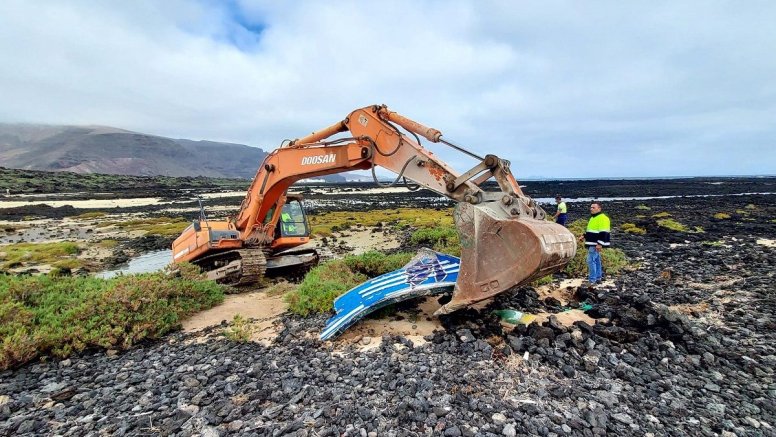
Recently, the land work has been completed in the municipalities of Teguise and Haría to remove the last boats abandoned during the last years on the coasts of Lanzarote, and also of La Graciosa. This environmental intervention has been carried out by the island Council during these weeks through a coordinated planning by the Security and Emergency Consortium, with the sole objective of removing the boats and remains of the boats not removed by the town councils.
The president of the Institution, María Dolores Corujo, has referred to "the need to execute this plan, which first required geolocating the boats and then obtaining the permits and enabling the necessary means." "It was an intervention that we had to undertake because the town councils could not, and only the mediation of the Security Consortium managed to solve this problem of visual and environmental impact," Corujo explained, before recalling that "the remains of vehicles accumulated for decades have also been removed in recent months from the beds of some ravines of Lanzarote", "another pending task in environmental matters", she clarifies.
For his part, the vice-president of the Cabildo and president of the Security and Emergency Consortium, Marcos Bergaz, has specified that "there were a total of eight boats that were stranded in different points of the Lanzarote and Graciosa coastline"; and "all have been transported to the Zonzamas Environmental Complex for treatment".
In addition, they emphasize that "at present, only one boat is missing to be removed, which is in a complicated place, so the specialized helicopter will have to do the work". Likewise, "it is also likely that a vehicle will be removed from the Risco area, unfortunately, crashed a few days ago", the counselor detailed today.
Finally, both Marcos Bergaz and María Dolores Corujo wanted to refer also to "the tragedy that a journey in a boat on the Canary route means for many people, a journey where they risk their lives and that forces governments to ensure dignified humanitarian assistance when they are rescued".
Add La Voz de Lanzarote as a preferred Google source.
Stay informed with the latest current news.