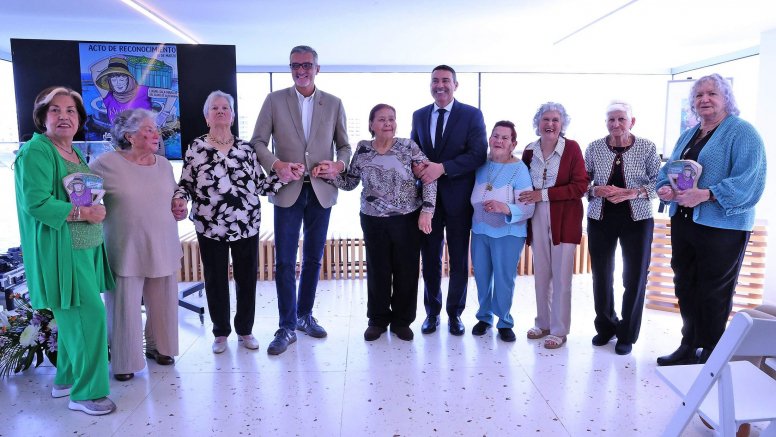
The Cabildo of Lanzarote, through the Area of Social Welfare and Inclusion and in collaboration with the Canarian Institute of Equality and the Government of the Canary Islands, has celebrated this Friday, March 13, in the Islote de la Fermina, for the third consecutive year, a day in honor of the work of eight women and their impact on Lanzarote and La Graciosa society.
This initiative is born, within the framework of International Women's Day, with the aim of creating a new space that allows to make visible and assert the weight of the female figure in sectors such as education, health, economy, politics and the primary sector, among others.
The president of the Cabildo de Lanzarote, Oswaldo Betancort, began the event by recalling the importance of making visible the trajectory of these women from their respective fields. “Today we celebrate lives that marked the development of Lanzarote and La Graciosa. Women who grew up in hard times, but knew how to transform difficulties into solidarity, commitment, and strength. This island was built on the basis of effort,” emphasized Betancort.
For his part, the Councilor for Social Welfare, Marci Acuña, stressed that the tribute “puts a face to many trajectories that for decades have remained in the background, but that have been decisive in building the society we know today.” Acuña explained that this recognition is part of a line of work aimed at preserving the social memory of the island and transferring these testimonies to new generations.
The tribute was attended by the vice president of the Cabildo, María Jesús Tovar; the Councilor for Seniors, Nori Machín; the CEO of the Art, Culture and Tourism Centers, Ángel Vázquez; as well as other public representatives of the island Institution and of municipal corporations, family members and close relatives of those honored.
The event concluded with the intervention of María Yolanda Lopez Martín, daughter of María del Consuelo Martín Martín, who dedicated some words of gratitude on behalf of her family. In her speech, she highlighted her mother's strength and resilience, focusing on the example she represents and the values shared by all the women recognized in this edition. Additionally, some distinctions were presented to the honorees.
Eight trajectories that are part of the memory of Lanzarote and La Graciosa
The eight women recognized in this 2026 edition represent life stories linked to work, culture, the countryside, the sea or social commitment. Their trajectories reflect the fundamental role of a generation that contributed to sustaining and transforming Lanzarotean society.
First, María Hiniesta Távora Triano, a pioneer in Lanzarote's hospitality industry by opening Bar Andalucía in 1960, was, along with her family, among the first to offer food to visitors on Islote de Hilario, in Timanfaya National Park, setting up the first oven in the old Tinecheide Refuge. Her career is also marked by her social commitment through initiatives such as AFACODA and the Derecho y Justicia association.
Another of the awardees was Rosa María Guadalupe Betancort, native of La Graciosa, who lived during her youth the traditional dynamics of the island, linked to fishing and the exchange of fish for grain in Lanzarote, a common practice among the families from La Graciosa in past decades. Likewise, Mercedes Viñoly López, who worked for a large part of her life in the agricultural and livestock activity of the municipality of Haría, dedicating herself to the cultivation of the land and to the production of cheese from the raising of goats.
On the other hand, Rosa Blanca Brito Moreno, born in Gran Canaria and settled in Lanzarote, found her home on the island and a deep connection with popular culture. She has been linked to folklore and the parranda Nuestra Señora de Guadalupe, actively participating in the conservation of musical traditions. At the same time, Brígida Gabriela Camacho Camacho who began working from a very young age to contribute to the family's livelihood. Subsequently, she developed her career in the field of restoration, linked to the Casa Brígida establishment.
Felicia Aguiar Cuba was linked in her youth to agricultural tasks in the Tiagua area, especially to the cultivation and work of tobacco. In later stages, she participated in cultural activities related to folklore, la bola, and theater. María del Consuelo Martín Martín dedicated a large part of her life to the care of minors, working in a reception center where she developed direct care tasks for boys and girls.
Finally, Áurea Mauri Cadavieco, from Galicia, developed her professional life in Lanzarote. After working in canning factories, she opened the first hair salon in the municipality of San Bartolomé and actively participated in local cultural life through the group Las Revoltosas, the choir and the theater. She also held public responsibilities in her municipality.
Add La Voz de Lanzarote as a preferred Google source.
Stay informed with the latest current news.