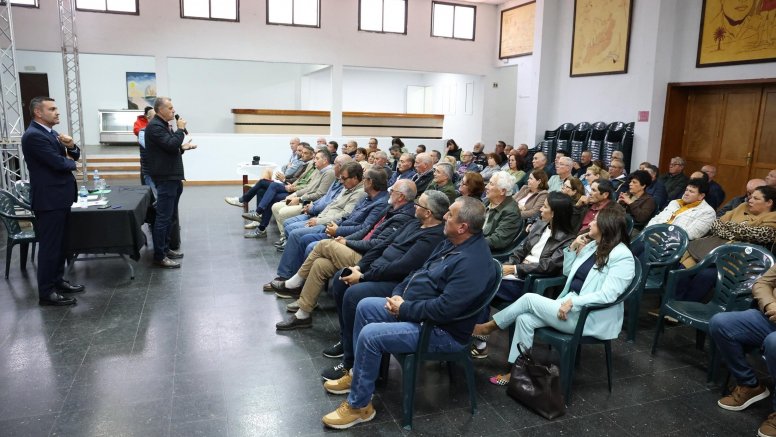
The president of the Cabildo of Lanzarote and counselor of Agriculture and Livestock, Oswaldo Betancort, participated this Wednesday in the Open Assembly held in the Democratic Center of Máguez and organized by the Association of Friends of Wine and Cheese of Lanzarote and the Canarian Foundation José Clavijo y Fajardo, with the objective of analyzing together with farmers, ranchers and residents the current situation of the primary sector on the island.
During the meeting, in which the Minister of Water, Domingo Cejas, was also present, along with other ministers from the Government group, Betancort conveyed the main lines of action that the island institution is developing to strengthen agricultural and livestock activity, as well as the efforts made before other administrations in defense of the sector's interests.
In this context, the president reported on his recent intervention in the Parliament of Canarias, where he expressed the existing concern in Lanzarote and Fuerteventura in relation to the resolution of the agri-environmental aid corresponding to the 2025–2028 period. Betancort valued very positively the commitment acquired by the Government of Canarias to guarantee that one hundred percent of the Lanzarote applicants will receive these aids, raising the allocation up to 7.9 million euros.
“The primary sector needs certainties and stability, and this commitment allows us to respond to a priority demand from our farmers and ranchers,” Betancort pointed out. “These aids,” he added, “will allow strengthening traditional grazing, supporting agricultural systems adapted to the territory, protecting local livestock breeds, and conserving structural elements such as gavias, essential in Lanzarote's agricultural model.”
Water and hydraulic planning
One of the central axes of the intervention was the hydraulic policy, key for the present and future of the sector. Oswaldo Betancort detailed that in this legislature the Cabildo has launched all the planning, among them the approval of the draft of the new PIOT, and has made a qualitative leap in terms of hydraulic works, two fundamental aspects for the development of the island's countryside. “So far this legislature,” Betancort pointed out, “we have addressed the urgent and we have projected the important.”
Regarding the municipality of Haría, the Minister of Water, Domingo Cejas explained that investments exceeding seven million euros are being carried out, aimed at improving water supply, purification, and hydraulic infrastructures. Among the most relevant actions is the renovation of the supply networks in Guinate, Tabayesco and Yé, with an investment of 4.5 million euros, as well as the improvement of purification with the EDAR Arrieta-Haría and the expansion of the La Atalaya reservoir.
To these initiatives are added actions already executed, such as the conditioning of the Órzola ravine or the improvements in the Mala dam, in addition to new cleaning and conditioning works of ravines in the municipality, which will allow improving the runoff and reinforcing the hydraulic safety.
For his part, Oswaldo Betancort highlighted the modernization of the irrigation zone in northeast Lanzarote with an investment of 24.4 million euros from Next Generation funds, which will benefit 667 irrigators across more than 300 hectares. Said project includes the construction of a new desalination plant, storage tanks, the incorporation of renewable energies and digitalization systems to optimize the use of regenerated water.
In this vein, he also highlighted the completion of the Línea Norte, with an investment exceeding six million euros, and the upcoming tender for the Línea Centro, which will allow closing the island's hydraulic ring. “These infrastructures allow us to guarantee supply with greater security and better respond to the needs of the sector,” he added.
Direct aid to the countryside and fishing
The support for the primary sector by the Cabildo also materializes in an important package of direct aid. The first island Corporation has multiplied by five the livestock aid, reaching 246,962 euros distributed among 85 farms, and also allocates 500,000 euros for the feeding of rearing animals.
In the agricultural sector, the institution has granted 249.200 euros to cover operating expenses of 122 beneficiaries during the 2025 fiscal year, covering up to 70% of the subsidized activity. In addition, a call for 480.000 euros has been launched aimed at brotherhoods and associations of fishermen from Lanzarote and La Graciosa.
Rural roads and landscape recovery
The president and counselor of Agriculture and Livestock, Oswaldo Betancort, also announced the investment of 750,000 euros, financed with FDCAN funds, for the conditioning of agricultural roads, with the objective of improving the accessibility and safety of a network essential for agricultural activity. In addition, another of the pillars of the island government's strategy is the recovery of abandoned farms, through initiatives such as the Banco de Tierras and the "Salvar La Geria" program, aimed at protecting the landscape and recovering productive soil.
In this way, in the municipality of Haría, between 2023 and 2026, more than 1.2 million square meters of abandoned or semi-abandoned farms have been recovered, specifically in the area of La Corona, that is, 122.61 hectares. “This means,” clarified Oswaldo Betancort, “the equivalent of 172 soccer fields. Recovering these farms is recovering productive territory, landscape, and opportunities for our people.”
Finally, the Asamblea Abierta concluded with an open round of interventions, in which the Asociación de Amigos del Vino y el Queso de Lanzarote thanked for the celebration of this space for direct dialogue. In this context, Oswaldo Betancort stressed the importance of active listening by stating that “listening to the sector is fundamental for making correct decisions”, highlighting that this premise constitutes the basis of his government action.
Add La Voz de Lanzarote as a preferred Google source.
Stay informed with the latest current news.