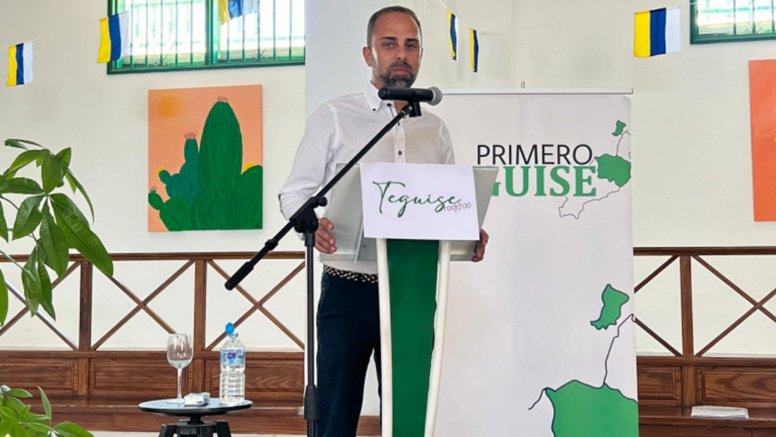
The islandist party warns that, although the budget grows in global terms, this increase "does not respond to an improvement in the council's investment capacity, but mainly to an **increase in revenue**, highlighting the rise in the waste collection fee. A greater economic effort demanded from residents that does not translate into a better-kept, better-maintained municipality, nor one with more opportunities.""The bill goes up, but the municipal project doesn't," summarizes Jonás Álvarez, councilman and president of Primero Teguise. "Even with more money in the coffers, they haven't been able to change the course of budgets that once again leave Teguise at a standstill."
The 2026 budget file itself "acknowledges a reality that is difficult to gloss over." The direct investment by the city council barely exceeds 900,000 euros, a figure "clearly insufficient for the largest municipality in Lanzarote." The rest of the announced investments depend almost entirely on funds from the Canary Islands Government, the Cabildo, or European programs, many of which are pending execution, deadlines, or external calls.
“They are selling as an investment what they don't manage, what they don't plan, and what they don't even control,” Álvarez ironically states. “If those subsidies don't arrive tomorrow, the city council will be in exactly the same position as it is now: without its own capacity to transform the municipality.”
From PTG, they recall that this situation "is not new." The comparison with the budgets for 2024 and 2025 shows "a continued trend of cutting or stagnating allocations linked to maintenance, prevention, municipal employment, and the care of public spaces, while normalizing living off external investments and raising taxes to balance accounts."
"The consequences of this model are visible. Less self-investment implies more deteriorated neighborhoods, services that arrive late, lack of planning for emergencies, and management based on reacting when the problem is already evident," he denounces. "Then we are surprised by floods, lack of cleaning, or the wear and tear of infrastructure, when we have been warning for years that without maintenance, there are no miracles," Álvarez points out.
The municipalist party also focuses on the "lack of political coherence of a governing group that asks for more effort from citizens while maintaining accounts that do not prioritize the essential." "When you raise taxes, you should give it back in better services. Here, residents pay more to keep seeing the same, or even less," they criticize.
Faced with this "continuity model," Primero Teguise defends the need for budgets that "bet on **direct investment, constant maintenance, prevention, and municipal employment** as the pillars of real and sustainable development. Budgets that do not depend exclusively on other administrations resolving what the council dares not plan."“Governing is not waiting for others to do your job,” concludes Jonás Álvarez. “Governing means deciding priorities, investing wisely, and returning every euro that residents contribute in the form of well-being. As long as they keep raising taxes to stay the same, Teguise will not move forward. And that is no longer austerity or realism, it is political resignation.”
Add La Voz de Lanzarote as a preferred Google source.
Stay informed with the latest current news.