Photos: Sergio Betancort
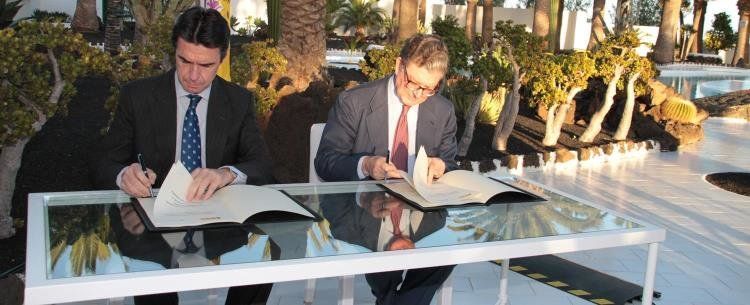
The Minister of Industry, Energy and Tourism, José Manuel Soria, and the president of National Heritage, Alfredo Pérez de Armiñán y de la Serna, have signed a collaboration agreement whereby, "at the express wish of His Majesty The King", the Royal Residence of "La Mareta" will be "at the service of the tourist interests of Spain".
Following the signing of this agreement, National Heritage "facilitates the use of the Royal Residence for the promotion and defense of the tourist interests of our country." Thus, it may be used "for the establishment or strengthening of bilateral or multilateral ties with other countries or organizations in tourism."
The Secretary of State for Tourism will compensate National Heritage for the days of use and in respect of estimated costs of supplies, services and own resources, while proceeding to the direct contracting of the specific services necessary for the realization of the various acts.
National Heritage, which manages the Residence, will take the appropriate measures to ensure that "La Mareta" is suitable for the preparation and development of the proposed acts, and will supervise and authorize both the final installations required and the capacities established. The agreement also contemplates the possibility of other state institutions, such as the Government of the Canary Islands, which has already expressed its willingness to sign it, joining.
From the King of Jordan to National Heritage
"La Mareta", located in the tourist town of Costa Teguise, was built by the will of King Hussein of Jordan in the late 70s and designed by the artist César Manrique. Ceded to the King of Spain on June 22, 1989, it was incorporated into National Heritage on July 18 of that same year in application of the Law regulating donations to the State through the King.
The residence owes its name to the pre-existence of a cistern dug into the ground and occupies a land area of 30,900 square meters. It is formed by a set of buildings of one and two stories high with a total constructed area of 1,900 square meters, which reinterprets the traditional Canarian architecture: white walls and flat roofs, with chimney tops adorned with dome-shaped decorations.
It also presents references to colonial architecture that can be seen in its balconies or wooden viewpoints. The exterior carpentry contrasts with its green color. The buildings are joined by garden spaces that total an area of 9,850 square meters.
Add La Voz de Lanzarote as a preferred Google source.
Stay informed with the latest current news.