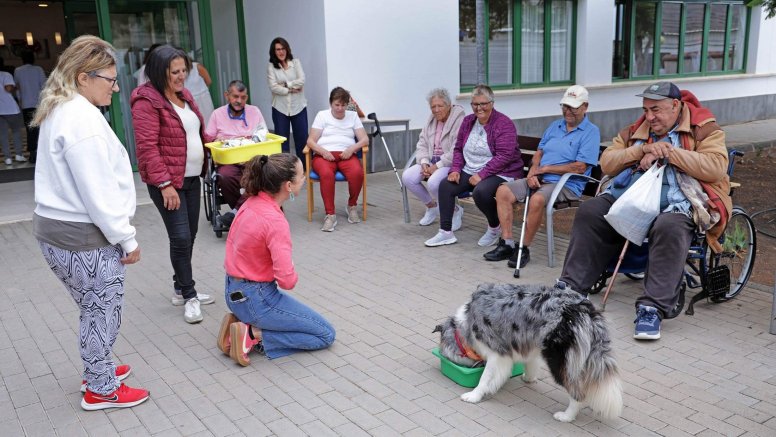
The president of the Cabildo of Lanzarote, Oswaldo Betancort, and the Minister of Social Welfare, Marci Acuña, visited the facilities of the Amavir Residence for the Elderly in Haría on Tuesday, where a novel program of mental health care and emotional development with animal support is being carried out, a program framed within the Corporation's Accessibility and Inclusion Strategy, which promotes island policies for the care of the most vulnerable people.
Both officials were able to learn firsthand about the dog-assisted interventions carried out by Dejando Huella Lanzarote, an initiative that combines skills, animal welfare, and personal development, fundamental pillars of a program that helps improve social and healthcare assistance on the island.
Oswaldo Betancort emphasized during the visit how "the effectiveness of public institutions is measured by how we care for the people who currently depend on us... In social services, the important thing is not only to provide infrastructure, but to provide quality service and care for the most vulnerable people.” In addition, Betancort stated that "faced with a pioneering project such as the one developed by Dejando Huella, which interacts with users and manages values of animal welfare, empathy, and development of personal autonomy, the commitment of the Presidency of the Cabildo is to give continuity to these initiatives that add quality of life to the population of Lanzarote and La Graciosa.”
For his part, Councilor Marci Acuña explained that "we have been developing this project for two years; but now we are moving forward and combining the treatment of mental illness - specifically addictions - with therapies in which the elderly also participate. This bond that is created between our addiction users and the elderly in the centers administered by the Cabildo, generates benefits for all of them. This is demonstrated by the excellent psychological results observed by the professionals," he added.
Empathy Between Generations
Oswaldo Betancort and Marci Acuña attended one of these sessions, in which the participants -people with mental health problems and addictions- work on their bond with animals, learn to manage emotions, and gain personal autonomy.
This program began almost two years ago at the Day Center and Residence of Zonzamas, a regional benchmark against addictions, where it continues today; and it is being expanded to centers such as Amavir Haría, where the users themselves are actively involved in activities with the elderly, sharing experiences and the support of the dogs. "It is a magnificent example of collaboration, overcoming obstacles, and empathy between generations," highlighted the island officials.
These types of interventions not only improve the self-esteem and social skills of the participants, but also provide well-being, companionship, and joy to the elderly. Animals act as emotional mediators, generating bonds and moments of shared happiness that enrich coexistence in the centers.
During the visit, the president and the councilor also took the opportunity to greet the team at the Haría residence and day center, where users live with a team of 21 care professionals, including social workers, psychologists, physiotherapists, and rehabilitation specialists, among others.
Betancort and Acuña expressed their gratitude for the work that Amavir has been carrying out in the residences of Haría and Tías, "two of the many services that the Cabildo of Lanzarote provides in social and healthcare matters, and which reflect the commitment of this Corporation to the comprehensive care and quality of life of our elders," Acuña detailed.
Add La Voz de Lanzarote as a preferred Google source.
Stay informed with the latest current news.