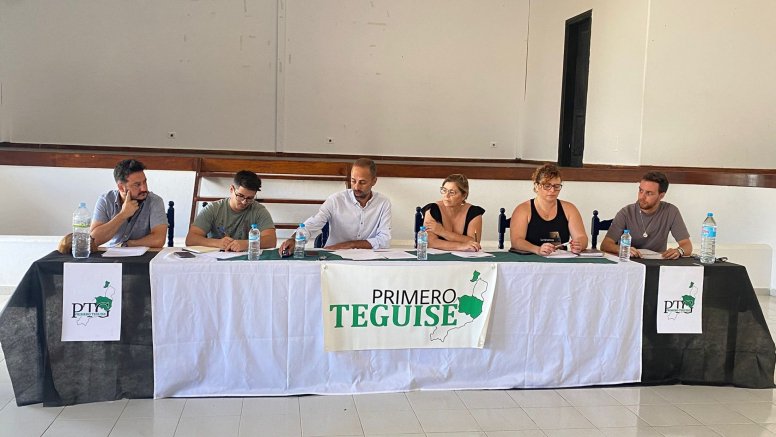
Primero Teguise has analyzed in recent weeks the situation of the Wastewater Treatment Plant (WWTP) of Costa Teguise and warns of "a problem that cannot be ignored: the frequent discharges into the sea, the overload of the facility and the opacity with which this issue is being managed".
According to the data studied by the group, the plant was designed for an approximate capacity of 20,000 equivalent inhabitants, around 3,600 cubic meters daily. However, "if we add the resident population of Costa Teguise and the average number of tourists that the core supports weekly, which at certain times of the year far exceeds 11,000 visitors, the real workload of the plant is situated at figures that approach or even exceed its design capacity," they assure.
“When a treatment plant works at its limit or above its capacity, it is “solved” with discharges and spills of water that may not receive optimal treatment before reaching the sea,” explains Jonás Álvarez, councilor and president of Primero Teguise.
Discharges occur when the plant cannot handle all the incoming flow, especially during periods of rain or peaks in tourist occupancy. At those times, "part of the water can exit through the outfalls without the full intended treatment, polluting the coast and compromising the quality of bathing water. The impact is not only environmental, affecting marine ecosystems and biodiversity, but also sanitary and tourist-related," they argue.
“Fecal waters, dirt that is not just murky water, but large pieces of feces -so as not to use a simpler word that we all understand”, explains the councilor,
“this is starting to become frequent, and we cannot allow the beach, which should be a safe and natural space, to become a focus of contamination and disease and a sanitary and ecological disaster”.
But to the technical concern another issue is added that from Primero Teguise they consider "equally serious": the lack of transparency and communication. “We have knowledge of residents who have submitted written requests asking about the state of the outfalls, about the discharges or about the water quality controls, and have not received a response. It is unacceptable that in the face of such a sensitive concern, administrative silence or ambiguous responses are chosen,” denounces Álvarez.
Primero Teguise assures that "there is a budget allocated for this plant and they believe it could be for a future investment to expand the capacity of the WWTP. However, as of today, there is no concrete execution schedule, nor a detailed explanation of the final capacity that would be reached after that expansion".
“From the Insular Water Council, an expansion is foreseen at some point. But, even if it were carried out, the new urban planning licenses already granted and the projects in process would practically consume that improvement from the very first moment. That is to say, we would continue running behind the problem instead of anticipating it,” warns Álvarez.
Primero Teguise underlines that "the debate is not whether Costa Teguise should grow or not. The debate is how and when. If we want to grow as a core, either touristically or residentially, we must first improve our basic infrastructures. More beds, more homes, and more complexes cannot be authorized while the treatment plant works at its limit." “Licenses cannot be granted left and right without first planning the real capacity of our hydraulic infrastructures. That is not development, that is improvisation,” criticizes the councilor.
The party defends that "any growth planning must be accompanied by a serious study of hydraulic capacity, of executed and not just announced investments, and of real coordination between the City Council, the Water Consortium and the Cabildo". "Costa Teguise is one of the main economic engines of the municipality and the island. The city council and the Department of Beaches should have precisely this matter on the table. We cannot afford to jeopardize our environmental quality or our image as a destination. If we really want to talk about sustainability, let's start by ensuring that our wastewater is adequately treated before reaching the sea," concludes Jonás Álvarez.
From Primero Teguise they insist that "the solution does not involve hiding the problem, but facing it with planning, transparency and responsibility". “Growth cannot go ahead of infrastructure. First the service is guaranteed, then development is authorized. The opposite is to mortgage the future of Costa Teguise.”
Add La Voz de Lanzarote as a preferred Google source.
Stay informed with the latest current news.