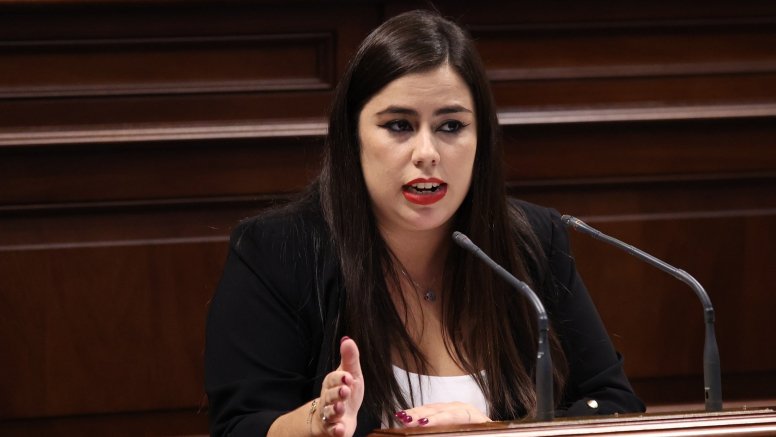
The Parliament of the Canary Islands unanimously approved this Wednesday a Non-Law Proposal (PNL) presented by the Socialist Group to try to place the islands on the path of technological innovation, scientific development, and sustainable economic diversification.
Socialist deputy Alicia Pérez defended the initiative and emphasized that "the Canary Islands cannot remain anchored in a low value-added production model," and stressed that innovation is the key tool to improve productivity, raise wages, and reduce inequality. "If there is a critical economic variable for the future of the Canary Islands, it is productivity, and this requires a firm commitment to R&D&I," she said.
The Socialist PNL starts from a clear diagnosis: the productivity of the Canary Islands has been stagnant for three decades, in parallel with an investment effort in R&D that is much lower than the rest of the country. In 2023, Canarian companies allocated only 0.57% of GDP to research and development, compared to 1.49% nationally. "It is not that there is a lack of talent, it is that there is a lack of effective incentives to transform that talent into projects," he said.
In this regard, the initiative approved by the Regional Chamber proposes urging the Government of Spain to make the appropriate legal modifications to Law 19/1994, of July 6, modifying the economic and fiscal regime (REF) of the Canary Islands, so that the partners of economic interest groups and temporary joint ventures with tax domicile in the Canary Islands, may apply the increased deduction percentages contemplated in our economic and fiscal regime. This would be regardless of whether the tax domicile of the partner is located in the Canary Islands or not, provided that the research, development and technological innovation activities have been effectively carried out in the territory of the Autonomous Community of the Canary Islands and the requirements established in the applicable regulations are met.
It is also requested that it deploy, on a complementary basis, different actions to promote business R&D&I in the Canary Islands, in compliance with European and state regulations on aid, such as increasing the budget allocations for competitive calls for R&D projects in collaboration with the Canary Islands public R&D ecosystem, as well as promoting programs to attract and create companies and technological venture capital funds, reinforcing the positioning of the Canary Islands as a technological hub.
Likewise, there is a commitment to strengthening the research and innovation capacity of the Canary Islands' public universities, addressing the needs included in their institutional proposals, and to implementing and expanding public procurement of innovation instruments, including pre-commercial public procurement, in the contracting of the autonomous public sector.
The initiative requests that the necessary budget allocations be incorporated into the Draft General Budget Law of the Autonomous Community for 2026 to comply with the measures included. "With this measure, we will attract investment from companies throughout Spain to projects developed here, generating qualified employment, strengthening our scientific capabilities, and expanding the country's innovative base," Pérez explained.
Pérez recalled that the Archipelago already has a successful experience in the audiovisual sector, where the combination of tax incentives, local talent, and institutional commitment has turned the Canary Islands into an international benchmark. "The same potential that has made the audiovisual sector an industry of the future can be replicated in the scientific and technological field," he said.
The socialist deputy also highlighted that since 2018, business spending on R&D in the Canary Islands has doubled and that requests for binding reasoned reports—necessary to apply tax deductions—have multiplied by twelve. "That shows that companies respond when there is legal certainty, public support, and confidence in Canarian talent," she stressed.
Pérez insisted that "the PSOE's objective with this PNL is to build a more resilient and competitive economic model, capable of generating opportunities for young people and avoiding exclusive dependence on tourism." "We have the tools, the talent, and a privileged tax regime; now it's time to turn all that into innovation, science, and quality employment," he concluded.
Add La Voz de Lanzarote as a preferred Google source.
Stay informed with the latest current news.