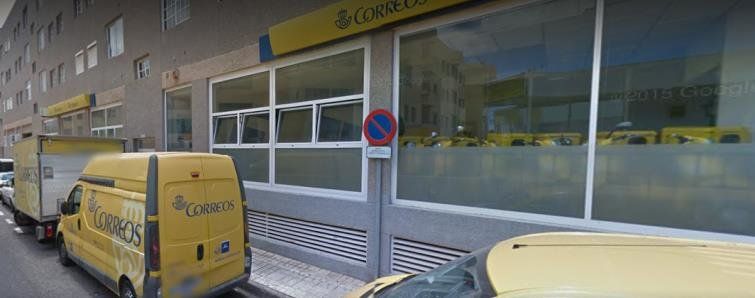
Postal workers in Lanzarote will gather this Wednesday in Arrecife to protest the "precariousness" of their work, the "drastic reduction of personnel" and the "deterioration" that they believe the service has been suffering since its outsourcing in 2012. The CGT union has announced this Monday the call for this demonstration, which will be held this Wednesday, at 6:00 p.m., in La Plazuela de Arrecife.
The union demands a "universal, public and quality" mail service. In its statement, it denounces that in the province of Las Palmas, since 2012, more than 33 delivery sections have been eliminated. "To make matters worse, Correos does not cover the delivery sections that are vacant and have been for months or even years in some cases," they add.
CGT points out that Correos staff "systematically assume the surcharges of the vacant adjoining areas", which leads to "increasing workloads, generating a psychosocial risk and causing stress, these being consequences of poor working conditions". This, they emphasize, "harms health" and "contravenes the Law on Prevention of Occupational Risks".
"Faced with this situation, Correos employees make a call to citizens and public authorities to demand compliance with the laws and regulations in force, as well as the rights and obligations of workers to S.E. Correos y Telégrafos S.A", the CGT claims in its statement. They also emphasize the "guarantee of communications, which is a constitutional right; the delivery of correspondence at least 5 days a week, as regulated in the Universal Postal Law 43/2010, of December 30, and compliance with the Directive of the European Parliament and Council of February 20, 2008". "You have the right to receive your mail 5 days a week," they proclaim in the leaflets announcing the call, in which they also assure that "Correos managers fail to comply" with that Universal Postal Law.
Outsourcing of "everything that can be privatized"
"The postal service is fundamental to guarantee communications", the union points out, citing the Spanish Constitution, "in more than 8,000 municipalities, 16 million homes, 3.2 million companies (more than 99% of them SMEs) and a total of 7,100 points of attention in rural areas".
For the CGT, "all the resources of the country" have been "subordinated to the payment of the external debt". It also considers that this has been done "at the expense of public services and the dismantling of the State's assets". Thus, it alludes to "the pressure of the financial markets, the illegitimacy of the debt created by a speculative financial system" and to the reform of article 135 of the Spanish Constitution, which it emphasizes was done "without consulting the citizens".
"In development of these policies, Correos was incorporated, at the beginning of 2012, into the SEPI Group (State Society of Industrial Participations)", they explain. "As a result of all of the above, the postal operator Correos initiated a restructuring, focused on a drastic reduction of personnel and an outsourcing of all services susceptible to being privatized (maintenance, links, technology, parcel delivery, etc.)", they add.
"The inevitable drop in income caused by such measures has been the perfect excuse for the segmentation of the company and its subsequent sale", they lament. They highlight, in this sense, that in the last 5 years, the Correos workforce has been reduced by 14,000 workers and that the "resizing carried out in the Classification, Distribution and Office Centers has produced a brutal elimination of personnel and with it, the consequent increase in workloads, as well as the deterioration of the postal service provided to citizens and the precariousness of labor".
Add La Voz de Lanzarote as a preferred Google source.
Stay informed with the latest current news.