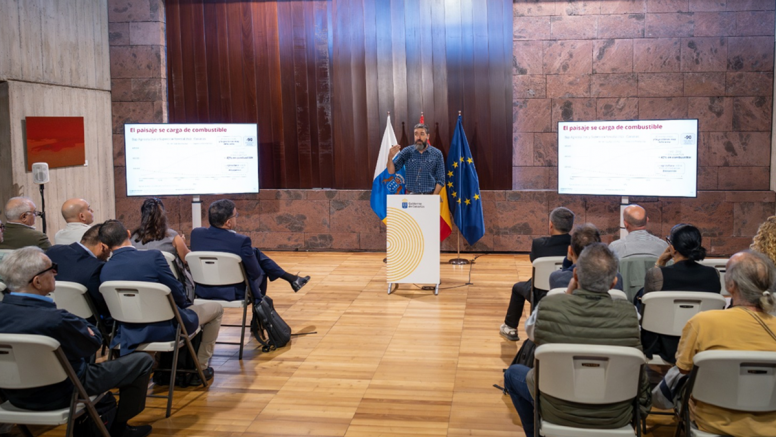
The Minister of Territorial Policy, Territorial Cohesion and Water, Manuel Miranda, participated this morning in a training day on fiscal and administrative measures, among which the forestry cent stands out, with which the appropriate tasks are available to maintain safer and more resilient forest landscapes in the face of the challenges of climate change.
For Miranda, who is also responsible in the regional executive for the Emergency area, "prevention work is essential when it comes to dealing with episodes of fires, drought and desertification, to which we are exposed, due to the notable change in climate and human habits."
The Minister thanked the work carried out by the experts of the Association of Forest Professionals of Spain (PROFOR) and the Official College of Forest Engineers, "at the request of the Presidency of the Government", as well as the officials of the Treasury, Territorial Policy and Ecological Transition, mainly, for the analysis work carried out and which is firmly positioned in having a stable and final financial resource, such as the forestry cent, to make a more resilient habitat possible.
The implementation of the forestry cent has been one of the main measures on which this group of experts concluded, made up of 17 people from all over the archipelago, which, as explained by one of the facilitators, Yeray Martínez, makes possible "the financing of measures that safeguard and promote the forest ecosystems of the islands and the conservation of the soils".
Among the main threats to the islands, as a result of climate change, "are large forest fires, a growing threat to the civilian population, infrastructure and the economy; in addition to longer fire campaigns, as well as a faster advance of desertification," he warned.
The loss of primary activity in the midlands areas of the western islands is causing the landscapes to be loaded with fuel with a high risk of inflammation, which leads to potential landslides after fires due to loss of forest cover.
In short, "it is a vicious circle that we must stop sooner rather than later if we want to maintain our habitat as a safe place for the development of daily life," he concluded.
In this sense, the forestry cent aims to have sufficient and permanent funds, unrelated to political conditions, "to enable the development of an active forest policy of fire prevention, the restoration of degraded ecosystems and soil conservation, constantly and effectively, and the adaptation of forest masses to climate change," explained the Deputy Minister of Ecological Transition, Julieta Schallenberg, at the close of the session.
Those competent to manage these resources are the island councils, "and they would be responsible for their voluntary application through a surcharge of up to 0.02 euros per liter, to the tax levy on motor fuels already existing in the autonomous community," Schallenberg specified.
It is mandatory that the resources collected are used in their entirety for actions focused on the fight against climate change, a condition that will be guaranteed by the Canarian Executive via regulation.
Other measures
The document of conclusions of the work sessions highlights the need to encourage the primary sector in the midlands to promote the mosaic landscape that is safer and generates multiple benefits, although at this time the market is not efficient and does not reward the creation of activity or landscape value.
It also highlights the possibility of using the excess biomass that accumulates in the mountains to satisfy the demand for hot water from 60% of the tourism we receive annually in the Canary Islands. As an obstacle, experts consider that "the current model prevents the development of a private forestry sector capable of facing the challenges".
"If we could promote these measures, having more funds annually, we would turn the vicious circle into a virtuous circle in which a significant and effective final investment would allow a more efficient and capable forestry sector, would generate more living and safe rural and forest landscapes, which would reduce the risks and impacts on society and increase the resilience of ecosystem services in the face of the climate crisis," added Yeray Martínez.
Add La Voz de Lanzarote as a preferred Google source.
Stay informed with the latest current news.