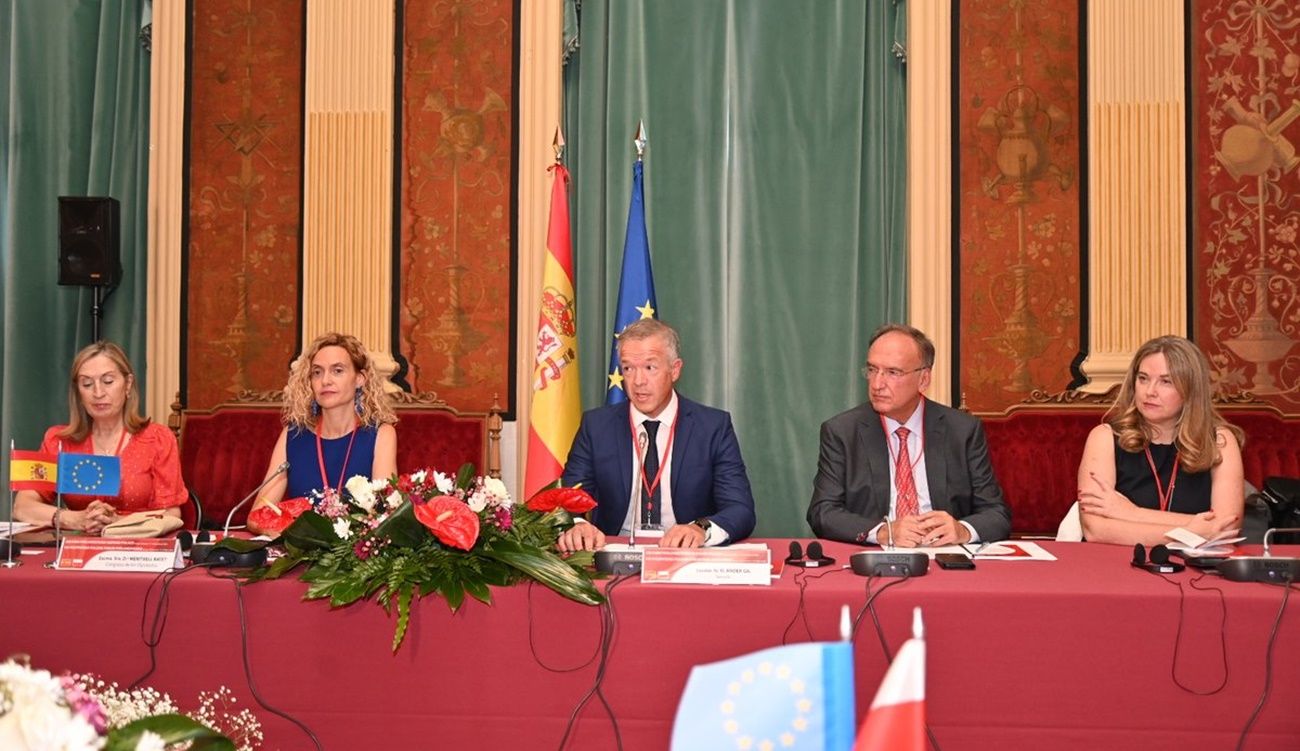
A delegation from the Congress and Senate of Spain has met for two days with a homologous representation of Polish parliamentarians in the city of Burgos, Castilla y León, on the occasion of the VIII Spanish-Polish Parliamentary Forum. A meeting whose purpose is to deepen bilateral relations between the two countries and promote common positions in the field of European politics.
The summit was structured in four working sessions entitled "Foreign and Security Policy. The European Union and NATO facing the war scenario in Ukraine"; "Bilateral relations. Economy and Trade"; "The European Union after the Conference for the Future of Europe" and "Bilateral relations in Education, Culture and Tourism".
The senator for Lanzarote and La Graciosa, Francisco Manuel Fajardo, as first secretary of the Bureau of the Upper House, spoke on the working panel entitled "The European Union after the Conference for the Future of Europe", where he stressed the character of the Canary Islands as the southern border of Europe and its importance despite the distance from the continent.
In the opinion of the socialist senator, the unprecedented situation that the European Union is going through after the Russian invasion of Ukraine is an opportunity to "give a new integrating impulse to the European pact on the basis of common action and a strengthening of solidarity between states and the international sphere".
Specifically, Fajardo advocated addressing the reforms "that are necessary" for the implementation of a new migration and asylum strategy that deals with the processes that are taking place in Spain -especially in the Canary Islands- and Poland and, likewise, respond to the important transnational challenges in the areas of security, climate change and defense, among others, in order to achieve a Europe "more democratic, safe, effective, prosperous and fair through the improvement of the living and working conditions of Europeans".
"The aforementioned reforms inevitably involve improving the channels of dialogue and cooperation between the European Parliament and the national parliaments and the full commitment of the Parliament, the European Commission, the European Council, the member states, their regional and local institutions and civil society not to forget the founding reason of the European Union: to strengthen through cooperation and understanding the democracies of the continent and to avoid short-term and nationalist interests," explains Fajardo.
Add La Voz de Lanzarote as a preferred Google source.
Stay informed with the latest current news.