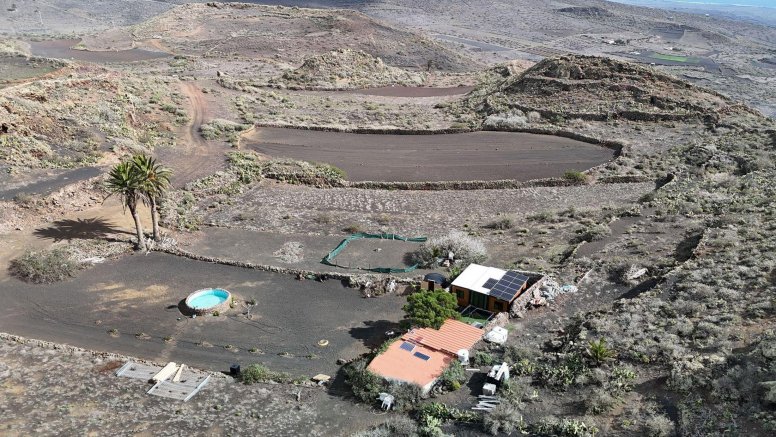
The Cabildo of Lanzarote, through the Department of Environment, headed by Samuel Martín, processed a total of 115 cases in 2025 for urban planning and environmental violations, mainly related to the construction of buildings without a license, the installation of permanent structures outside the law, and other actions contrary to the provisions of Law 4/2017, of July 13, on Land and Protected Natural Areas of the Canary Islands.
The report, sent to the Canary Agency for the Protection of the Natural Environment, details that Haría was the municipality with the highest number of complaints, with 31 cases, followed by Teguise with 27. Next are Tinajo (18), Yaiza (14), and Tías (11). For their part, Arrecife (8) and San Bartolomé (6) show the lowest figures, which is partly due to their smaller area of rural land and protected natural spaces.
The president of the Cabildo of Lanzarote, Oswaldo Betancort, emphasized that this data highlights the importance of complying with urban planning and environmental regulations on an island with limited and particularly fragile territory. Betancort recalled that "every illegal construction on rural or protected land has a direct impact on the landscape, natural resources, and the island model that we must all preserve together".
In this regard, the president insisted that the Cabildo acts "with technical criteria and in accordance with the law," and stressed that "the protection of the territory is a legal obligation and a collective responsibility to future generations." "The Cabildo maintains a firm position against those interventions that are contrary to the landscape and agricultural values that underpin Lanzarote's recognition as a Globally Important Agricultural Heritage System (GIAHS)," he concluded.For his part, the Minister of Environment, Samuel Martín, explained that the processed files respond, for the most part, to buildings erected without a municipal license, to the occupation of unauthorized land, or to non-compliance with granted authorizations. "The regulations exist to order the territory and prevent irreversible damage. Breaking them has legal and environmental consequences," he stated.Martín added that "Environmental Agents carry out constant surveillance and inspection work in coordination with other administrations," and recalled that in the last four years approximately 670 similar cases have been processed on the island, which shows that it is a persistent problem that requires both control and public awareness.
The Environment Department insists on the need for the public to be informed before carrying out any action on rural land or in protected areas. Building without a permit or installing permanent structures outside the law can lead to economic sanctions and environmental damage that is difficult to reverse. Compliance with urban planning regulations is a key tool to ensure orderly development, compatible with the conservation of the landscape and natural heritage that characterizes Lanzarote and La Graciosa.
The Cabildo of Lanzarote is developing a detailed catalog of infractions with the aim of providing municipalities with a clear overview of the most frequent irregularities detected in each town. This tool will improve institutional coordination and reinforce prevention. The island Corporation recalls that supporting the necessary infrastructure for the development of the agricultural sector is a priority, as long as these actions strictly adhere to legality and do not result in disguised residential uses or landscape impacts incompatible with territorial protection.
Add La Voz de Lanzarote as a preferred Google source.
Stay informed with the latest current news.