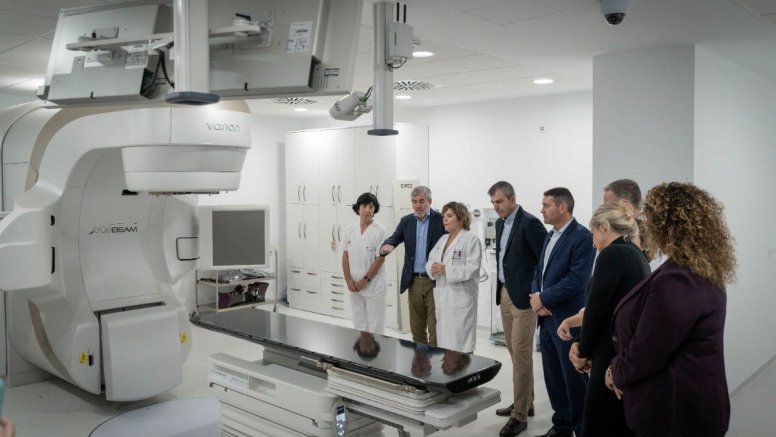
The President of the Canary Islands Government, Fernando Clavijo, referred this Monday to the start-up of the Radiotherapy Oncology Unit of the Molina Orosa Hospital in Lanzarote as "the best example of commitment to public health" and stressed "the work we started from minute one to respond to the needs of each of the Islands and this Unit was one of them."
The Canarian president visited the new unit together with the vice president, Manuel Domínguez, the Minister of Health, Esther Monzón, and the president of the Cabildo of Lanzarote, Oswaldo Bentancort, the Radiotherapy Oncology unit. The Minister of Universities, Science and Innovation and Culture, Migdalia Machín, and the mayor of Arrecife, Yonathan de León, also attended the visit to the new service, which will come into operation on December 13. This new service responds to a historical demand from the population of Lanzarote and makes it possible for cancer patients in Lanzarote not to have to travel to Gran Canaria to receive their treatment.
The start-up of the Radiotherapy Oncology unit represents a qualitative leap in patient care and improves their quality of life and comfort. This new unit, in addition to bringing treatment closer to patients, allows for continued comprehensive care in Lanzarote.
The linear accelerator is put into operation once the construction of the bunker in which it is located has been completed, as well as the calibration and accreditation process of the device by the National Nuclear Safety Council.
As a preliminary step to the start of activity, the Molina Orosa Hospital has been carrying out medical follow-up consultations for cancer patients on the island since June 12. In these months, 705 patients already treated have been assessed.
Bunker and linear accelerator
The new Radiotherapy Oncology Unit has 538 square meters and includes 2 consulting rooms, a professional work area, an administrative support area, waiting rooms, the bunker, where the linear accelerator is located with its control area and its corresponding technical support and the specific areas of the staff.
This new service has involved an investment of 4.6 million euros, co-financed by the European Regional Development Fund (ERDF) by 85 percent and by European NextGeneration funds through the InVeat ERDF Plan. Of these 4.6 million euros, 2.1 correspond to the linear accelerator.
Since the latest generation linear electron accelerator was installed in August, work has been carried out on adjusting and calibrating the high-tech equipment to be able to offer treatments in a safe and effective manner.
During their tour of the new facilities, the president and the Minister of Health were accompanied by the Manager of the Health Services, Pablo Eguia, the director of the Lanzarote Health Area, Esther Machín, the head of the radiotherapy oncology service of the Gran Canaria Doctor Negrín University Hospital, Marta Lloret, and the director of nursing of the Molina Orosa, Teresa Salegre.
300 patients per year
Currently, around 350 cancer patients from Lanzarote are assessed at the Gran Canaria Dr. Negrín University Hospital, a reference center for Radiotherapy Oncology on the island. The patients will be gradually incorporated into the new Lanzarote unit during the first month of operation and, according to the initial assessment, throughout the first year, about 300 patients will be able to receive their treatment in the accelerator that is now being launched.
The Unit will be attended by the team of twenty-one Radiotherapy Oncology specialists from the Dr. Negrín University Hospital who travel to Lanzarote, from their reference service, subspecialized in the treatment area that it will cover, in such a way that patients will continue to be treated by the same professionals who have been treating them and following the same guidelines they had until now.
The service also has a team of qualified nurses, three radiotherapy technicians, two administrative assistants and the physicists who will travel from Gran Canaria to supervise the correct operation of the accelerator.
The radiation oncologists who move to the hospital, in addition to assisting patients, will collaborate in the tumor committees and in those activities and projects that are carried out around this pathology in the hospital.
Radiotherapy oncology
Radiotherapy is part of the multidisciplinary treatment of cancer and is used in up to 70 percent of patients who suffer from it, mainly required for tumors of the breast, prostate, head and neck, rectum, cervix, brain, esophagus, lung, sarcomas. Most of them are treated with external radiotherapy, although some require other techniques such as brachytherapy and intraoperative radiotherapy, which can be used in isolation or in combination.
From now on, patients who require radiotherapy will only have to travel to Gran Canaria to carry out the assessment of the first visit and plan their treatment, with the exception of patients with urgent or palliative treatments, whose care will be carried out entirely at the Molina Orosa.
Add La Voz de Lanzarote as a preferred Google source.
Stay informed with the latest current news.