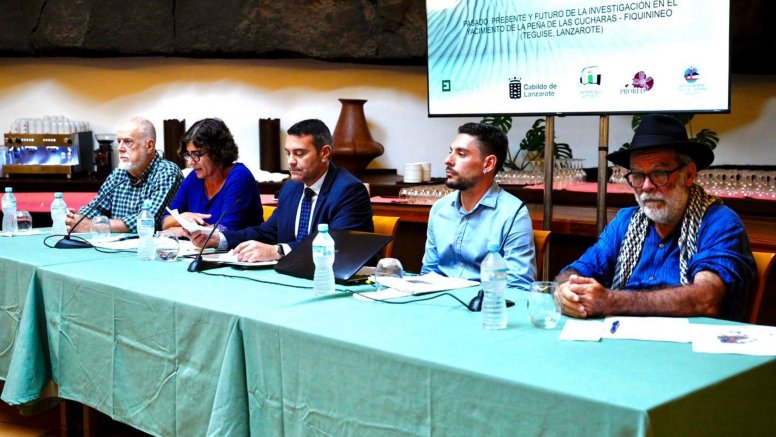
The Farmer's Monument hosts until tomorrow, Saturday, the Archaeology Dissemination Days under the sand: past, present and future of research at the Fiquinineo-La Peña de Las Cucharas site, a professional meeting open to the public that is highlighting one of the most relevant sites in the Canary Islands, as well as a training space that transcends the archaeological discipline itself to offer a comprehensive perspective of the culture, ethnology and history of a people.
The inauguration took place this Thursday with the presence of the president of the Cabildo de Lanzarote and councilor for Historical Heritage, Oswaldo Betancort, accompanied at the table by Juan Francisco Navarro Mederos, Rita Marrero Romero, Efraín Marrero Salas and José de León Hernández.
Betancort congratulated the Historical Heritage Area for the organization and highlighted that "the Fiquinineo site, located in the Jable de Arriba, is much more than an archaeological vestige: it is a living testimony of the aboriginal past and the historical transformation of Lanzarote after the Norman conquest of 1402." He also stressed that "thanks to the continuous work since 2009, today we have a much deeper knowledge about Fiquinineo and about the importance of the Jable as a cultural, natural and agricultural space," he commented on a pioneering enclave in the Canary Islands by applying research methodologies and techniques such as soil micromorphology.
The island's president recalled that this enclave, which in the past suffered looting, has managed to overcome this to become an example of sustainable heritage management, a space for research and dissemination that "connects us with the origins of Lanzarote and that obliges us to protect it and highlight its value for future generations."
About fifteen interventions
The first day included the institutional inauguration and the screening of a short film, Memoria de La Peña de Las Cucharas-Fiquinineo. The morning session focused on the geomorphology of the sand plains and aeolian dynamics, led by researchers from the University of La Laguna. In the afternoon, the conferences revolved around life in the villages under the sand plains, enslaved Moorish women and magical practices, daily life through archaeology, and Canarian numismatics.
In this Friday's session, the Prored researchers will present the stratigraphic evolution, the conservation and restoration processes, and the virtual recreation of the Casa Honda of the site. There will also be presentations by specialists in aboriginal and imported ceramics. In the afternoon, the program will be dedicated to archaeozoology, agriculture, and the uses of plants in the indigenous and colonial stages, to conclude with a presentation on the recognition of El Jable as an Important System of World Agricultural Heritage by the FAO.
The closing of the conference will be marked on Saturday by talks on teaching and outreach experiences related to the site and the presentation of the Surcando la Memoria information system. As a culmination, between 12:30 and 2:30 p.m. there will be a guided tour of the Fiquinineo–Peña de Las Cucharas site, led by Prored specialists Efraín Marrero and Hacomar Ruiz.
Free participation
Attendance to the conference and the guided tour is free, with prior registration via email jornadasfiquinineo2025@gmail.com, until full capacity is reached. In addition, the sessions can be followed live through the Youtube channels of Patrimonio Lanzarote and the Cabildo.
"Heritage only truly makes sense when we feel it as part of our collective identity and transmit it to future generations," commented Oswaldo Betancort.
The conference, organized by the Historical Heritage Service of the Cabildo de Lanzarote, is a collaboration between the Government of the Canary Islands, the Canary Islands Development Fund - whose management in the Cabildo is carried out by the Councilor of the Planning and Project Coordination Unit, María Jesús Tovar - and the Centers for Art, Culture and Tourism, bringing together specialists from various disciplines who address topics ranging from archeology and ethnology to restoration, geography, and didactics.
Add La Voz de Lanzarote as a preferred Google source.
Stay informed with the latest current news.