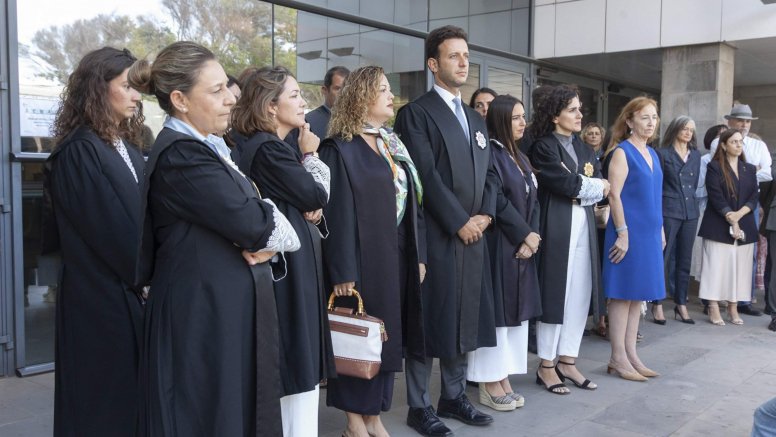
The five associations of judges and prosecutors that called the strike in the judicial and fiscal career on July 1, 2, and 3 consider that the mobilization has been "historic" and describe it as "a turning point in the defense of the rights of citizens, judicial independence, professional dignity, and the constitutional principles of equality, merit, and capacity."
The presidents and spokespersons of the Professional Association of the Magistracy (APM), the Francisco de Vitoria Judicial Association (AJFV), the Independent Judicial Forum (FJI), the Association of Prosecutors (AF), and the Professional and Independent Association of Prosecutors (APIF) met this Friday to assess the impact of the mobilizations and agree on new actions in the future.
The five associations of judges and prosecutors, except for two that did not join the strike, convened "a historic concentration" before the Supreme Court on June 28, as well as a strike on July 1, 2, and 3 in response to the government's reforms processed through "the urgent route -inexplicably-" in the Cortes Generales "which will prevent parliamentarians from interviewing legal operators to learn firsthand about their scope."
The associations denounce that the "reforms prepared by the Government attribute more power to the State Attorney General, elected by the Executive, without reinforcing their independence, and create a training center for candidates dependent on the Government itself."
In this way, they describe that the reforms represent "a back door in the access to the judicial and fiscal career, breaking the principles of equality, merit, and capacity." Thus, they have highlighted that they "allow the introduction of 1,004 substitutes who will become judges and prosecutors with simple ad hoc tests, which violates the rights of the 4,000 people who are currently studying for the competitive examination with great family and personal effort."
They describe it as "the largest judicial strike"
At the end of the meeting held this Friday, the associations of judges and prosecutors have issued a statement in which they convey to the citizens, legal operators, and State institutions their joint assessment of an unprecedented mobilization in recent democratic history. The strike, supported by 70% of judges and prosecutors, has been a turning point in the defense of the rights of citizens, judicial independence, professional dignity, and the constitutional principles of equality, merit, and capacity.”
“This is the largest judicial strike since the restoration of democracy, reflecting the seriousness of the legislative reforms underway,” highlighted the representatives of the majority of the judicial and fiscal career.
The strike, called on July 1, 2, and 3, represented “an act of collective responsibility, supported with exemplary behavior by thousands of judges and prosecutors throughout Spain, who assume the corresponding deduction of wages.”
The strike on June 11, also supported by 70% of the career, and the concentration on June 28 before the Supreme Court, “were acts of institutional defense. Not only were professional rights claimed, but also the democratic quality of the judicial system.”
The judges and prosecutors regret the possible damages caused by the strike, which have been partially alleviated by the minimum services, and appreciate the support received from the citizens: “Our cause is none other than the defense of an independent, impartial, professional Justice at the service of the citizen.”
Strategic surveillance and availability for new strikes
The convening associations have agreed not to extend the strike immediately, although they maintain their total operational availability to resume new collective conflict measures if there are no substantial changes in the reforms, and when the legal, institutional, and social conditions that guarantee their effectiveness concur.
The Strike Committee of the five associations, which established the Minimum Services, will remain “active, in permanent surveillance, and with unity of action.”
Meetings with political parties and the European Parliament
The associations of judges and prosecutors have requested meetings with the parties with parliamentary representation to expose the serious consequences of these reforms. These meetings have been held due to the impossibility of them being called, together with the rest of the legal operators, to appear in the Justice committee of the Congress, due to the urgent processing established by the Government.
The representatives of the judicial and fiscal career have held meetings with the parliamentary groups that have received them (PSOE, PP, and VOX) and reiterate their willingness to meet with the other political forces.
In addition, a delegation will travel to Strasbourg from July 7 to 9, where they will hold meetings with MEPs and senior representatives of the European Parliament to express their concern about the regression of judicial independence in Spain, appealing to the jurisprudence of the Court of Justice of the European Union and Article 19 of the Treaty on European Union.
Deterioration of European standards of judicial independence.
The mobilizations have been convened in response to reforms processed urgently, without any justification, and which represent a serious setback in the right of citizens to an impartial judge, in the professional rights of both careers, in judicial independence, and in the Rule of Law.
In particular:
- The introduction of 1,004 substitute judges and prosecutors through an ad hoc exam violates the principles of equality, merit, and capacity. It represents a comparative grievance with access through the free shift and harms more than 4,000 opponents.
- Increased subjectivity in the systems of access to the judicial and fiscal career, while rewarding those who access through the so-called fourth shift - for jurists of recognized competence and experience - since they are granted five years of fictitious seniority when they apply for positions in the judicial summit (of discretionary designation by the General Council of the Judiciary).
- Attribution to the Center for Legal Studies, dependent on the Government, of powers to prepare opponents, evidencing a risk of ideological selection.
- Limitation of the financing of judicial and fiscal associations, to reduce their operational capacity and function.
- Designation of 4 of the 9 members of the Judicial Ethics Commission by the Cortes Generales, with a risk of partisan designation as occurs with the CGPJ, enabling its politicization and delegitimizing its function.
- Reduction of the representativeness of the career in the election of members of Governing Chambers.
- Reinforcement of the power of the State Attorney General, appointed by the Government, further limiting the autonomy and impartiality of the Prosecutor's Office, as a preliminary step to attributing criminal investigation to it.
According to their version, "these reforms, as a whole, represent a deterioration of the constitutional and European standards of judicial independence."
Add La Voz de Lanzarote as a preferred Google source.
Stay informed with the latest current news.