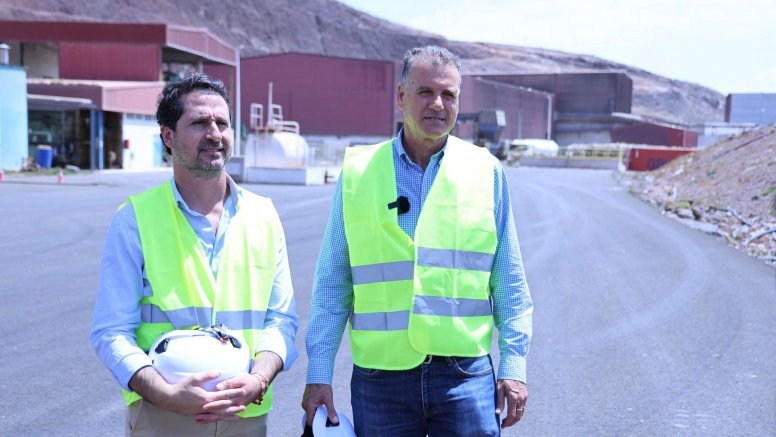
The Governing Council of the Cabildo of Lanzarote has approved this Monday the authorization of the expense to build a new composting plant in the Zonzamas Environmental Complex, a key infrastructure to "continue advancing towards a real circular economy on the island." The project, co-financed by funds from the Cabildo of Lanzarote, the Ministry of Ecological Transition of the Government of the Canary Islands and the Canary Islands Development Fund (FDCAN), will involve a total investment of 7,044,999.99 euros (6,584,112.15 euros plus 460,887.85 euros in respect of IGIC).
For the president of the Cabildo of Lanzarote, Oswaldo Betancort, this decision "marks a new firm step in the transformation of the waste management model in Lanzarote and La Graciosa. We are talking about an infrastructure that not only complies with European requirements in terms of recycling, but also allows us to revalue organic waste by converting it into quality compost, useful for agriculture, gardening or the restoration of natural spaces."
“The investment in this plant is also an investment in the future and in sustainability, aligned with our commitment as a Biosphere Reserve. Throughout this legislature we have accelerated strategic projects that modernize Zonzamas and improve the public services we provide to citizens,” added Betancort.
High-efficiency composting for organic and vegetable waste
For his part, the Minister of Waste, Domingo Cejas, assessed that the construction of this plant "will allow the treatment of approximately 3,500 tons of bio-waste and 875 tons of vegetable waste annually, which will result in obtaining 2,600 tons of compost per year. It is an infrastructure designed to respond to the new reality of separate collection of the organic fraction, which we are implementing in a coordinated manner with the seven municipalities of the island."
“Responsible waste management cannot only remain in basic recycling; it is about closing the circle, recovering what seemed unusable and turning it into a resource. This plant, a leader in the Canary Islands, is a clear example of this,” Cejas stressed.
The new equipment will be integrated within the Zonzamas Environmental Complex and will have a modern and efficient design: a 2,200 m² warehouse equipped with a trench fermentation system and forced ventilation, which will accelerate the composting process with maximum environmental guarantees. Its metallic structure and double-sloped roof will respect the heights already existing in the complex.
Master Plan and Prevention Program: in public consultation
On the other hand, this same Monday the announcement has been published in the Official Gazette of the Province of Las Palmas by which the initial version of the Waste Prevention Program and the Waste Master Plan of Lanzarote and La Graciosa, as well as its Strategic Environmental Study, is submitted to public information and hearing process. The documents will be available for consultation for 45 business days at the electronic headquarters and on the Cabildo's transparency portal, as well as in person.
The president of the Cabildo, Oswaldo Betancort, stressed that “this new Master Plan and Prevention Program set the course for public policies on waste for the coming years. It is a rigorous and ambitious document that is born from the will to listen, plan and act with environmental responsibility.”
In this sense, Councilor Domingo Cejas pointed out that “the Plan incorporates key objectives such as minimizing waste generation, promoting reuse, optimizing transport, reducing landfill and promoting green employment. Furthermore, it opens the door to citizen participation and improved coordination between administrations.”
The general objectives include promoting a circular consumption model, maximizing recycling, preventing soil contamination, and complete waste traceability. Specific measures are also included, such as promoting local employment in the sector, developing new infrastructures, and environmental education for different productive sectors.
Add La Voz de Lanzarote as a preferred Google source.
Stay informed with the latest current news.