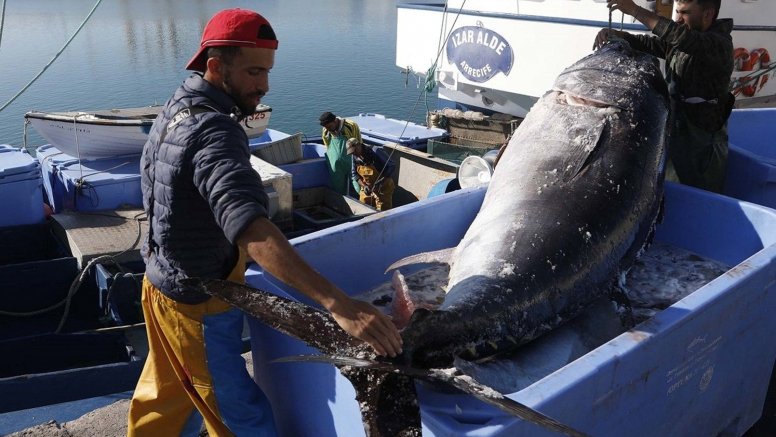
The fishermen's guilds of Lanzarote have agreed to join the national fishing sector strike called for next Monday, January 19, as part of the mobilizations promoted by the National Federation of Fishermen's Guilds (FNCP) and the sector as a whole at the state level, in protest against the application of the new European Fisheries Control Regulation.
The decision was made after an online meeting held between brotherhoods and federations, in which Lanzarote's adherence to the agreements reached at the national level was consensually decided. As a result, the island's brotherhoods have agreed to halt the fishing fleet for that day, close sales points, and call for a public rally. Specifically, on Monday, January 19, at 2:00 PM, a rally will be held in Arrecife, in the Puerto Naos area, as the central act of protest on the island.
The National Federation of Fishermen's Guilds (FNCP) denounces that the current interpretation of Regulation (EU) 2023/2842 "imposes absurd, dangerous, and inapplicable obligations, especially for the inshore and coastal fleet, jeopardizing the economic viability of thousands of vessels, maritime safety, and the supply of fresh, local fish".
Among the most controversial measures, the sector **rejects the imposition of port arrival notices of up to four hours** for vessels that fish a few minutes from the coast and undertake trips of less than 24 hours
This requirement forces ships to wait unnecessarily at sea, with the consequent economic damage, deterioration of fish quality, and, more seriously, unnecessary risks to the safety of the crews.
Likewise, the FNCP denounces the **requirement to register catches** from the so-called "zero kilogram," an interpretation that the sector considers "technically unfeasible and legally indefensible.""Claiming that fishermen should weigh minimal catches on deck, with the boat moving and in full operation, does not improve control, but rather generates legal uncertainty, increases the risk of arbitrary sanctions, and raises the probability of workplace accidents in one of the toughest and most dangerous sectors of the economy," they point out
Impact on artisanal fishing in the Canary Islands
In the case of the Canary Islands, and very especially in artisanal fishing, the rigid application of these obligations "has a disproportionate and particularly damaging impact".
The Canary Islands' artisanal fleet is mainly composed of small vessels, with reduced crews, short trips, and daily tasks heavily linked to weather conditions and the state of the sea.
The imposition of bureaucratic procedures designed for large industrial fleets "is not only inapplicable but also threatens the economic viability of a sector that operates on very tight margins and plays a key role in supplying fresh local fish, maintaining coastal populations, and preserving a model of selective, low-environmental-impact fishing."
The fishing sector insists that "it is not opposed to control or sustainability, but it rejects being the scapegoat for poor regulatory application, designed without taking into account the operational reality of the sea or the professional judgment of skippers."
The FNCP demands that the Ministry of Agriculture, Fisheries and Food **act immediately and defend before the European Commission the flexibilities that the regulation itself contemplates**, especially for artisanal and small-scale fishing
The fishing brotherhoods of Lanzarote emphasize that this mobilization is carried out in coordination with the entire national fishing sector and they trust that the meeting scheduled for that same day in Madrid between sector representatives and the General Secretariat for Fisheries will allow for the opening of a real dialogue process that leads to a "fairer, more flexible, and adapted to the reality of artisanal and island fishing" application.
"In Lanzarote, as in the rest of the Canary Islands, fishing is much more than an economic activity: it is a family tradition, a way of life, and a hallmark of coastal communities. For generations, Canary Islands artisanal fishing has been an example of sustainability, respect for the marine environment, and balance with resources, guaranteeing the future without depleting it. Defending this model is defending the history, culture, and dignity of entire communities that have lived responsibly from the sea," they argue.
The defense of artisanal fishing "is not just a claim of the sector, but a collective cause in defense of local employment, maritime culture, and a sustainable fishing model that belongs to all of Canarian society".
"Citizen presence and support are fundamental for the voice of the sea of Lanzarote and the Canary Islands to be heard with the strength, dignity, and respect it deserves," they conclude
Add La Voz de Lanzarote as a preferred Google source.
Stay informed with the latest current news.